
The headline numbers for 2026 look like a good year for airlines. Underneath them is a tighter, more demanding operating picture — one that puts unusual weight on the least glamorous part of the business: the schedule.
The state of play
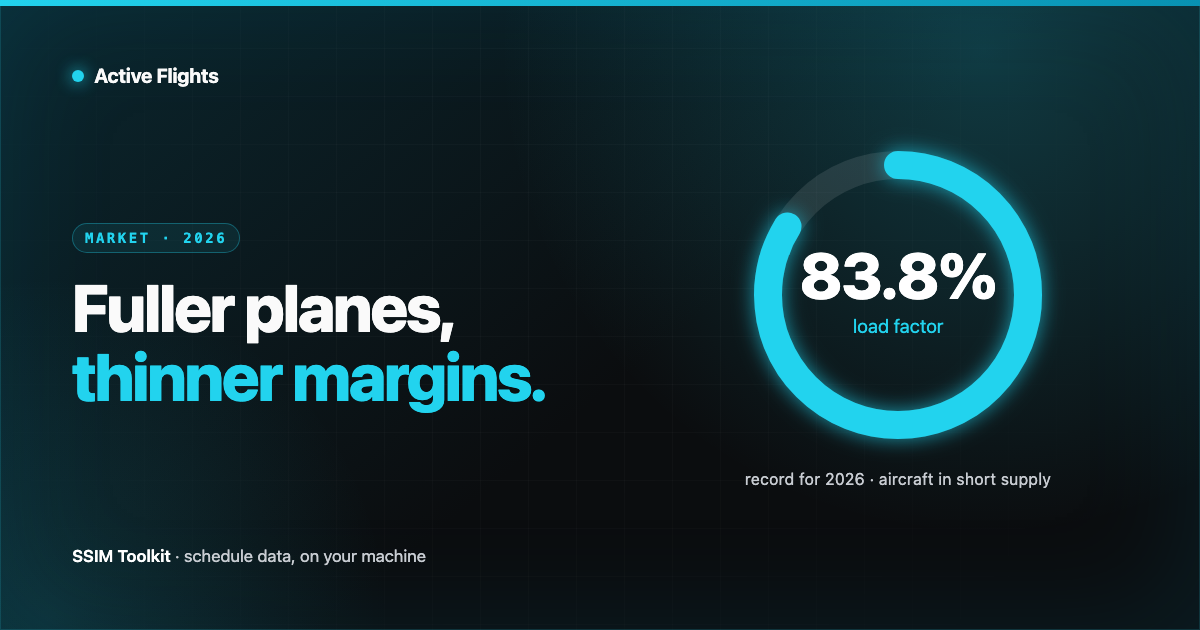
IATA’s outlook for 2026 has the industry carrying about 5.2 billion passengers, up 4.4% year over year, with revenue passenger kilometres expanding roughly 4.9% and total industry revenue near $1.1 trillion. Demand keeps printing growth — January traffic was up 3.8%, February up 6.1% — and yet the number that matters most for day-to-day economics is the one climbing to a record: the passenger load factor, forecast at 83.8% for the full year, with Asia-Pacific reaching an all-time regional high of 84.4%.
| 2026 at a glance | IATA outlook |
|---|---|
| Passengers | ~5.2 billion (+4.4% YoY) |
| Traffic growth (RPK) | ~4.9% |
| Industry revenue | ~$1.1 trillion (+4.5%) |
| Passenger load factor | 83.8% — a record |
| Net margin | ~3.9% |
A record load factor sounds like pure good news. It isn’t only that. Load factors are this high in part because new aircraft remain in short supply, so airlines are meeting demand by filling the aircraft they already have rather than adding frames. Full planes are efficient planes — but they also leave almost no slack. And all of this is happening on a net margin of roughly 3.9%: a few dollars of profit per passenger, on average. Aviation has always been a thin-margin business; 2026 is a reminder of just how thin.
When aircraft are scarce and margins are a rounding error, the schedule stops being paperwork and becomes the primary lever on profitability.
Why the squeeze lands on the schedule
If you can’t easily add capacity, you have to make the capacity you have work harder. That is fundamentally a scheduling problem, and it shows up in a few concrete ways.
- Utilisation is under a microscope. Squeezing one more rotation out of a tail, or trimming a turnaround, is worth real money when frames are the binding constraint. Those decisions live in the schedule, and they depend on reading it precisely — down to the minimum connect times, the aircraft rotations, and the ground time.
- There’s no room for schedule error. At an 84% load factor, a mis-modelled connection or an overlooked overlap doesn’t get absorbed by empty seats — it strands passengers or misallocates a scarce aircraft. The cost of a bad row in a schedule file is higher than it was when planes flew two-thirds full.
- Every seasonal cut is a re-optimisation. Building the summer or winter schedule isn’t a copy-paste from last year; it’s a fresh allocation of scarce lift against demand that has shifted regionally — IATA has been explicit about sharp regional differences month to month. That means more comparing, more validating, more “what actually changed between these two files.”
The data layer nobody sees
Here’s the part that gets missed. All of that scheduling work runs on a specific, decades-old data format: the IATA Standard Schedules Information Manual (SSIM). It’s how carriers, airports, GDSs, and coordinators exchange the schedule. A single feed from a large carrier can be millions of fixed-width records, and the real files are full of legitimate, hard-won conventions that a naïve parser flags as errors and a good one understands as normal.
When margins are fat and aircraft are plentiful, sloppiness in that layer is survivable. When they aren’t, the schedule-data layer becomes a place where small inefficiencies compound: the analyst who can’t quickly see what changed week over week, the coordinator who can’t tell a real validation error from a known quirk, the engineer maintaining a brittle in-house parser instead of building something the business asked for.
What “good” looks like in a tight year
The teams that come through a capacity squeeze well tend to share a few habits, none of them exotic:
- They can open the whole feed, fast. Not a sample — the actual multi-gigabyte file, locally, in seconds, so the summary and the outliers are visible immediately.
- They separate real problems from real-world quirks. Validation that knows the difference between a spec violation and an established carrier convention, so the triage queue is short and trustworthy.
- They diff, not guess. “What changed between winter and summer” is a two-minute answer with a flight-level comparison, not a Tuesday meeting with a hand-built spreadsheet.
- They keep the sensitive data close. Commercial schedules are competitive information; the fewer places they travel, the smaller the risk surface.
None of this replaces network planning or revenue management. It’s the layer beneath them — the one that decides whether the people doing that work are reasoning about clean, trustworthy data or fighting the file.
The takeaway
2026 is shaping up to be a year of full planes and slim margins, with growth constrained less by demand than by the supply of aircraft. In that environment, the schedule is no longer just an operational artefact — it’s an efficiency frontier. The airlines that treat their schedule data as infrastructure worth investing in, rather than a file to be endured, will have a quiet but real edge.
That’s the bet behind what we’re building: get the foundation — reading, validating, and analysing SSIM — fast, faithful, and local, and every workflow on top of it gets better. More on that in future posts.
Figures in this piece are from IATA’s public 2026 outlook and monthly demand releases. They’re industry aggregates and will be revised as the year develops.
Sources
- IATA — Global Outlook for Air Transport, December 2025
- IATA — Airline Profitability Stabilizes with 3.9% Net Margin Expected in 2026
- IATA — 2026 Begins with 3.8% Air Passenger Demand Growth
- IATA — February Air Passenger Demand Grows 6.1%
- IATA — Strong 2025 Passenger Demand Masks Ongoing Capacity Constraints
Want early access?
We're opening SSIM Toolkit to teams in waves through 2026 — free during the preview. Drop your email and we'll reach out when it's your turn.
You're on the list. Check your inbox for a confirmation email to finish signing up.
Something went wrong — please try again, or email hello@activeflights.com.