

The local workbench
for airline schedule data.
A desktop app for the people who live in SSIM. Open multi-million-leg feeds locally in seconds; validate against the standard, inspect any record, analyse the whole network, and export — without writing a parser yourself, and without your data ever leaving your machine.
Drop a feed. See it immediately.
Open a SSIM file and it becomes a living, queryable schedule — even multi-million-leg feeds from the largest global networks. The pipeline runs entirely on your machine: parse → validate → analyse, nothing uploaded.
- ✓ Full-fidelity — every record type (RT1–RT5) and data element parsed and kept
- ✓ Private — parses on your machine; the file never leaves your device
- ✓ Fast — engineered for real airline feed sizes, responsive throughout
- · Carriers, record counts, and the schedule period it covers
- · A clean read on validation status — errors, warnings, info
- · A jump-link to every issue, in context
- · The whole network ready to explore, query, and export
Every surface, built for schedule work.
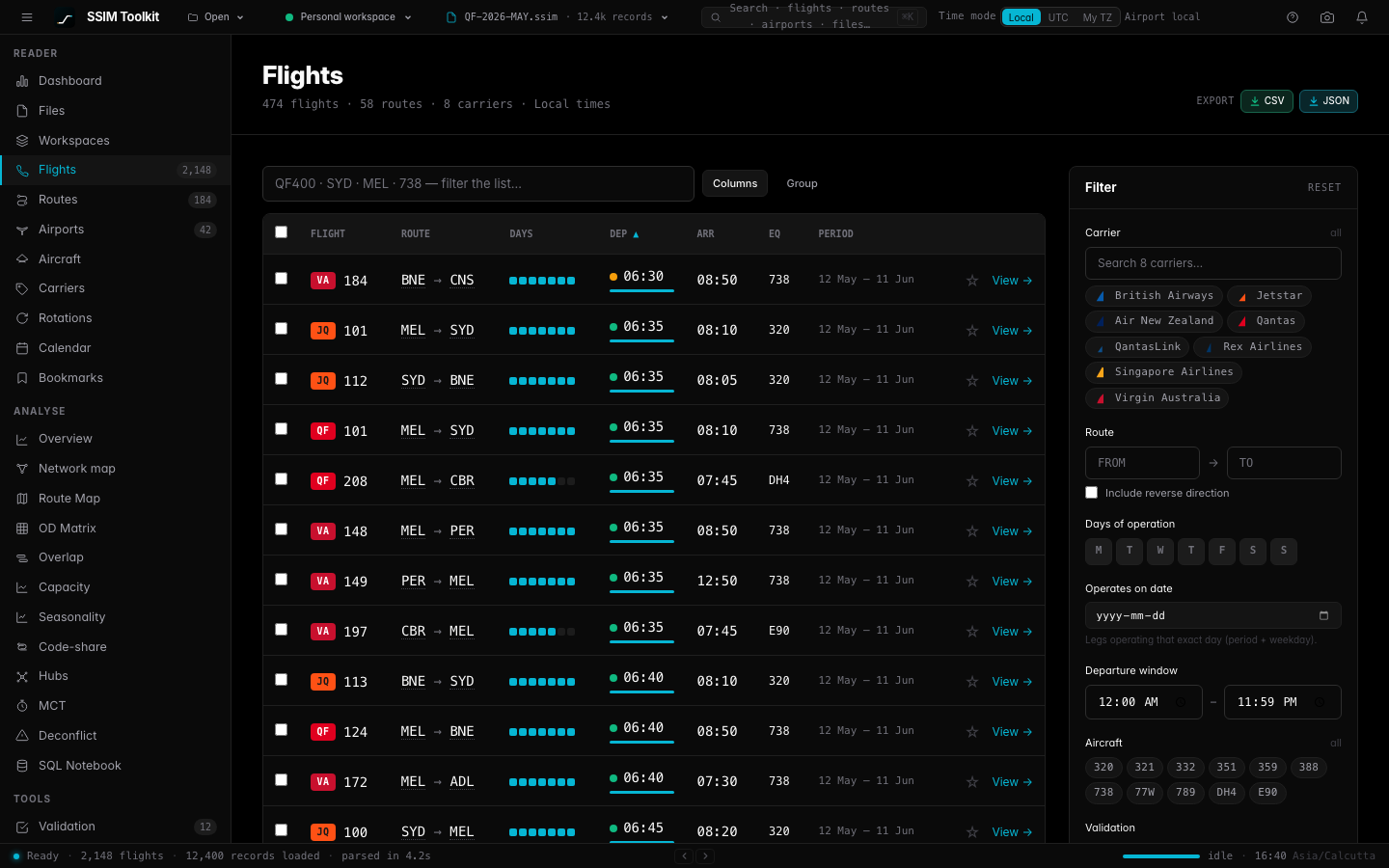
Read a flight at a glance.
Filter to exactly what you need.
Status, the days it operates, the time of day it departs, the validation band — every row tells its story without you parsing 200 bytes by hand. A searchable facet sidebar narrows millions of legs to the set you care about, fast.
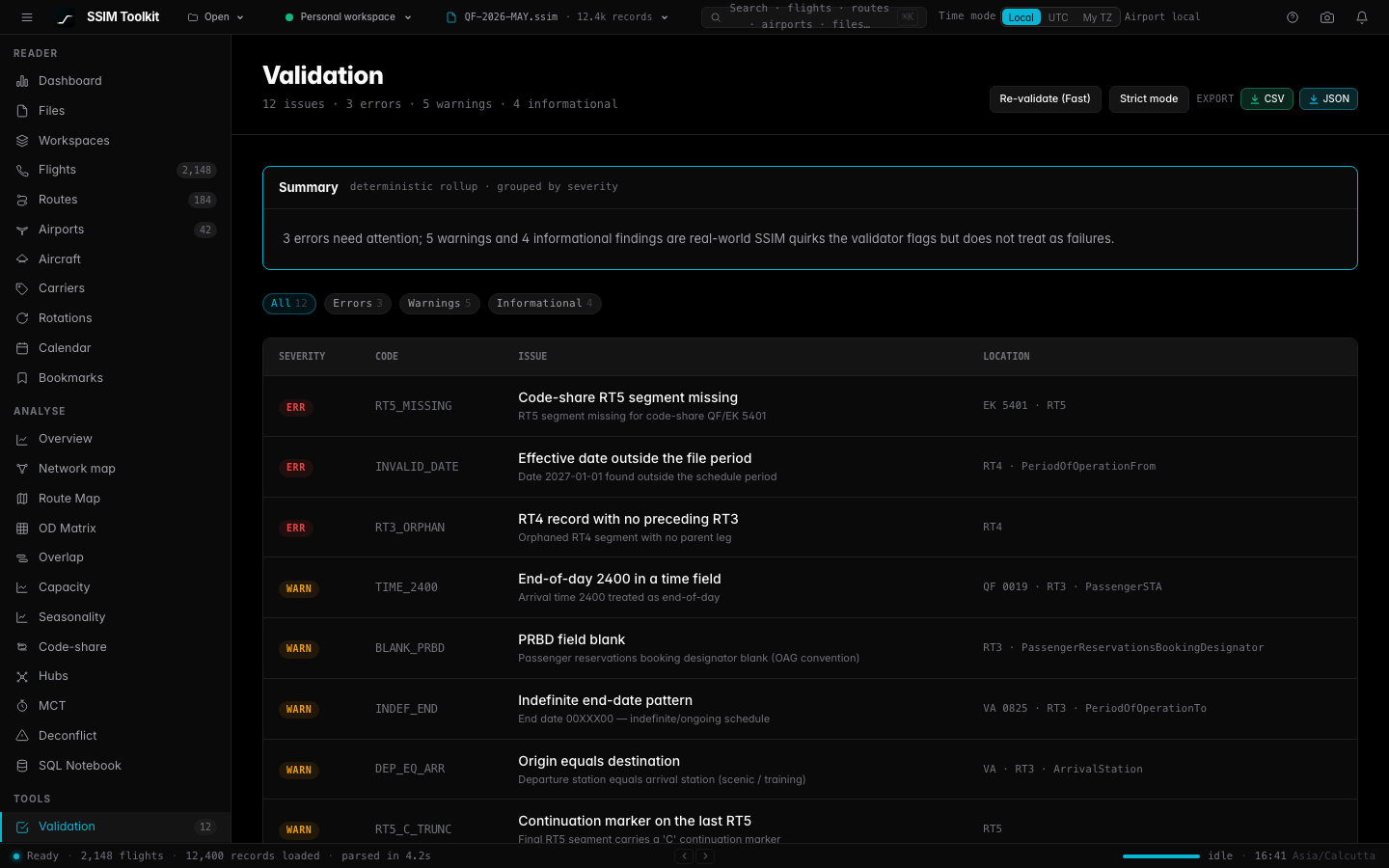
Real issues surfaced.
Real-world quirks understood.
Strict validation against the SSIM standard that knows the difference between a genuine error and the conventions you only learn after years with carrier feeds. Each issue carries its rule, severity, field, and byte offset — phrased in spec terms, never internal jargon.
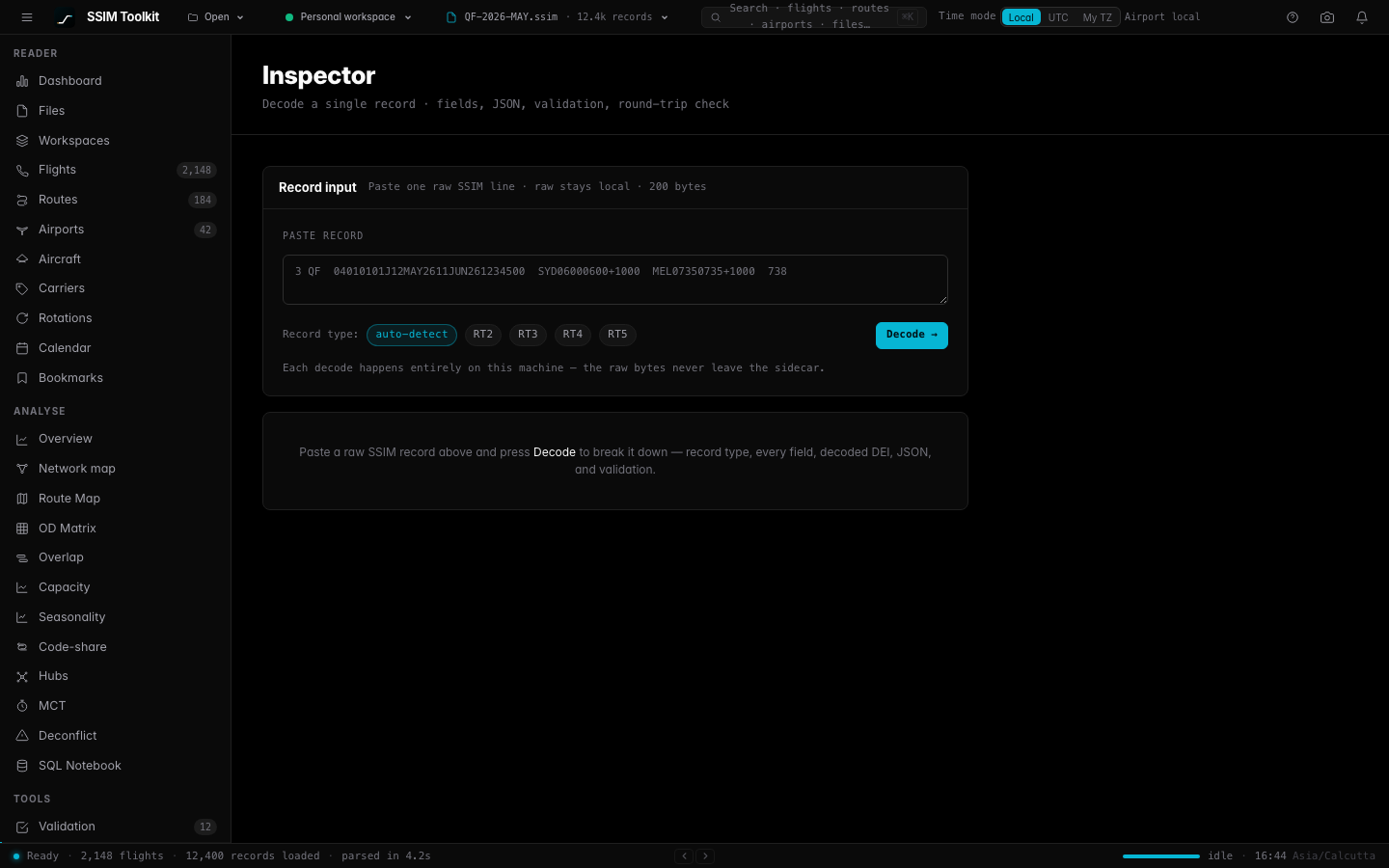
Drop in a record.
Get every field, explained.
Paste a single schedule record, or jump in from any flight. Every field is shown with its position, value, and plain-English meaning; the JSON view gives you the same record as canonical structured data. The "what does this actually mean?" question, answered.
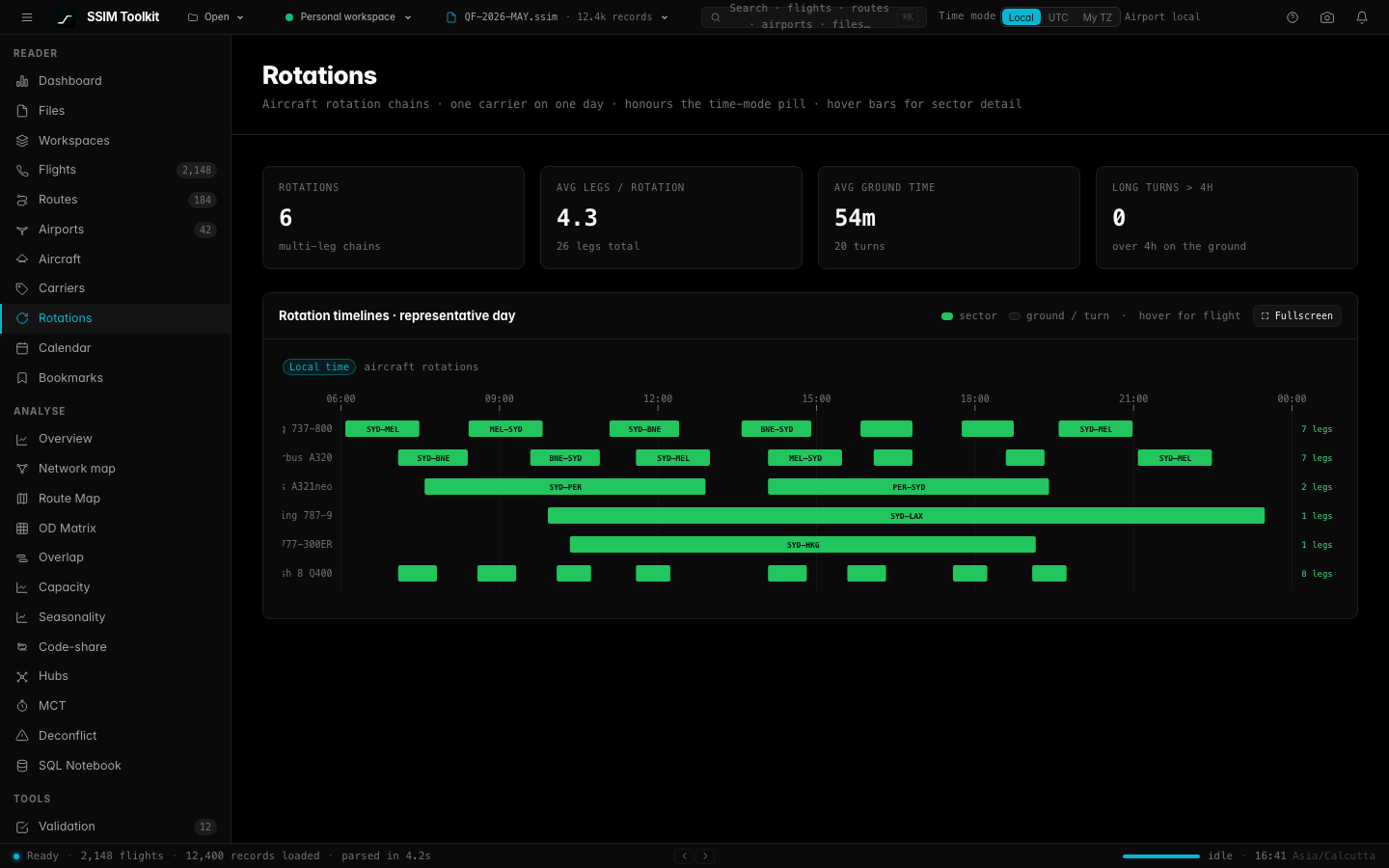
How the day
actually flows.
One row per aircraft type, 24 hours across the X-axis, every flight a bar from departure to arrival, time-zone aware. Tight turnarounds get an amber tint. The operational view of a schedule, not just a list of rows.
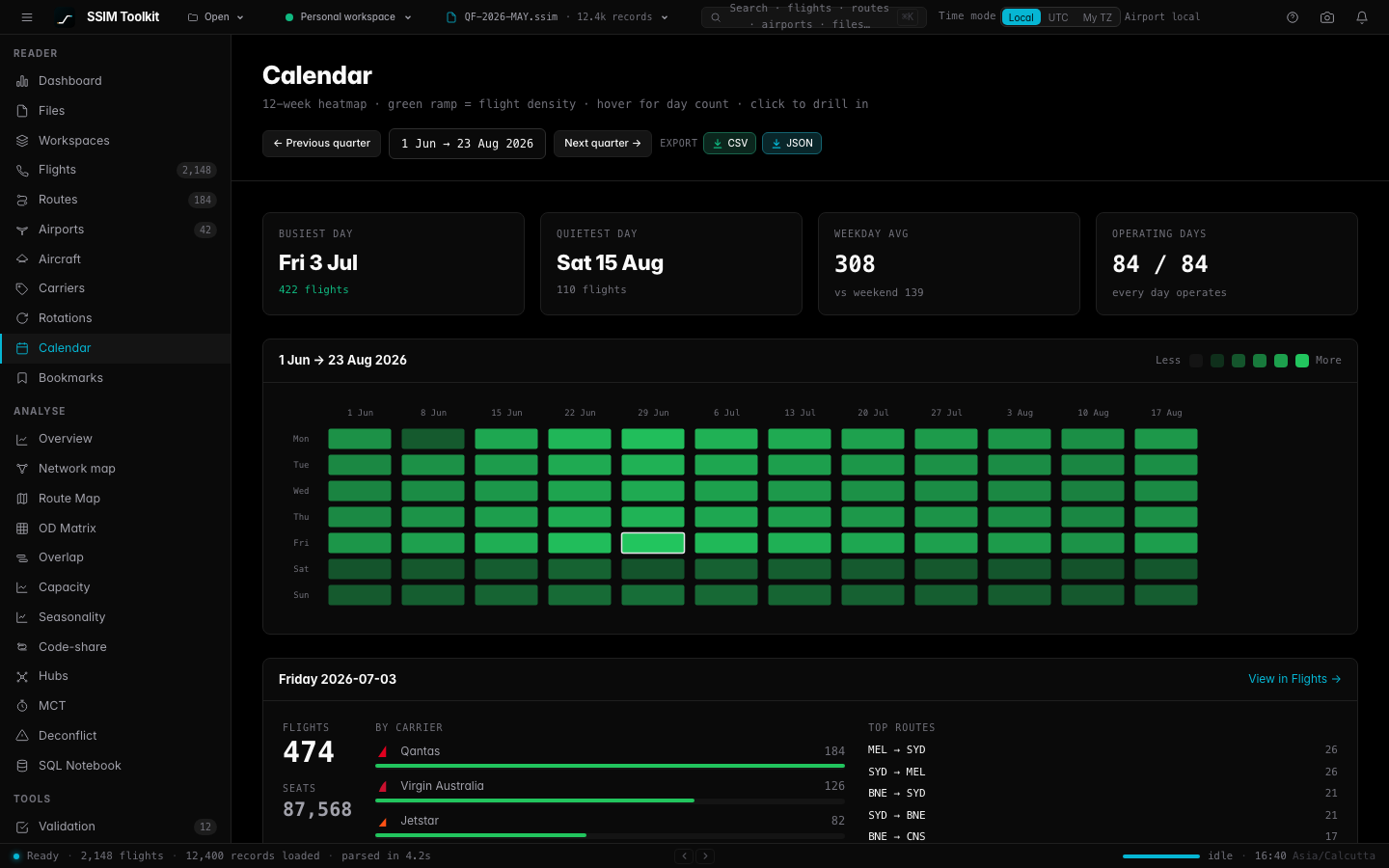
Where the heavy
days fall.
A density heatmap of the whole schedule period — see seasonality, the busy weeks, the day-of-week shape at a glance, and click any day to drill into the flights operating on it.
See the whole network.
Maps, graphs, matrices, and trends — derived analytics over the loaded schedule, all on-device, all within a 30 ms query budget.
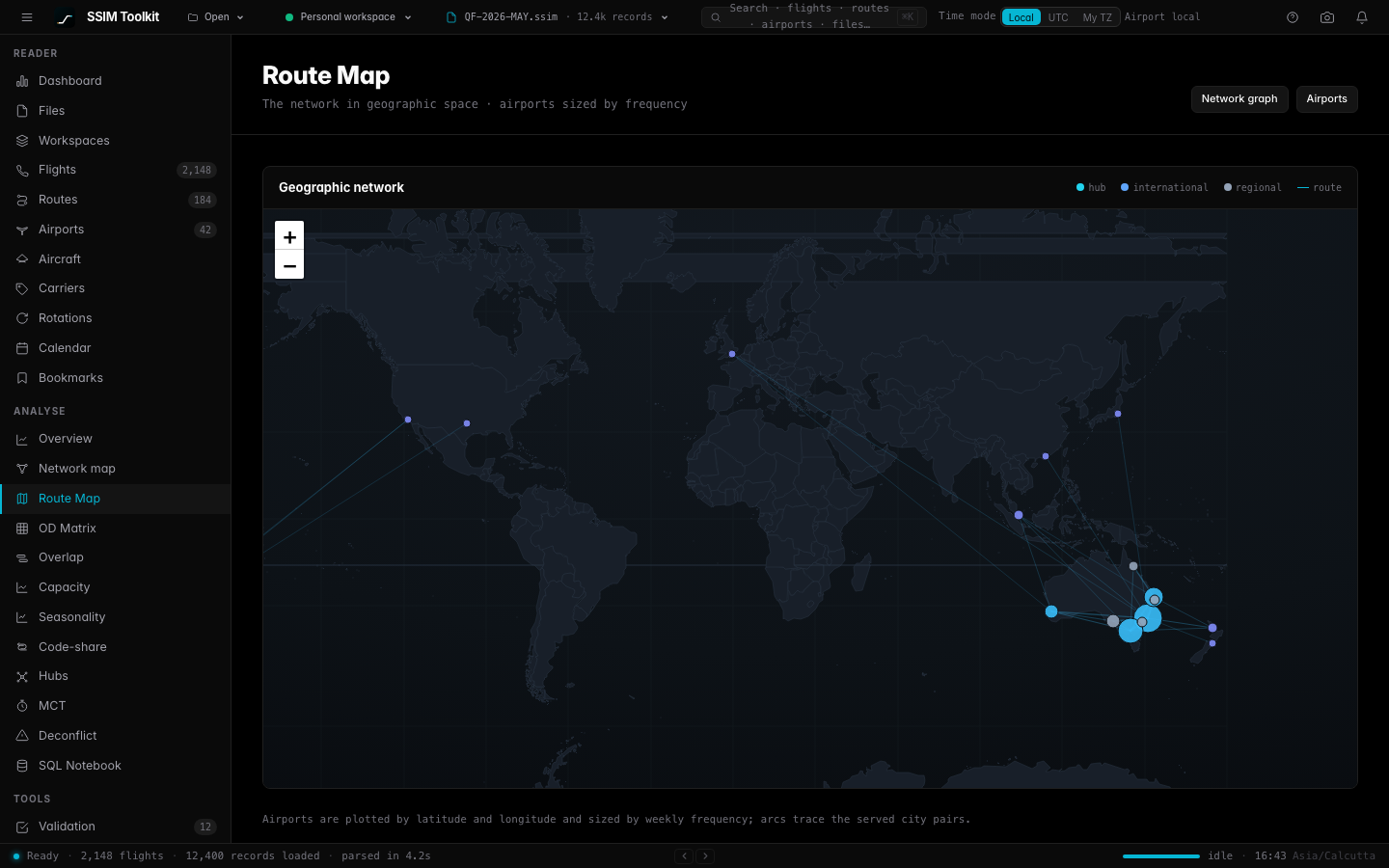
Geographic route map
Airports plotted by lat/long and sized by frequency; arcs trace the city pairs. Offline — no tile provider.
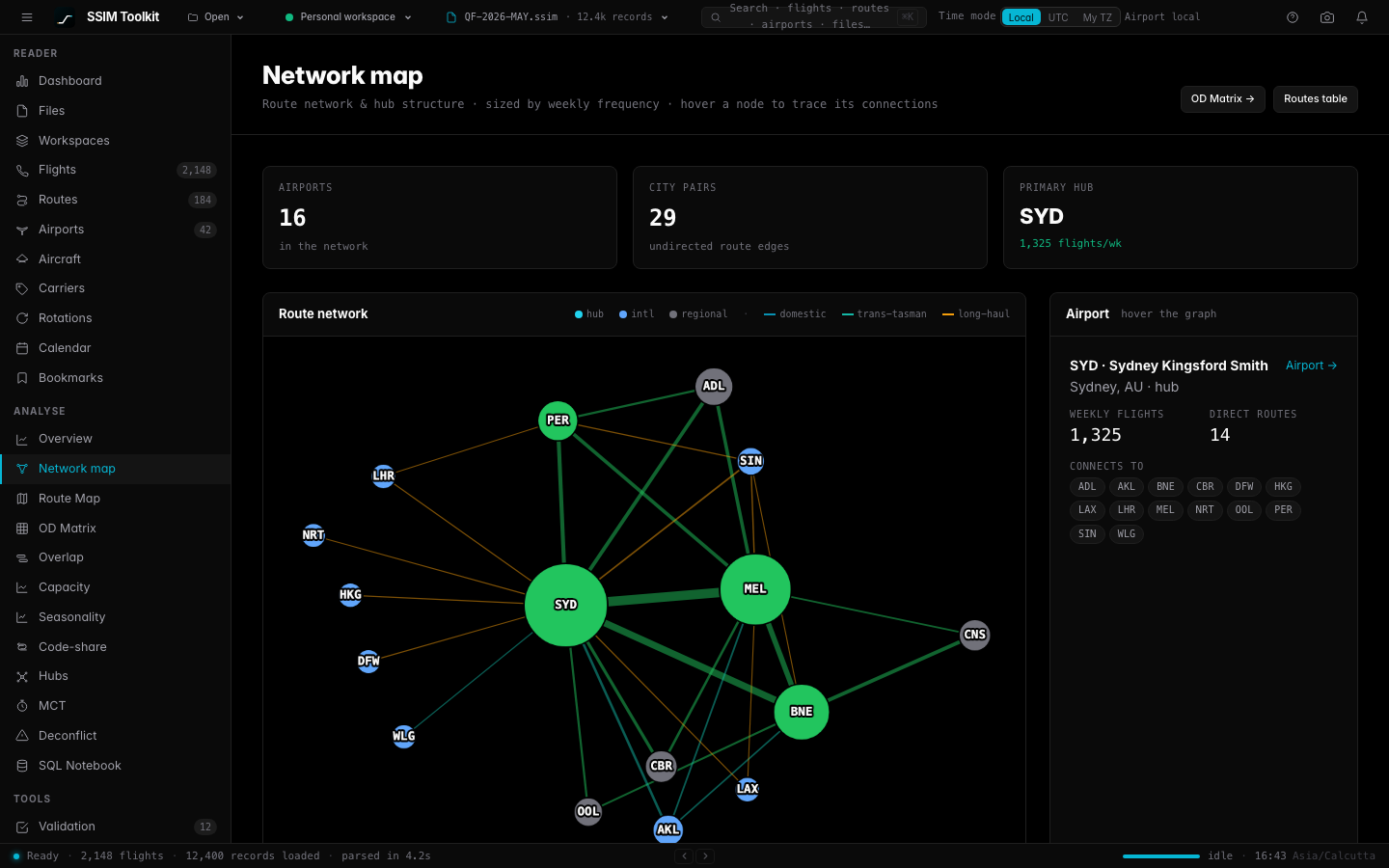
Network graph
The route network as a force-directed graph, coloured by route kind, hubs ranked by degree.
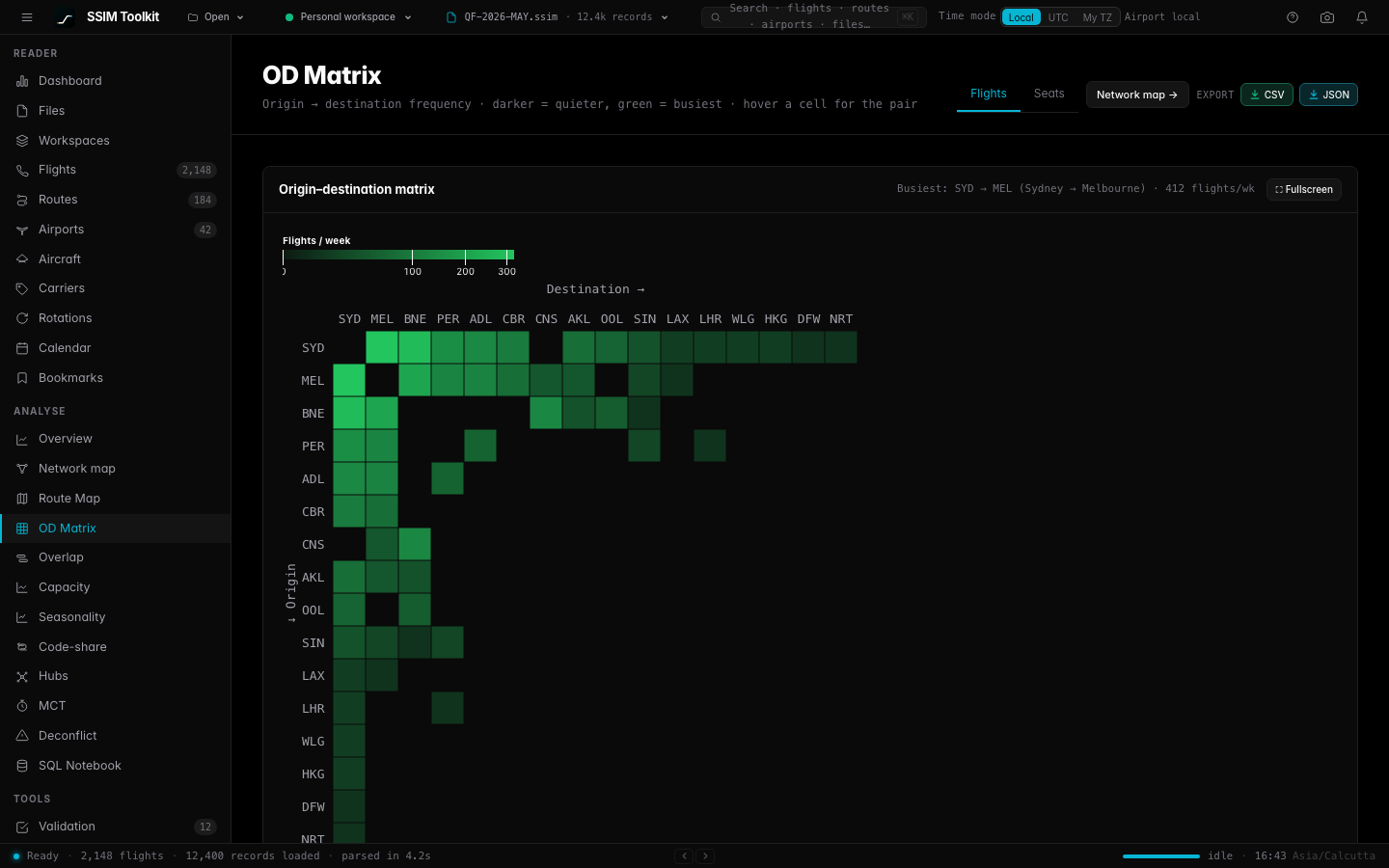
OD matrix
Origin–destination flows as a heatmap — the densest markets surfaced instantly.
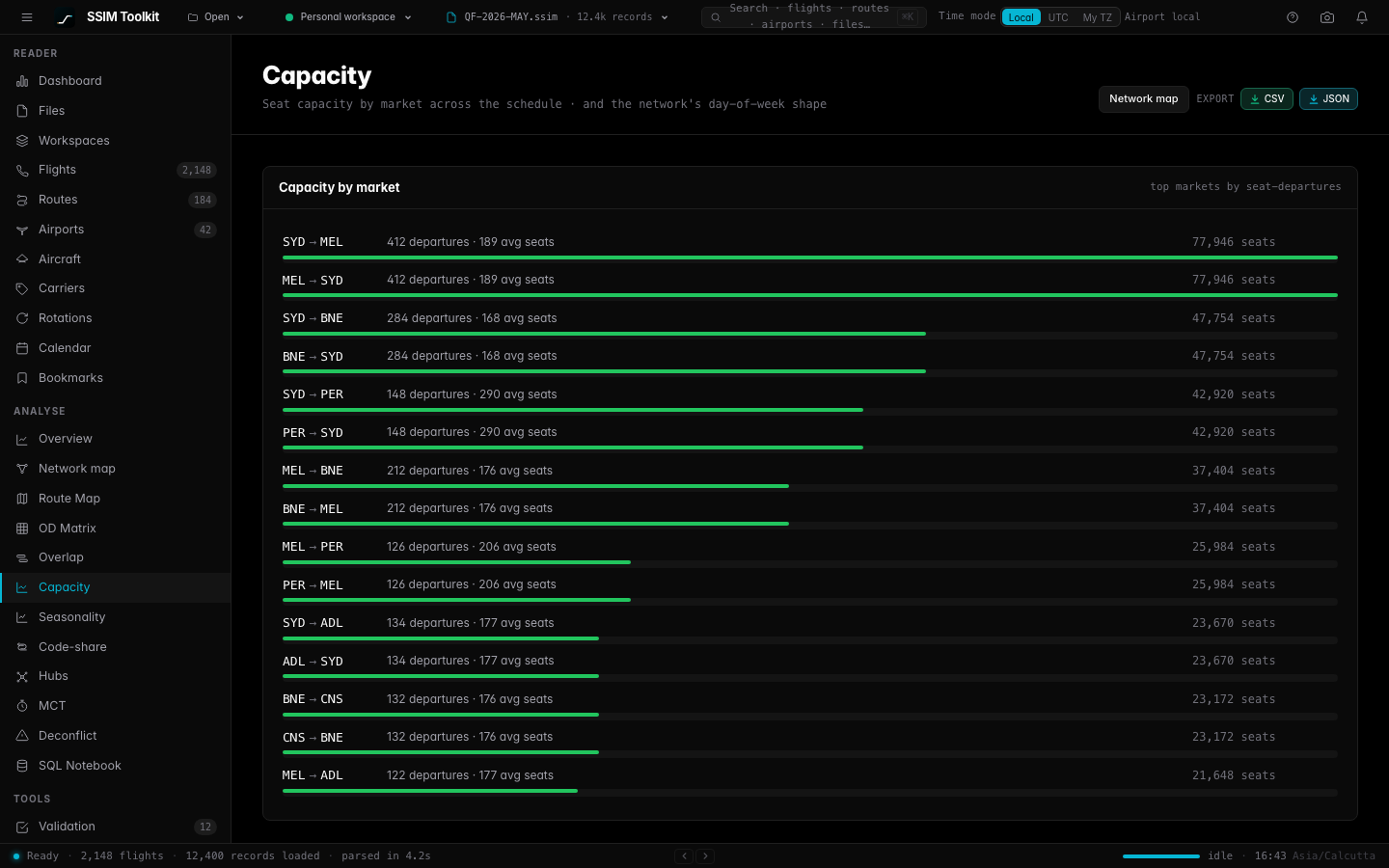
Capacity & frequency
Seats and seat-hours per market, day-of-week shape, and seasonality across the period.
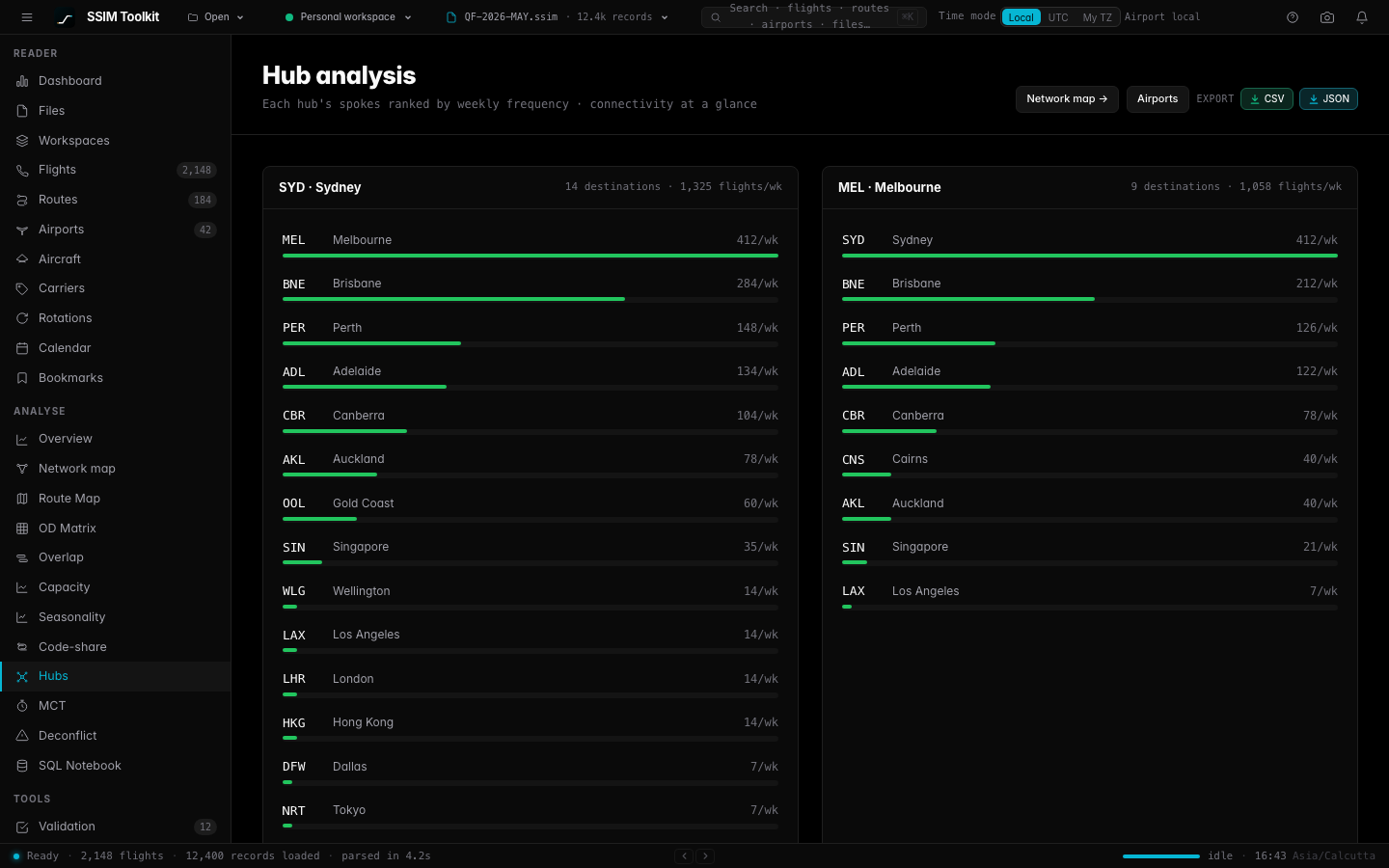
Hub analysis
Departures, arrivals, destinations, and seats per station — the network's pivot points.
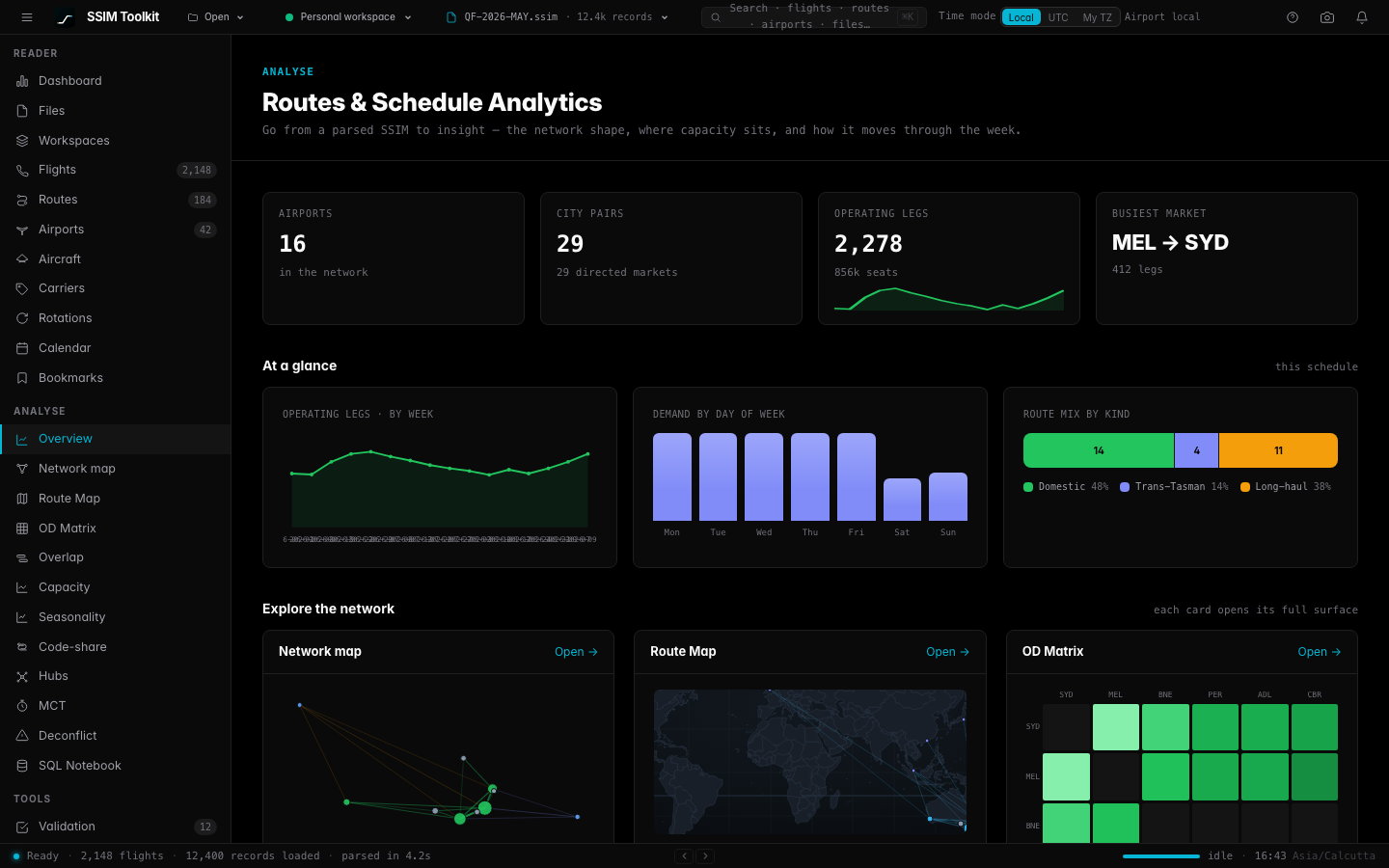
Network overview
The whole schedule at a glance — the launch point into every deeper analysis.
The hard questions, answered.
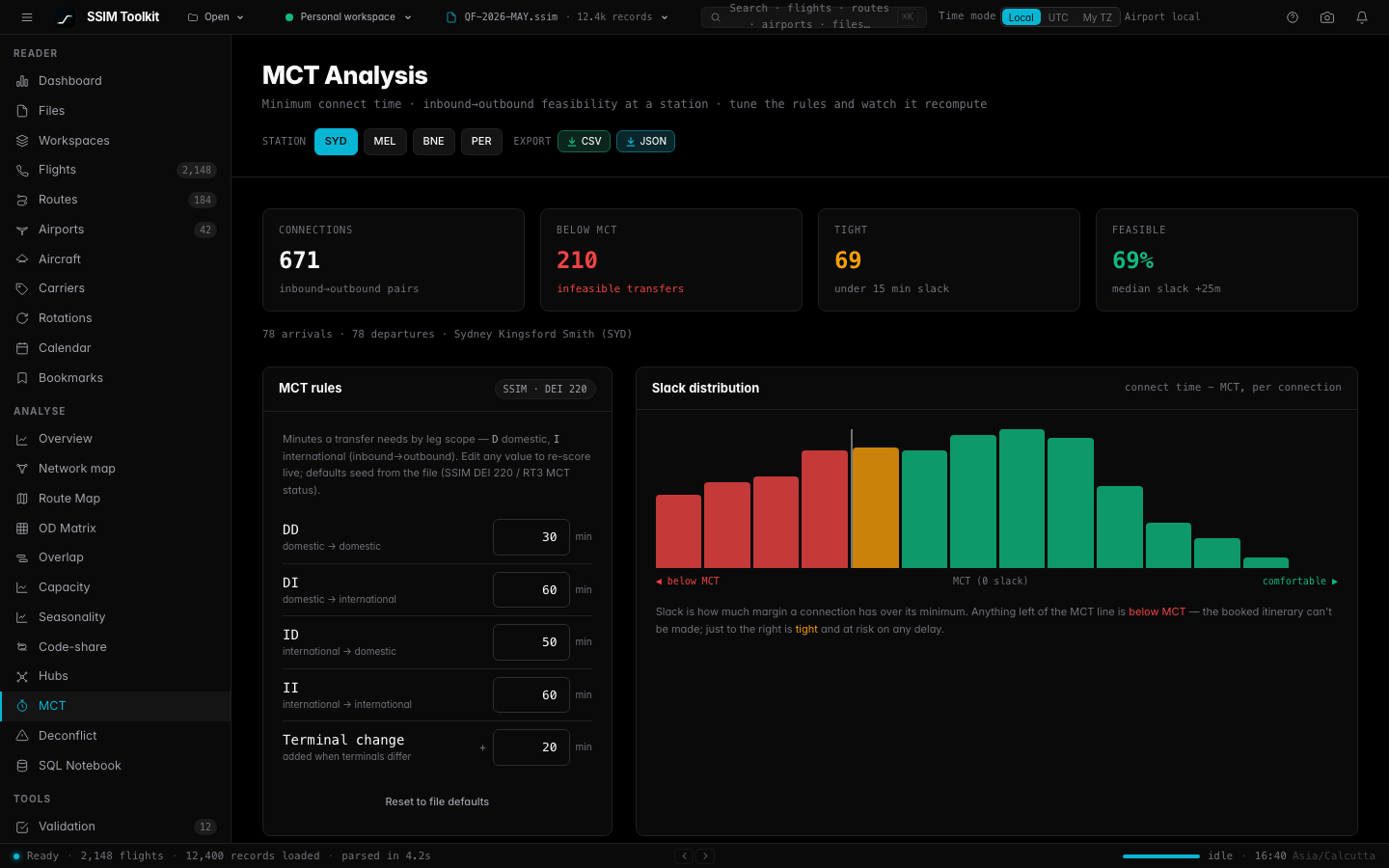
Can passengers actually
make the connection?
Evaluate every inbound→outbound transfer at a hub against editable minimum-connect-time rules, scoped to a real operating day. Each connection is banded feasible / tight / below-MCT, with "delay outbound by N → recovers k" recovery nudges.
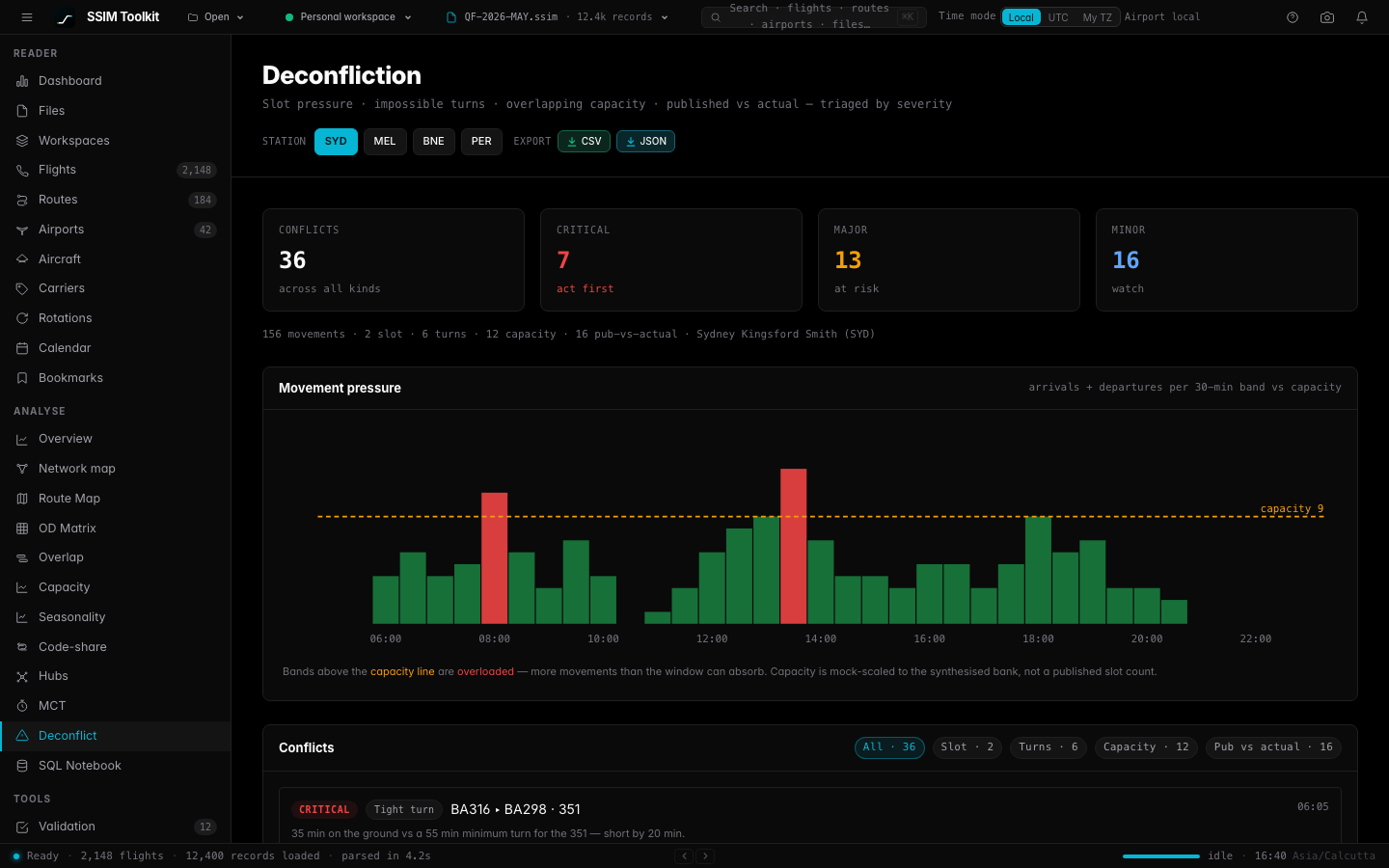
Slot pressure and tight
turns, surfaced.
Bank a station's real movements for a date and surface slot-overload, tight-turn, and capacity-overlap conflicts, with a movement-pressure timeline. Date-scoped for correctness — a SSIM period can span months.
The whole schedule,
one query away.
Every other surface is a curated view. The SQL Notebook hands you the keys: write read-only DuckDB SQL directly against the loaded schedule's serving store and pull out exactly the insight you need. No black boxes, no waiting on a feature request — full control to interrogate your own data and verify every number the app shows you.
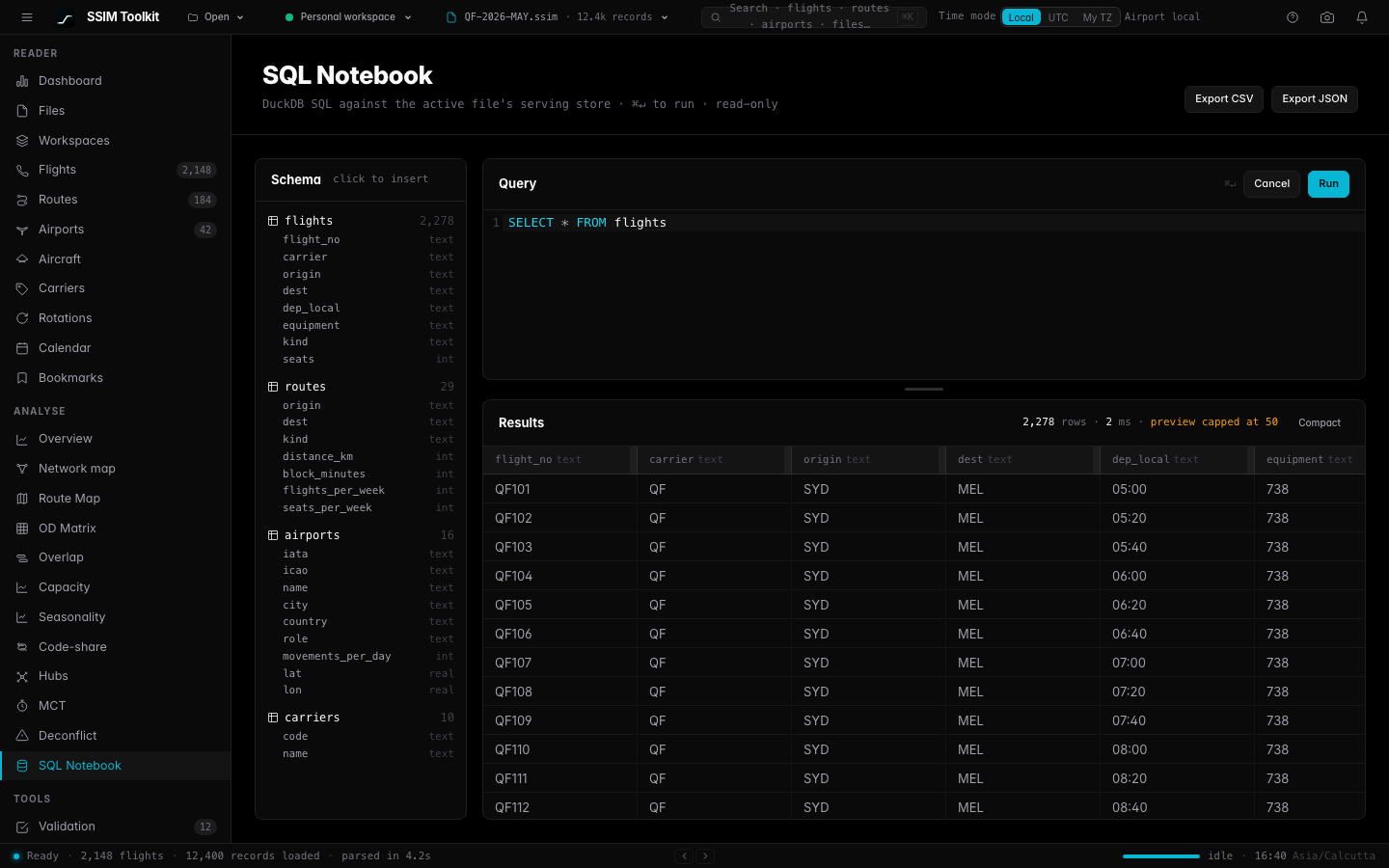
Nothing is a black box
The same DuckDB serving store every surface runs on is open to you directly. If a chart raises a question, drop to SQL and check the numbers yourself — every figure in the app is one query away from being verified.
Ask anything, not just the built-ins
Join flights, segments, carriers and the pre-aggregated relations however your question demands. You're never limited to the views we shipped — your insight, your query.
Answers in milliseconds
It runs against the in-memory serving store, so even on a multi-million-leg feed a query returns within the app's 30 ms budget, with a live results grid and timing.
Take the result with you
Export any result set straight to CSV or JSON — turn an ad-hoc question into a deliverable in one click.
Safe by construction. The console is read-only and guarded — only SELECT queries run, nothing can write or reach outside the schedule, and it all happens on your machine. Full power, zero risk to your data.
Drive the whole toolkit
with your AI assistant.
SSIM Toolkit ships a built-in MCP server (Model Context Protocol). Connect Claude, Cursor, VS Code, or Windsurf in one click and explore your schedule in plain English — "what's below MCT at SYD?", "which routes did this carrier add?" The assistant asks; the deterministic engine answers. AI on the outside, determinism on the inside.
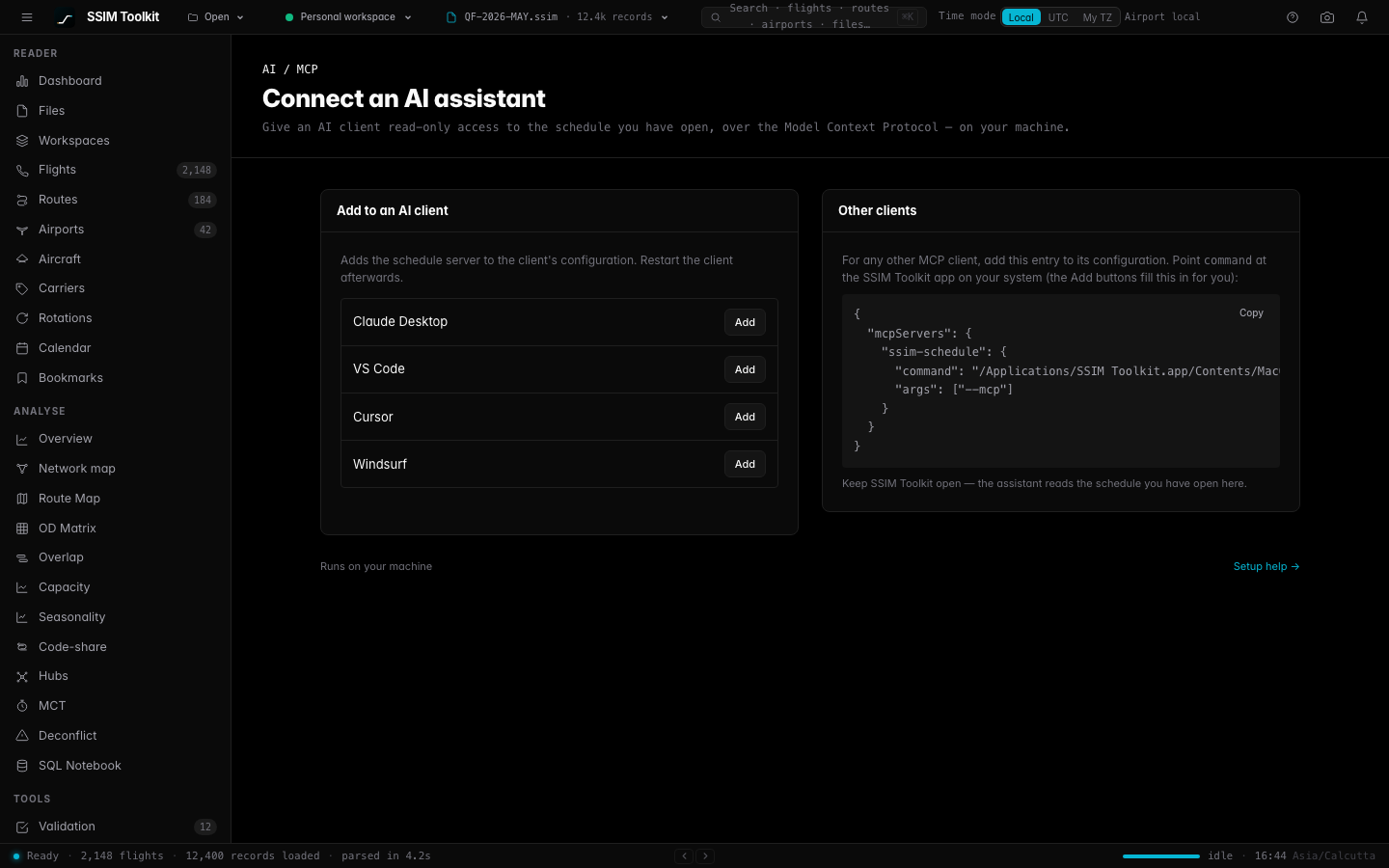
One-click setup
Connect Claude, Cursor, VS Code, or Windsurf — the app writes the configuration for you. No keys to paste, no server to run yourself.
Read-only by design
An assistant can explore and ask, but never change your data. The whole surface — flights, routes, analytics, validation, even guarded SQL — exposed as safe, read-only tools.
On-device, single source of truth
The server runs locally over a private socket against the very data set the app has open. No second copy, no staleness — and it speaks only the schedule, never internal detail.
Deterministic answers, in natural language
Ask "which markets are below MCT at SYD?" in plain English; the assistant drives the deterministic engine and the numbers come straight from the toolkit.
Entirely optional, entirely in your control. The toolkit is fully usable without an assistant. The MCP server is local and read-only — it can't change your data — and whether to connect an AI assistant, and which one, is always your choice.
Send the data where your team already works.
Convert rigid SSIM into the formats real data work needs — scoped to your active filters, written by the engine's DuckDB core.
Parquet
Carrier-partitioned, ZSTD-compressed, ready for your warehouse or a notebook.
CSV
Honours your active filters — the format every spreadsheet and stakeholder speaks.
JSON
Canonical structured records for a database load or a downstream service.
Data-set bundle
Zip the whole canonical Parquet set + manifest for back-up or hand-off.
Local by default
The data pipeline does no networking. Files and parsed data stay on your machine; the app only reaches the network for licensing and updates, which carry none of your schedule data.
Deterministic, not AI
The same file always yields the same result. No model in the loop, no guessing — so every finding is reproducible, auditable, and defensible.
Owned, not rented
A desktop app you install and run, licensed per team seat — not a seat on a platform that sells you schedule data. You bring the files you already have.
Be among the first
to use it.
Join the Early Access list and we'll send you a build when your wave is up. Free during the preview; a 30-day trial at GA.
You're on the list. Check your inbox for a confirmation email to finish signing up.
Something went wrong — please try again, or email hello@activeflights.com.