
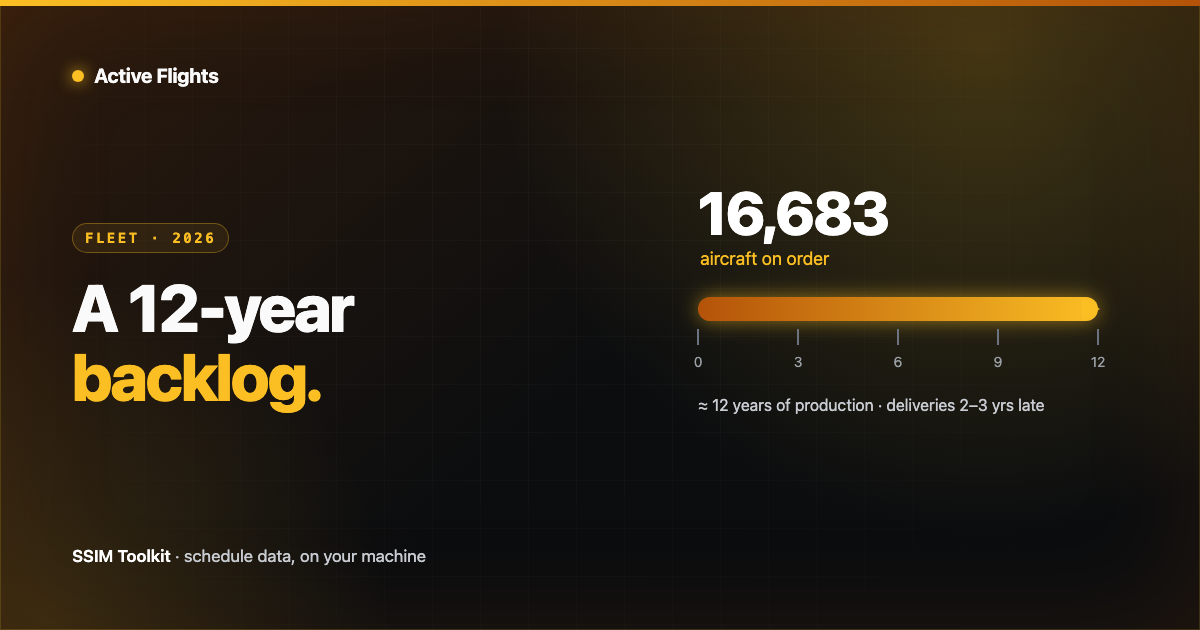
There is a number in commercial aviation right now that reframes almost every planning conversation: the combined Airbus and Boeing order backlog reached about 16,683 aircraft at the end of April 2026 — roughly twelve years of production at current rates. It is a stunning show of demand. It is also a scheduling problem in disguise.
The backlog, briefly
Break the headline down and it gets more pointed. Airbus reported a backlog near 8,777 aircraft in early 2026 — about 9.7 years of work — with Boeing’s commercial book around 6,770. The constraint isn’t orders; it’s output.
| Order backlog (early 2026) | Aircraft | ≈ years of output |
|---|---|---|
| Airbus | ~8,777 | ~9.7 |
| Boeing (commercial) | ~6,770 | — |
| Combined | ~16,683 | ~12 |
Labour shortages, supplier constraints, quality inspections, and certification delays have left deliveries an estimated two to three years behind schedule, and Airbus has warned customers the delays will persist for at least three more years.
Engines have become the sharpest bottleneck of all. Durability issues and stretched maintenance cycles have left some newly built aircraft parked for months waiting for powerplants. The knock-on costs are real: industry analysis attributes more than $11 billion a year in extra airline expense to delivery delays, engine shortages, maintenance bottlenecks, and related disruption, plus roughly $1.4 billion in surplus spare-parts inventory as carriers stockpile against uncertainty.
Why a fleet problem is a schedule problem
An airline’s schedule is, at bottom, a promise about which aircraft will be where and when. That promise is built on the fleet plan: these frames arrive in Q2, those retire in Q4, capacity grows here and shrinks there. When deliveries slip by years and the timing is uncertain, the fleet plan stops being a firm input and becomes a forecast that keeps changing underneath the schedule.
The result is a level of schedule churn that used to be exceptional and is now routine:
- Deferrals ripple outward. An aircraft that doesn’t arrive on time is a route that can’t launch, a frequency that can’t be added, a wave at the hub that has to be rebuilt around the aircraft you actually have.
- Old metal stays in service. Airlines extend leases and defer retirements to cover the gap — which means maintaining schedules for fleets they expected to have phased out, with different performance and maintenance profiles.
- Capacity gets reshuffled, not added. With growth constrained, planners move lift between markets far more often than they add it. Every one of those moves is a new schedule to validate, compare against the last version, and check for conflicts.
Each of these is a data operation before it is anything else. Someone has to take the new schedule file, understand exactly how it differs from the plan of record, confirm it doesn’t double-book an aircraft or violate a connection, and get the clean version into the systems downstream — often on a tight turn, and often repeatedly through a season rather than once.
In a stable fleet era, the schedule was mostly written once and maintained. In the backlog era, it is continuously rewritten — and the ability to rewrite it quickly and correctly is a real operational capability.
Schedule agility as a hedge
There’s an investor-shaped observation buried here. When the constraint on an airline is aircraft availability, the differentiator shifts from who can grow fastest to who can adapt their plan fastest and most accurately. Two carriers dealt the same delivery slip will not fare equally: the one that can remodel its schedule, see the downstream effects, and redeploy scarce aircraft with confidence protects more revenue than the one drowning in spreadsheets and brittle tooling.
That agility rests on unglamorous foundations:
- Fast, faithful reading of the schedule feed — the real SSIM file, including the awkward real-world conventions, opened locally in seconds rather than sampled.
- Capacity & network analysis — seats and frequency per market, hub structure, and where the network is growing or thinning as fleets and routes shift.
- Deconfliction — catching overlapping or duplicated flights and impossible rotations before they reach operations, not after.
- Reproducibility — the same file always yielding the same answer, so a scenario you modelled last week means the same thing this week.
None of that is exotic. But most teams reach for a home-grown parser and a pile of spreadsheets, and that stack quietly caps how fast and how safely they can respond when the fleet plan moves again.
The takeaway
The backlog is often told as a manufacturing story — and it is. But its second-order effect is felt in scheduling departments, where the fleet can no longer be treated as a fixed input and the schedule has become a document that is rewritten again and again through the year. In that world, the tooling that lets a team read, analyse, and deconflict schedules quickly and correctly isn’t back-office plumbing. It’s part of how the airline absorbs a shock it didn’t choose.
Getting that foundation right — local, deterministic, fast — is exactly what we’re building toward with SSIM Toolkit. When the plan keeps moving, the teams that can keep up will be the ones who trust their schedule data.
Backlog, delivery, and cost figures are drawn from 2026 industry reporting and manufacturer disclosures cited below; order-book numbers move month to month.
Sources
- Aerospace Global News — Airbus & Boeing have 12 years of aircraft backlog after April order surge
- Forecast International — Airbus and Boeing Report January 2026 Orders and Deliveries
- AeroTime — Aviation supply chain crisis strains airline growth
- Mexico Business News — IATA Warns Delivery Delays, Green Costs to Hit Airlines in 2026
Want early access?
We're opening SSIM Toolkit to teams in waves through 2026 — free during the preview. Drop your email and we'll reach out when it's your turn.
You're on the list. Check your inbox for a confirmation email to finish signing up.
Something went wrong — please try again, or email hello@activeflights.com.