
Open a schedule file and you see a list of flights. Watch an airport and you see something different: individual aircraft, each flying a connected chain of legs through the day, turning around between them. Bridging those two views — turning a flat list of legs into rotations — is one of the most useful things you can do with schedule data, and one of the easiest to get subtly wrong.
From legs to a rotation
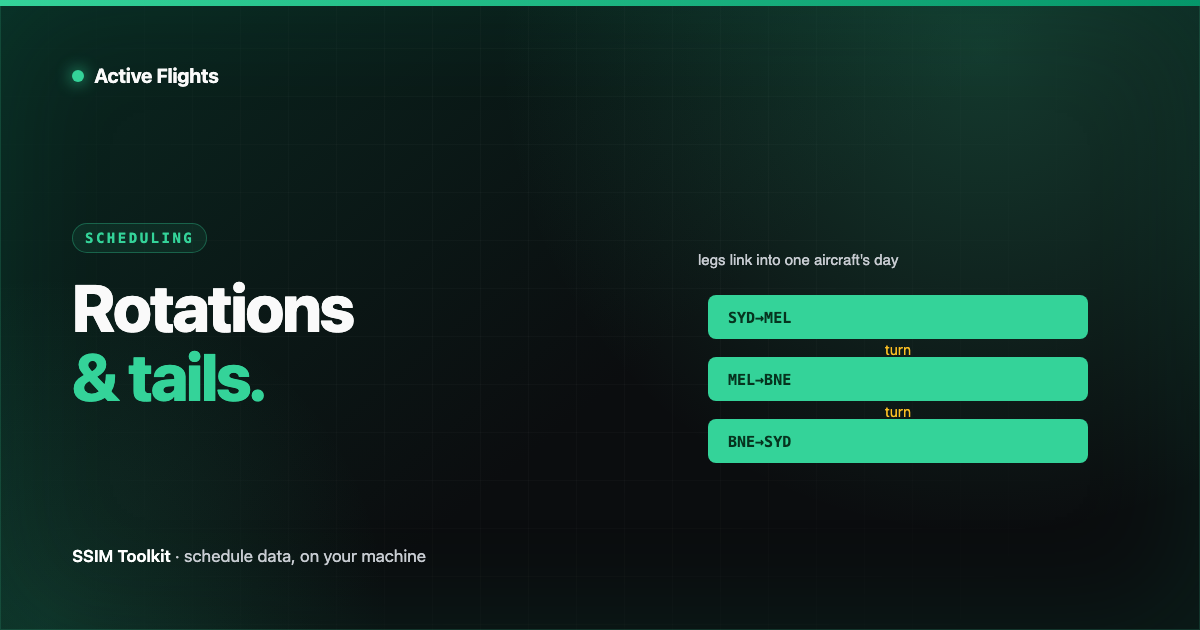
A rotation is the ordered sequence of legs a single aircraft flies: it lands somewhere, turns around, and its next leg departs from that same station. Chain those and you get an aircraft’s day.
Leg 1  SYD → MEL   0600–0730
Leg 2  MEL → BNE   0815–0945      ← departs where Leg 1 arrived, after a turn
Leg 3  BNE → SYD   1030–1245
= one aircraft's rotation
The linking rule sounds simple — next leg departs from this leg’s arrival station — but making it correct means respecting a few things at once: station continuity, the time and day handling so an overnight turn isn’t misread, and the minimum ground time needed to actually turn the aircraft.
Tails vs sub-fleets
Two related but distinct questions:
- Rotation — which legs form one aircraft’s sequence? You can build rotations from the schedule alone, by linking legs through stations and turns.
- Tail assignment — which specific aircraft (registration) flies that rotation? This adds real-world constraints — maintenance, crew, aircraft position — and is usually a separate, tighter optimization.
Even without tail numbers, the rotation view is enormously useful: it’s how a planner sees whether a day actually flows, and it’s the frame in which the killer conflicts show up.
Why it’s where reality bites
Rotations are exactly where the deconfliction problems live. A schedule can look perfect leg-by-leg and still be impossible once you build the rotation:
- Impossible turnarounds — two consecutive legs leave less ground time than the minimum to turn the aircraft.
- Broken continuity — the next leg departs from a station the aircraft isn’t at.
- Overlaps — the same aircraft assigned two legs at once.
None of these are visible in a flat list. They only appear when you reason across the sequence — which is the whole point of building the rotation.
A schedule tells you the flights. The rotation tells you whether an aircraft can actually fly them.
Doing it right
Building rotations means linking legs by station and time, respecting minimum ground times and the day/DST handling, and surfacing the sequences that can’t physically work — deterministically, across the whole schedule. That rotation-and-deconfliction view is one of the core things SSIM Toolkit is built to give you: not just the flights, but the days they imply, and the ones that don’t add up.
Want early access?
We're opening SSIM Toolkit to teams in waves through 2026 — free during the preview. Drop your email and we'll reach out when it's your turn.
You're on the list. Check your inbox for a confirmation email to finish signing up.
Something went wrong — please try again, or email hello@activeflights.com.