
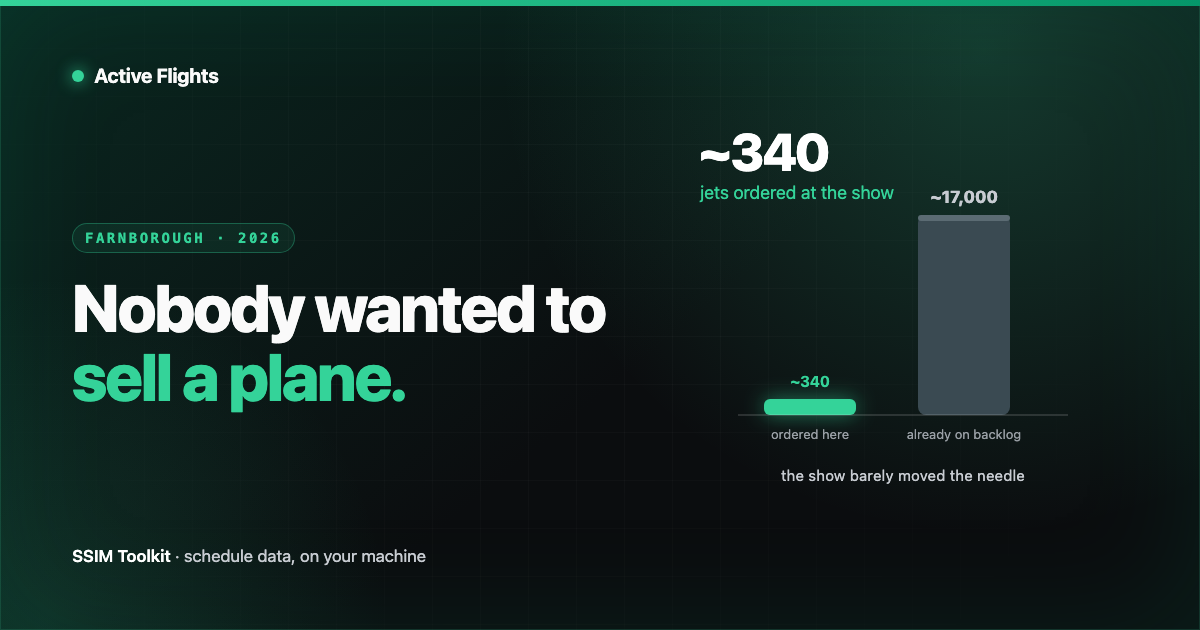
Every two years, the Farnborough International Airshow is where airlines line up to buy airplanes by the hundred and the two companies that build them trade billion-dollar headlines. The 2026 edition wrapped on 24 July. And the strangest thing about it was how little the planemakers seemed to want to sell.
Who “won”
On the scoreboard, Boeing edged it: 186 firm orders to Airbus’s 157 — a 29-aircraft lead. Boeing’s book skewed to widebodies (134 narrowbody, 52 widebody); Airbus leaned narrowbody (127 and 30). By the usual airshow arithmetic, though, the whole week was quiet. Two years earlier, Farnborough 2024 racked up something like $105 billion of orders in its first four days. This year the two giants combined for a little over 340 jets total.
Why so quiet? Because they’re sold out
Here’s the twist: the quiet wasn’t a demand problem. It was the opposite.
Airbus and Boeing already have production sold out for years, with combined order backlogs approaching 17,000 aircraft. When you can’t build any faster, a shiny new order doesn’t get you a plane sooner — it just joins the back of a very long queue. So instead of chasing headline deals, both manufacturers spent the week doing something far less glamorous: managing delivery slots — deciding who gets the scarce early build positions, not how many more they can promise.
That flips the whole logic of an airshow. The scarce thing in the room wasn’t a buyer with a cheque. It was a spot on the production line in this decade.
What actually sold — and who’s buying
The deals that did land tell you who holds the leverage now:
- SMBC Aviation Capital placed the biggest single order of the show — and hedged, splitting it 100 Boeing 737 MAX and 100 Airbus A320neo. When slots are the constraint, a lessor books both lines.
- Riyadh Air, Saudi Arabia’s new flag carrier, kept stocking up — 28 more Boeing 787s plus 6 Airbus A350-1000s.
- AerCap, the world’s largest lessor, took 15 Boeing 787s — the installed-base buyers grabbing slots while they can.
- Philippine Airlines and even Uganda Airlines (a modest but symbolic 8 jets) rounded out the book.
Notice the pattern: lessors and well-funded new carriers, locking in future capacity. If you’re an airline without that kind of balance sheet or a place near the front of the queue, the message from Farnborough 2026 was simple — get comfortable with the fleet you already have.
The quiet lesson
An airshow order is a promise about a delivery slot years out. It’s a date on a schedule that doesn’t fly for a long time. Meanwhile the aircraft that actually have to earn money this year are the ones already in the air — and, increasingly, the older ones nobody can replace. When new metal is this scarce, the game quietly shifts from buying capacity to squeezing it out of what you’ve got. That happens in the schedule, not at the airshow — but that’s a story for another day.
For now, the takeaway from Farnborough 2026 is almost poetic for an aviation trade show: the hardest thing to buy wasn’t attention, or even a plane. It was a place in line.
Order tallies are the figures reported for Farnborough 2026 and vary slightly by source; the named deals and backlog figure are from the roundup linked below.
Sources
Want early access?
We're opening SSIM Toolkit to teams in waves through 2026 — free during the preview. Drop your email and we'll reach out when it's your turn.
You're on the list. Check your inbox for a confirmation email to finish signing up.
Something went wrong — please try again, or email hello@activeflights.com.