
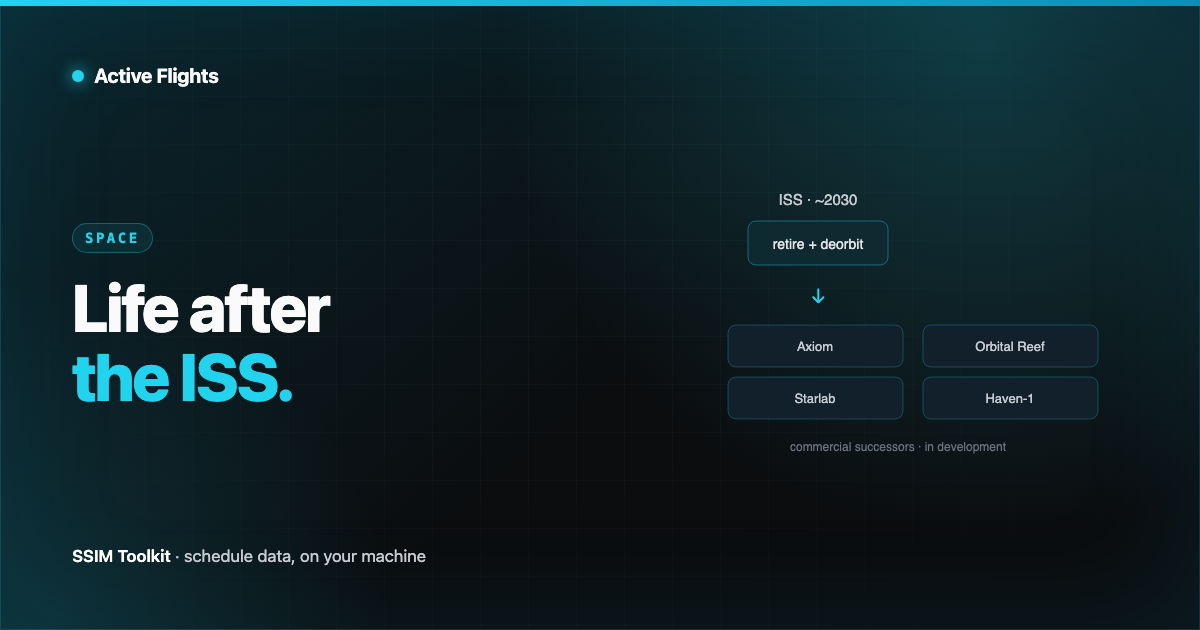
For more than two decades, the International Space Station has been humanity’s continuously crewed outpost in space — a football-field-sized laboratory orbiting about 400 km up. It cannot fly forever. Its structure is aging, and the countries that run it have committed to keeping it going only through 2030. So a genuinely strange question is now a live one: what happens to the ISS, and what takes its place?
A planned, deliberate ending
The ISS will not simply be abandoned. Leaving a 400-tonne structure in orbit to break up on its own would be reckless — exactly the kind of debris hazard that space agencies now work hard to avoid. Instead, NASA intends to bring it down in a controlled way.
In 2024, NASA selected SpaceX to build the U.S. Deorbit Vehicle, a purpose-built spacecraft under a contract with a potential value of up to $843 million. Its single job is to dock with the station and, through a series of braking burns, guide it into a controlled reentry over a remote stretch of ocean — the traditional graveyard for large spacecraft in the South Pacific. Unusually, NASA will own and operate this vehicle rather than buy it as a service.
That is the plan: operate through about 2030, then a careful, targeted deorbit.
The handoff to private stations
The bigger shift is what NASA wants to happen next. Rather than build another government station, the agency is encouraging companies to build their own — “commercial LEO destinations” — and become a customer among many. Several are in development, at very different stages, and it is worth being precise about what is actually built versus planned.
Axiom Station (Axiom Space) takes an incremental route. Axiom plans to launch its first module and dock it to the ISS itself, then add more modules before eventually detaching to fly free — targeting no earlier than 2026 for the first element. Building onto the existing station first lowers the risk.
Haven-1 (Vast) is going for a milestone: the first commercial space station in orbit. It is a single, compact module designed to launch on a Falcon 9, host short crew visits, and prove the concept. Vast began assembling the flight unit in early 2026 and is targeting launch no earlier than 2027 — hardware that is genuinely being bent into shape, not just drawn.
Orbital Reef (Blue Origin and Sierra Space) is a larger, modular “business park in space,” designed to launch on Blue Origin’s New Glenn rocket with a stated goal of no earlier than 2027.
Starlab (Voyager Technologies and Airbus) is a single large station intended to fly in one launch aboard SpaceX’s Starship, with the partners working through major design reviews and aiming for roughly the end of the decade.
Planned versus built — the honest picture
It is easy to read that list and picture four stations nearly ready to fly. The reality is more sober. Most of this hardware is still in design, testing, or early assembly; every date above is a target that has moved before and may move again, and there is a real chance not all of them reach orbit. The ISS’s 2030 retirement is a firm-ish deadline, and the industry is racing to make sure something is up there to catch the handoff — so there is no gap in humanity’s permanent presence in orbit.
What is striking is the change in model. The next chapter of low Earth orbit is being written less by a single flagship program and more by a handful of companies, each betting that there is a business in living and working in space. Whether that bet pays off is the story of the coming decade.
From the team behind SSIM Toolkit — the local workbench for airline schedule data.
Sources
Want early access?
We're opening SSIM Toolkit to teams in waves through 2026 — free during the preview. Drop your email and we'll reach out when it's your turn.
You're on the list. Check your inbox for a confirmation email to finish signing up.
Something went wrong — please try again, or email hello@activeflights.com.