
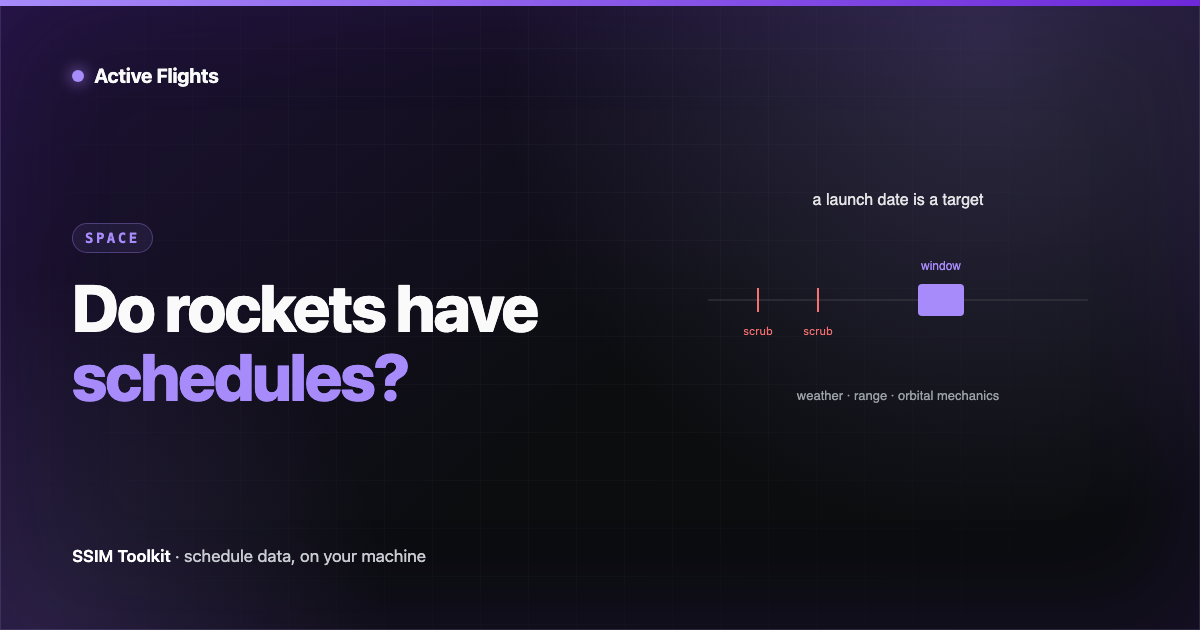
When a company says a rocket will launch “on the 14th,” it sounds like booking a flight. In reality, that date is a target wrapped in physics, weather, and a queue of other rockets waiting for the same patch of sky. Spaceflight runs on schedules — just not the kind you can set and forget.
The manifest: a plan, not a promise
Every launch provider keeps a manifest: an ordered list of upcoming missions, each with a payload, a target orbit, a rocket, a pad, and a planned date. It is the space equivalent of a timetable. But unlike a train that can leave a minute late and catch up, a rocket often has a razor-thin moment when it can go at all — and if it misses that moment, everything behind it on the manifest shifts.
Launch windows: when orbital mechanics sets the clock
The reason for those thin moments is orbital mechanics. A rocket does not just go “up” — it goes toward a specific orbit, and that orbit is essentially fixed in space while the Earth turns underneath it.
For some missions there is a comfortable launch window of a few hours: any time in that span works, with small adjustments. For others, the window is instantaneous — a single second. The classic example is a flight to the International Space Station. The station’s orbital plane sweeps over the launch site only briefly, and the rocket has to lift off at the exact instant the pad rotates into that plane. Changing an orbital plane after launch is brutally expensive — shifting it by a single degree can cost more velocity than a rocket can spare — so for a station rendezvous there is essentially one usable moment per day. Launch a heartbeat late, and you wait roughly 24 hours for the geometry to come back around.
Range congestion: sharing the coast
Even a perfect window is not enough if the road is busy. Most U.S. launches from Florida fly through the Eastern Range, a swath of tracking, safety, and airspace managed by the Space Force. Every launch needs the range cleared, which means launches have to be spaced out and deconflicted from one another — and from aircraft and ships downrange.
That coordination is under real pressure, because the pace has exploded. Florida’s Space Coast flew a record 93 launches in 2024, up from 74 the year before, making it the busiest spaceport on Earth. The following year it blew past that: the range recorded its 100th launch of 2025 by late November. Fitting that many missions through one range means treating launch slots like a scarce, shared resource — because they are.
Scrubs and slips: why the date moves
Then there is everything that can go wrong on the day. A scrub is a launch called off after the countdown has begun; a slip is a delay to a later date. Both are routine, not failures.
The causes are familiar to anyone who has watched a countdown: weather that violates safety rules, a stubborn technical reading, or a fueling problem. NASA’s Artemis I megarocket was scrubbed twice in 2022, the second time by a persistent liquid-hydrogen leak during fueling. Weather alone is a frequent culprit — lightning, high winds, and even the conditions downrange where a booster might land all factor in.
This is why seasoned launch watchers treat a date as a target and keep the next backup date in mind. The rocket flies when the physics, the hardware, the weather, and the range all agree — and getting all four to line up is the whole art of the schedule.
The same problem, everywhere
Strip away the rockets and a launch manifest is a familiar kind of object: a plan that has to reconcile hard constraints (the window), shared infrastructure (the range), and disruptions (the scrub) into a single sequence that actually works. Whether you are sequencing rockets down a coastline or aircraft across a network, scheduling is the discipline of making a fixed set of resources absorb a moving set of demands — and doing it without the whole plan falling over when one piece slips.
From the team behind SSIM Toolkit — the local workbench for airline schedule data.
Sources
Want early access?
We're opening SSIM Toolkit to teams in waves through 2026 — free during the preview. Drop your email and we'll reach out when it's your turn.
You're on the list. Check your inbox for a confirmation email to finish signing up.
Something went wrong — please try again, or email hello@activeflights.com.