
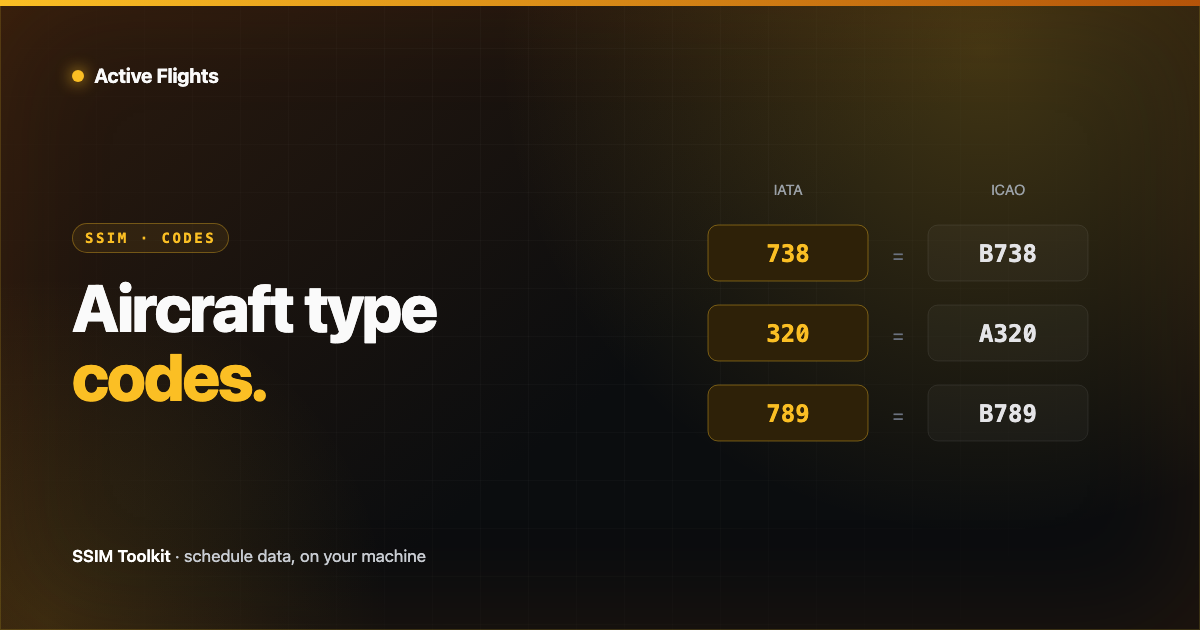
Every flight-leg record carries an equipment field: a short code for the aircraft type operating the flight. It looks trivial — three characters — but it hides a genuine source of confusion, because the industry maintains two different type-coding systems, and they don’t look alike.
Two codes for the same aircraft
- IATA aircraft type code — three characters, used in schedules, reservations, and most commercial systems. This is what appears in an SSIM equipment field.
- ICAO aircraft type designator — up to four characters, used in flight plans, air traffic control, and operational/safety contexts.
Same aircraft, two codes:
| Aircraft | IATA (3-char) | ICAO (4-char) |
|---|---|---|
| Boeing 737-800 | 738 |
B738 |
| Airbus A320 | 320 |
A320 |
| Boeing 787-9 | 789 |
B789 |
| Boeing 777-300ER | 77W |
B77W |
Because the SSIM schedule speaks IATA, a system that expects ICAO (or vice-versa) will mismatch on every row unless you map between them. That mapping is one-to-… careful: it isn’t always clean, because the two systems slice variants differently.
Why it’s not just cosmetic
The equipment code is a key you join on, and a proxy for real properties:
- Capacity and configuration. Type drives the seat count and cabin layout the schedule implies — get the code wrong and your capacity analysis is wrong.
- Sub-fleet nuance. A single IATA code can cover aircraft an airline treats as distinct sub-fleets (different configs, ranges, or performance). The schedule’s code may be coarser than the operational reality.
- Cross-system joins. Pulling maintenance, performance, or ATC data alongside the schedule means reconciling IATA↔ICAO. A silent mismatch drops rows or double-counts.
- New variants. As new types and re-engined variants enter service, code assignments evolve; a hard-coded lookup rots.
The equipment field is three characters that stand in for an entire aircraft. Treat it as a code to be mapped carefully, not a label to be trusted blindly.
Doing it right
Reading equipment well means recognising the schedule’s IATA codes for what they are, mapping to ICAO (and to your own fleet taxonomy) deliberately, and being honest about where one code covers sub-fleets you actually care about. It’s a small discipline that prevents a whole class of quiet capacity and join errors downstream.
Parsing the equipment field faithfully — and keeping it attached to the right leg — is part of reading a schedule correctly, which is what SSIM Toolkit is built to do so you don’t re-solve it per pipeline.
Want early access?
We're opening SSIM Toolkit to teams in waves through 2026 — free during the preview. Drop your email and we'll reach out when it's your turn.
You're on the list. Check your inbox for a confirmation email to finish signing up.
Something went wrong — please try again, or email hello@activeflights.com.