
In the intro to SSIM we said a schedule file is a small set of record types stacked in order. This post opens them up. By the end you’ll be able to look at a raw SSIM file and know what every line is doing.
The five record types
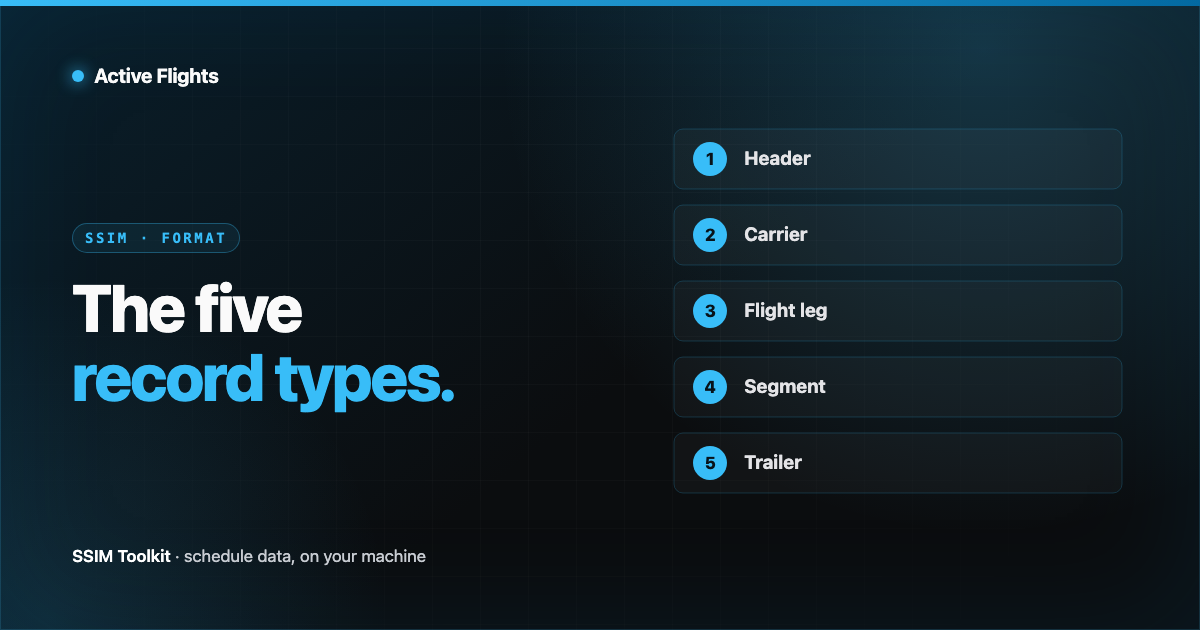
Chapter 7 defines a fixed-width, 200-byte file built from five record types. The first character of every line is the record type; everything else hangs off that.
A file, top to bottom
Here’s the record sequence of a small file — schematic, showing the record type followed by a plain-English gloss of each line (each real line is exactly 200 fixed-width characters):
1  Header    file title / general header
2  Carrier   QF · northern winter 2026 · time mode = Local
3  Leg       QF0011 · SYD→MEL · 01APR26–25OCT26 · daily · 0600/0730 · 738
4  Segment   QF0011 · codeshare AA1234 · traffic restriction
3  Leg       QF0012 · MEL→SYD · 01APR26–25OCT26 · daily · 0815/0945 · 738
5  Trailer   record counts (integrity check)
Read it as a story: the header (1) opens the file and the carrier record (2) says this is Qantas, northern winter 2026 season, times in local. Each flight leg (3) is one physical hop — QF11 SYD→MEL, 06:00–07:30, on a 737-800. Segment data (4) hangs off the leg it follows: the codeshare partner, traffic restrictions, and other Data Element Identifiers (DEIs). The trailer (5) closes the file with counts you can verify against what you parsed.
The flight-leg record (type 3), field by field
This is the record you’ll spend the most time with. The high-value fields:
| Field | What it tells you |
|---|---|
| Airline designator + flight number | Which flight this is |
| Period start / end | The date range the row is valid for |
| Days of operation | Which weekdays it runs (1 = Mon … 7 = Sun; blanks mean “not that day”) |
| Board / off point | The city pair for this leg |
| Departure / arrival time | Scheduled times, in the file’s time mode (local or UTC) |
| Aircraft type | The equipment (e.g. 738, 32N, 789) |
The subtle part is that a single type-3 line isn’t one flight — it’s a pattern. “QF11, Mon–Sun, 01 Apr–25 Oct” expands into every operating date in that window. Getting that expansion exactly right — including season edges and days-of-week — is one of the most common places parsers quietly disagree.
The segment record (type 4)
Where the flight leg says how the aircraft moves, the segment record says what can be sold and how it’s coded. It carries DEIs: codeshare designators, traffic restrictions (which markets can be sold on a multi-leg service), meal and product codes, and more. Miss these and a schedule looks complete but is commercially wrong — you’d show a flight as sellable in a market it can’t actually carry.
The gotchas, per record type
- Carrier record: the time mode (local vs UTC) it declares governs how you read every time in the file. Assume the wrong one and every departure is off by hours.
- Flight legs: blank vs zero vs space in the days-of-operation field; overnight arrivals (a “day change” indicator) that push arrival to the next day.
- Segment data: DEIs attach to the preceding leg — associate them with the wrong leg and the codeshares scatter.
- Trailer: the counts exist for a reason. If your parsed total doesn’t match the trailer, stop — something upstream is wrong.
Reading SSIM isn’t hard because the fields are complex. It’s hard because a hundred small conventions all have to be right at once, and the format won’t tell you when one isn’t.
Doing it well
This is precisely the work SSIM Toolkit is built to take off your plate: parse every record type faithfully, expand the operating dates correctly, keep the segment data attached to the right leg, and check the whole thing against the trailer — locally, in seconds, on real airline-sized files. The record types stop being a parsing project and go back to being what they are: your schedule.
Next in the series: Minimum Connect Time — the single hardest number in scheduling.
Sources
Want early access?
We're opening SSIM Toolkit to teams in waves through 2026 — free during the preview. Drop your email and we'll reach out when it's your turn.
You're on the list. Check your inbox for a confirmation email to finish signing up.
Something went wrong — please try again, or email hello@activeflights.com.