
Next week, from 20–24 July 2026, the aviation industry gathers at the Farnborough International Airshow — one of the two great order-books of the calendar. Expect a week of headline commitments from Airbus, Boeing, Embraer and COMAC, the engine makers (Rolls-Royce, GE Aerospace, Pratt & Whitney), and a fast-growing advanced-air-mobility contingent. For scale: the 2024 edition booked on the order of $105 billion in deals.
The orders make the headlines. What happens to those aircraft after the press release is where our corner of the industry lives.
What to watch
Beyond the order totals, three threads matter for anyone who works with schedule data:
- The backlog gets longer, not shorter. New orders stack onto a combined Airbus/Boeing book already worth about twelve years of production. A 2026 order is a 2030s aircraft. Every airline planning team already knows its fleet plan is a forecast that keeps moving.
- Engines and delivery slips stay the story. The constraint isn’t demand for aircraft; it’s the ability to build and power them. Announcements are easy; on-time delivery is the hard part, and it’s been running years behind.
- New categories, new scheduling problems. The advanced-air-mobility (eVTOL) presence keeps growing — with aircraft like BETA’s CX300 and Vertical Aerospace’s VA-1X on the flying and static lines. A new class of short-hop, high-frequency operations is coming, and it will need to be scheduled, slotted, and deconflicted like everything else.
Why the order wave lands on the schedule
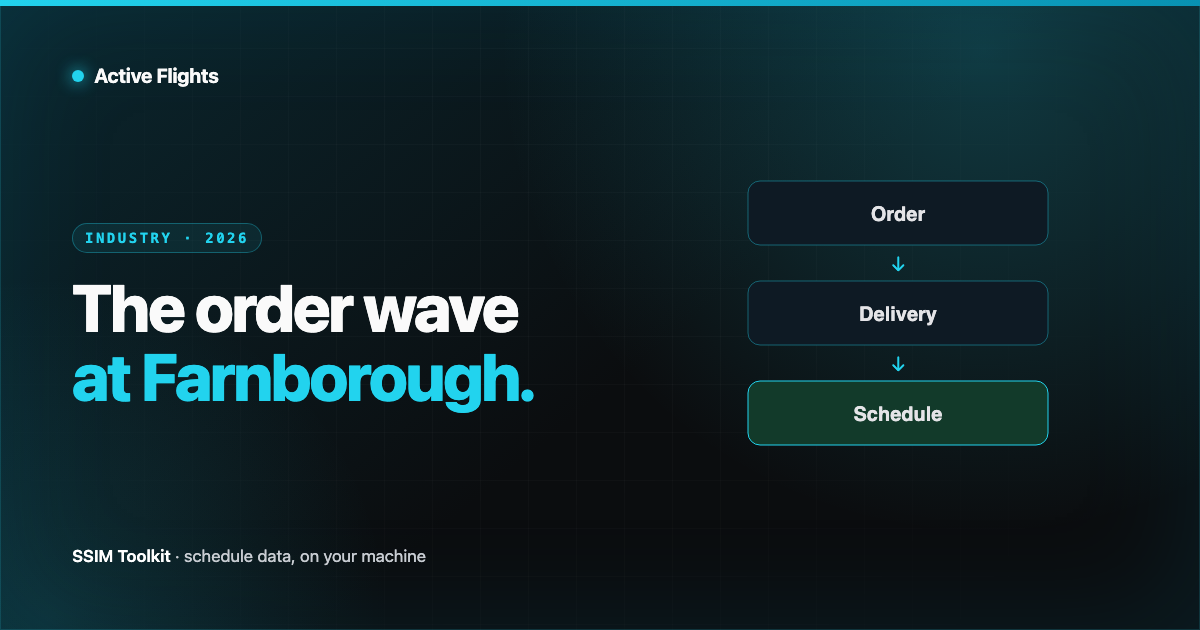
Here’s the throughline of this whole blog, seen from the airshow floor: an order is a bet on future capacity, but capacity only becomes real when an aircraft flies a schedule. Between the two sits a multi-year, uncertain gap — and the wider that gap, the more often the schedule has to be rebuilt to match the fleet an airline actually has rather than the one it ordered.
That’s not a one-time event; it’s a standing condition. Deferred deliveries ripple into route launches that slip and frequencies that can’t be added. Extended leases keep older aircraft flying schedules they were meant to have exited. Capacity gets reshuffled between markets far more often than it gets added. Each of those moves is a new schedule to validate, compare against the last version, and deconflict.
The airshow measures the industry’s optimism in dollars. The schedule measures what that optimism can actually deliver, week by week.
The quiet takeaway
Farnborough is a good week to remember that the exciting part of aviation — the new metal, the big numbers — ultimately resolves into a very unexciting artifact: a schedule file that has to be right. The teams that can read, compare, and reconcile those files quickly are the ones that turn an order wave into an operation without drowning in spreadsheets.
We’ll be watching the orders like everyone else — and thinking, as ever, about the schedule that has to absorb them.
Sources
Want early access?
We're opening SSIM Toolkit to teams in waves through 2026 — free during the preview. Drop your email and we'll reach out when it's your turn.
You're on the list. Check your inbox for a confirmation email to finish signing up.
Something went wrong — please try again, or email hello@activeflights.com.