
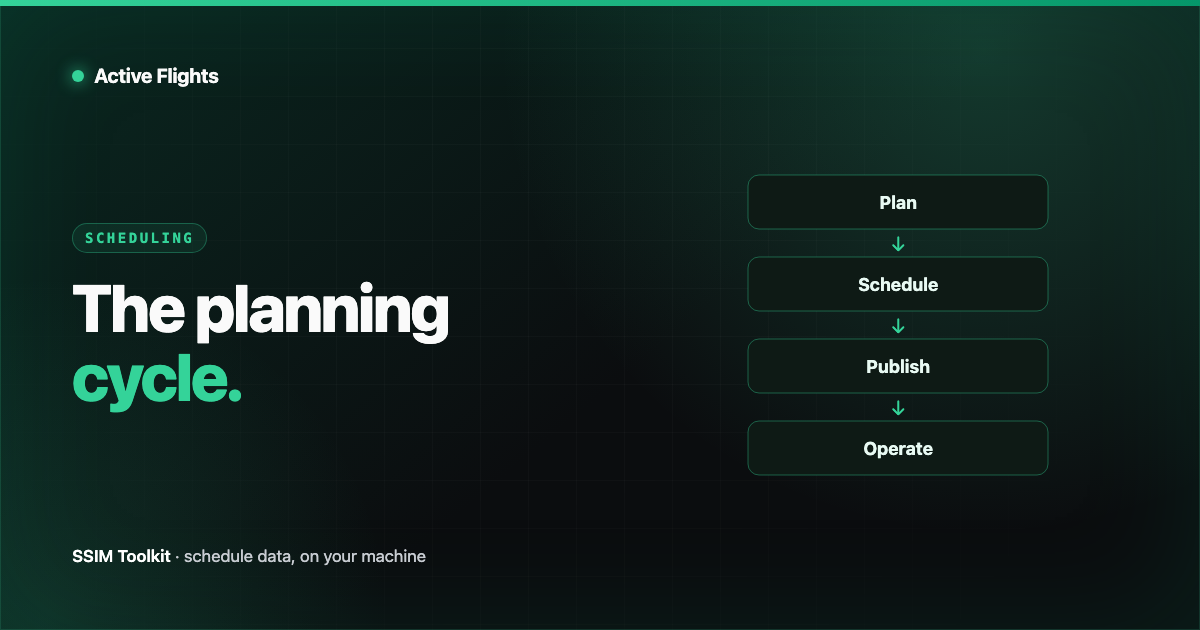
A flight doesn’t appear fully formed. It travels a long road — from a strategic bet about a market, through months of refinement, to an aircraft pushing back from a gate. Understanding that road, and where schedule data flows along it, makes it obvious why the humble SSIM file sits at the centre of so much.
The cycle, stage by stage
The path from strategy to operation runs roughly like this:
- Network planning. The long-range question: which markets do we serve, and with how much capacity? Route economics, demand forecasts, competition. Output: a route network and broad capacity plan.
- Schedule development. Turning the network into an actual timetable — frequencies, departure times, aircraft rotations, and the bank structure that makes connections work. This is where minimum connect times and hub waves get engineered.
- Fleet assignment. Matching aircraft types to flights by demand and range — deciding which tail flies which leg, subject to maintenance and crew.
- Slot coordination. Securing the slots the schedule needs at coordinated airports, and reconciling the plan with what’s actually held.
- Publication. Releasing the schedule to the world as an SSIM file — to airports, GDSs, distributors, and internal systems.
- Maintenance. Keeping it current through the season with SSM and ASM messages as things change.
- Day of operations. Operations control flies the plan — and every disruption feeds back into how the next schedule is built.
It’s genuinely a cycle: what happens on the day, and how the last season performed, informs the next round of network planning.
Who touches it, and what moves
| Stage | Owned by | Key output |
|---|---|---|
| Network planning | Network / commercial | Route network + capacity plan |
| Schedule development | Scheduling | The timetable + rotations |
| Fleet assignment | Scheduling / fleet | Aircraft-to-flight assignment |
| Slot coordination | Slot team | Held slots reconciled to schedule |
| Publication | Scheduling / IT | Published SSIM feed |
| Maintenance | Scheduling / ops | SSM / ASM change stream |
| Day of operations | OCC | The operated schedule |
Notice the connective tissue running down the right-hand column: nearly every stage produces, consumes, or modifies schedule data. The network plan becomes a timetable becomes a published file becomes a stream of changes becomes the operated day — and each hand-off is a place the data has to stay faithful.
Where it breaks down
Because the cycle spans so many teams and systems, the failures tend to happen at the seams:
- A schedule that no longer matches the slots held.
- A published file that drifts from the internal plan after a season of messages.
- A comparison between “what we planned” and “what we published” that takes days because the two live in different tools.
- Conflicts — an aircraft double-assigned, an impossible turnaround — that slip through until day of operations.
Every one of these is a schedule-data problem: reading a feed correctly, comparing two versions, checking one dataset against another.
The planning cycle is a relay race, and schedule data is the baton. Drop it at a hand-off and the whole leg has to be re-run.
Doing it well
The teams that run this cycle smoothly share a trait: they can read, compare, and check schedule data quickly at every seam — not just at publication. Open the feed fast, validate against the standard, analyse the whole network, and check it against slot pressure. That’s the foundation SSIM Toolkit is built to provide: one fast, local, deterministic place to work with the schedule at every stage of its life, so the baton never gets dropped.
Next, the failure mode that hides at the seams: deconfliction.
Want early access?
We're opening SSIM Toolkit to teams in waves through 2026 — free during the preview. Drop your email and we'll reach out when it's your turn.
You're on the list. Check your inbox for a confirmation email to finish signing up.
Something went wrong — please try again, or email hello@activeflights.com.