
Publishing a schedule is the easy part. Keeping it current — as flights are re-timed, cancelled, re-equipped, and added, sometimes many times a day — is the real work. That maintenance travels as two IATA message types: SSM and ASM. If the SSIM file is the schedule’s snapshot, SSM and ASM are how it stays alive.
Two message types, two jobs
Both are defined in the SSIM standard, in their own chapters:
- SSM — Standard Schedules Message (SSIM Chapter 4). The workhorse for regular, often bulk schedule updates exchanged between systems — the routine flow of schedule information between carriers, airports, and distributors.
- ASM — Ad Hoc Schedule Message (SSIM Chapter 5). For individual, ad-hoc changes to a specific flight — a single re-time, a one-day cancellation, an equipment swap — outside the regular bulk cycle.
Roughly: SSM keeps the series in sync; ASM handles the exceptions to it.
Action identifiers
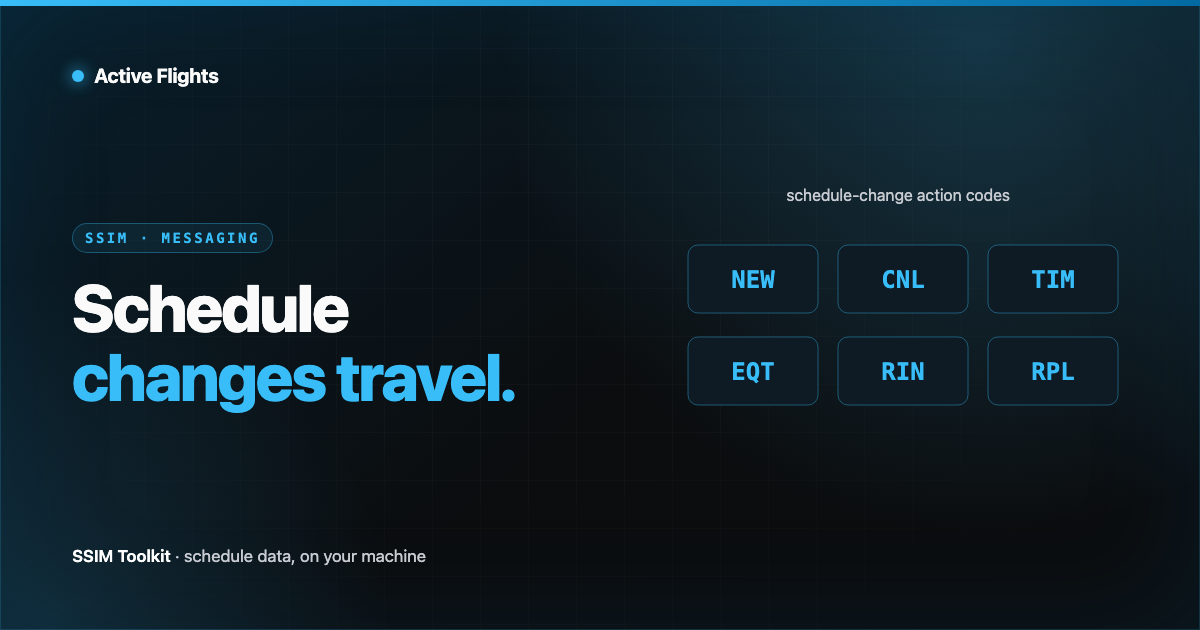
Every message carries an action identifier that says what to do. The common ones:
| Code | Action |
|---|---|
| NEW | Create a new flight / series |
| CNL | Cancel a flight |
| RPL | Replace (update) an existing series |
| TIM | Change timing (departure / arrival) |
| EQT | Change equipment (aircraft type) and/or conditional data |
| RIN | Reinstate a previously cancelled flight (ASM) |
| ADM | Change existing information (ASM) |
| CON | Change expressed by data element only (ASM) |
SSM covers actions like NEW, CNL, RPL, TIM and EQT; ASM adds the finer-grained, single-flight actions such as RIN, ADM and CON.
What a message looks like
Messages are terse, teletype-style text. Schematically, an ad-hoc timing change reads like this (illustrative — the real telex format has precise line structures):
ASM                        ← message type: Ad hoc Schedule Message
TIM                        ← action: change timing
QF0011/25JAN26 J SYDMEL    ← the flight + date this applies to
0615 0745                  ← the new departure / arrival
Every message identifies which flight it targets (designator, number, date, leg) and what changes. Get the target wrong and you’ve edited the wrong flight; apply messages out of order and the schedule ends up in a state that never actually existed.
How the changes flow
Why it’s harder than it looks
The difficulty isn’t the message format — it’s applying the stream correctly:
- Matching the target. Each message has to resolve to exactly the right flight and date range in your current picture. Ambiguity here corrupts the schedule quietly.
- Order and idempotency. Messages must be applied in the right sequence; a CNL after a TIM is a different outcome than the reverse. Re-processing the same message shouldn’t double-apply.
- Series vs exception. An ASM one-day change sits on top of an SSM series without rewriting it — you have to hold both and know which wins for a given date.
- Reconciling drift. After thousands of messages, does your schedule still match the latest full file? The trailer counts and periodic full-file compares exist for exactly this reason.
A schedule is only as trustworthy as the message stream that maintains it. The file is a snapshot; the truth is snapshot-plus-messages, applied in order.
Doing it well
Keeping a schedule current means parsing SSM and ASM faithfully, resolving each to the right flight, applying changes in order, and being able to reconcile the running result against a fresh full file when one arrives. That’s the same discipline SSIM Toolkit brings to the schedule file itself — read it faithfully, deterministically, reproducibly, and locally — the reliable full-file foundation any message-driven workflow has to stand on.
Next: the data-quality edge cases that break parsers in the first place.
Sources
Want early access?
We're opening SSIM Toolkit to teams in waves through 2026 — free during the preview. Drop your email and we'll reach out when it's your turn.
You're on the list. Check your inbox for a confirmation email to finish signing up.
Something went wrong — please try again, or email hello@activeflights.com.