
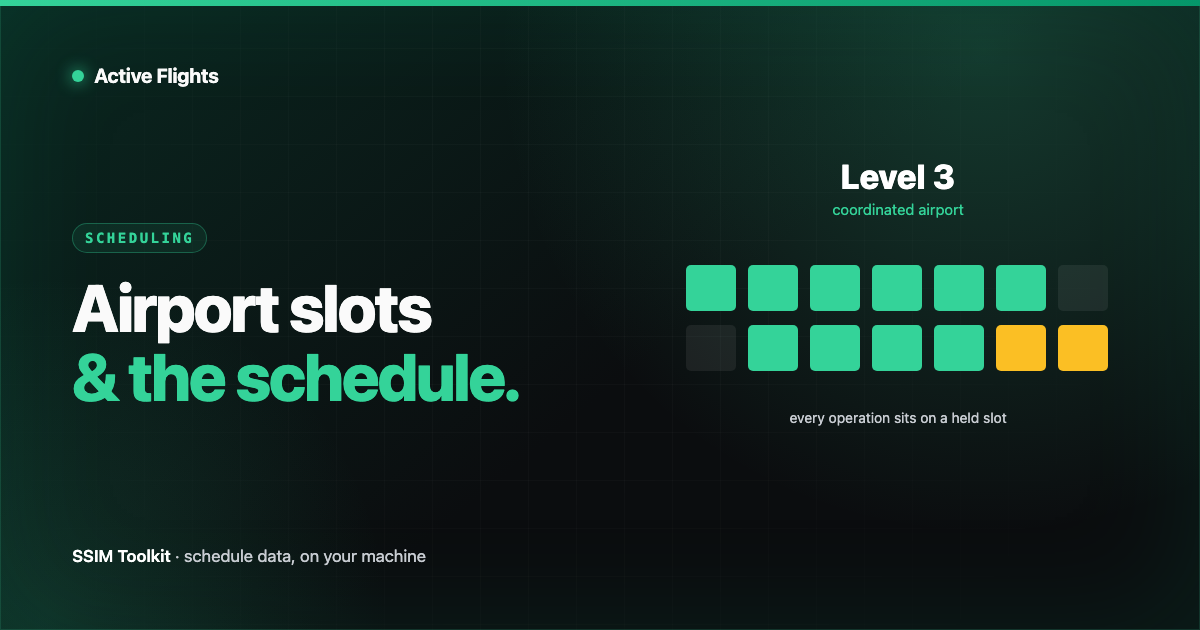
At a quiet regional field, an airline can more or less fly when it likes. At Heathrow, or Tokyo Haneda, or New York JFK, it cannot. To operate there you need a slot — and slots are one of the scarcest, most fought-over resources in aviation. Here’s how the system works and why it’s inseparable from the schedule.
What a slot actually is
An airport slot is a permission to use the full airport infrastructure — runway, taxiways, stands, terminal — to arrive or depart at a specific time on a specific day during a scheduling season. Where an airport’s capacity can’t meet demand, someone has to allocate that scarce capacity in advance, fairly and efficiently, so airlines can plan and passengers aren’t left circling. That allocation is slot coordination.
The rulebook is the Worldwide Airport Slot Guidelines (WASG), published jointly by IATA, Airports Council International (ACI), and the Worldwide Airport Coordinators Group (WWACG). It’s the shared framework the industry uses so a slot means the same thing in London as it does in Singapore.
The three levels
Airports are classified by how tight the supply/demand balance is:
| Level | Name | What it means |
|---|---|---|
| Level 1 | Non-coordinated | Capacity comfortably meets demand; no coordination needed |
| Level 2 | Schedules-facilitated | Congestion at some peaks; a facilitator agrees voluntary schedule adjustments |
| Level 3 | Coordinated | Demand significantly exceeds capacity; an independent coordinator allocates every slot |
The cycle, and “use it or lose it”
Slots are allocated per scheduling season (northern summer and winter), ahead of time, at slot conferences. The system leans heavily on historic precedence: an airline that operated a series of slots and used them sufficiently — the well-known 80/20 rule, meaning at least 80% of the time across the season — generally keeps (“grandfathers”) them for the equivalent next season. Slots that fall below the threshold can be lost back to the pool and reallocated. It’s why you’ll hear airlines talk about “protecting” slots by flying them.
Where slots meet the schedule
This is the part that matters for anyone handling schedule data: at a Level 3 airport, your published schedule and your slot holdings have to agree. Every flight you plan there must sit on a slot you actually hold, at the time you hold it. That agreement is maintained through slot messaging — clearance requests and allocations exchanged with the coordinator — and it has to stay reconciled as both sides change.
So, like MCT, slots are a second dataset applied against the schedule. The SSIM file says what you intend to fly; the slot book says what you’re permitted to fly; and the two drift apart constantly as schedules are re-timed and slots are traded, returned, or reallocated.
A schedule that doesn’t match the slot book isn’t a plan — it’s a problem waiting for the day of operation.
Why reconciliation is hard
The friction is the same shape as everywhere else in scheduling: two large datasets, different update rhythms, and a correct answer that depends on lining them up exactly. A re-timed flight that no longer matches its slot, a slot given up but still in the schedule, a seasonal rollover where historics didn’t carry as expected — each is easy to miss by eye and expensive to miss in operation.
Doing it well
The job is to hold the schedule and the slot picture together and continuously ask: does every coordinated-airport operation sit on a slot we hold, at the right time? — across the whole season, reproducibly, and flagging the mismatches the moment they appear.
That’s the same local-first, deterministic approach SSIM Toolkit takes to the rest of the schedule: bring the datasets together on your machine, compare them faithfully, and surface exactly what doesn’t line up — so a slot mismatch is caught at the desk, not at the gate.
Next: summer vs winter — how airlines rebuild the schedule twice a year.
Sources
Want early access?
We're opening SSIM Toolkit to teams in waves through 2026 — free during the preview. Drop your email and we'll reach out when it's your turn.
You're on the list. Check your inbox for a confirmation email to finish signing up.
Something went wrong — please try again, or email hello@activeflights.com.