
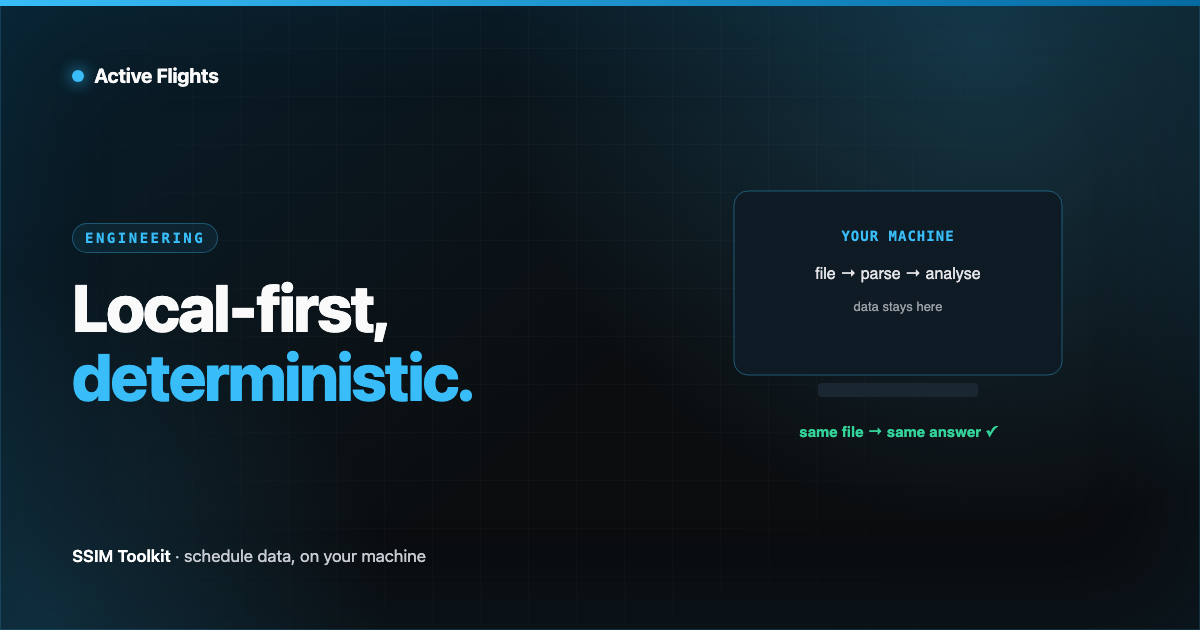
Two words describe how we think schedule tooling should work: local-first and deterministic. They sound like implementation details. They’re actually the whole argument — the difference between a tool you can trust with commercial data and important decisions, and one you have to hedge around.
Local-first: the data stays with you
Airline schedules are commercial information. Who flies where, at what frequency, on what aircraft — that’s competitive intelligence, and moving it around creates risk that has nothing to do with the analysis you actually wanted to do.
Local-first flips the default. The file is read, parsed, and analysed on your machine; it doesn’t get uploaded to someone else’s server to be useful.
The benefits stack up:
- Privacy and security. Data that never leaves the device can’t be intercepted in transit or exposed on someone else’s infrastructure. The risk surface shrinks to your own machine. (More on our stance on the security page.)
- Speed. No upload, no round-trip, no waiting on a remote service to process a multi-gigabyte feed. Local is simply faster for files this size.
- Offline and owned. It works on a plane with the network off, and it keeps working regardless of someone else’s uptime. You own the tool, not a rented dependency.
Deterministic: the same file, the same answer
The second property is quieter but just as important. Deterministic means the same input always produces the same output — no randomness, no model that “usually” gets it right, no answer that changes between runs.
For schedule data this is non-negotiable. When you ask how many flights operate on a Tuesday, or which connections clear their MCT, you need the answer, derived from the spec — not a plausible guess. Determinism buys you three things:
- Reproducibility. A result you got last week means the same thing today. A scenario you modelled is stable.
- Auditability. Every output traces back to a field and a rule. You can explain why the number is what it is.
- Trust. You can build on top of it — automations, exports, reports — knowing the foundation won’t shift under you.
Commercial data you can’t afford to leak, and numbers you can’t afford to be approximately right: those two constraints point straight at local-first and deterministic.
What this rules out
Being explicit about the trade: the numbers come from a deterministic engine that runs where your data already lives — no model quietly computing them, nothing in the loop you can’t see. That’s deliberate. The engine is boringly exact. Where AI fits — and it does — is on the outside of that deterministic core, which is its own post.
Doing it well
This is the spine of how SSIM Toolkit is built: a deterministic engine that reads, validates, and analyses SSIM entirely on your machine. Fast because it’s local, trusted because it’s reproducible, and yours because it isn’t rented. The foundation everything else in the series has been circling.
Want early access?
We're opening SSIM Toolkit to teams in waves through 2026 — free during the preview. Drop your email and we'll reach out when it's your turn.
You're on the list. Check your inbox for a confirmation email to finish signing up.
Something went wrong — please try again, or email hello@activeflights.com.