
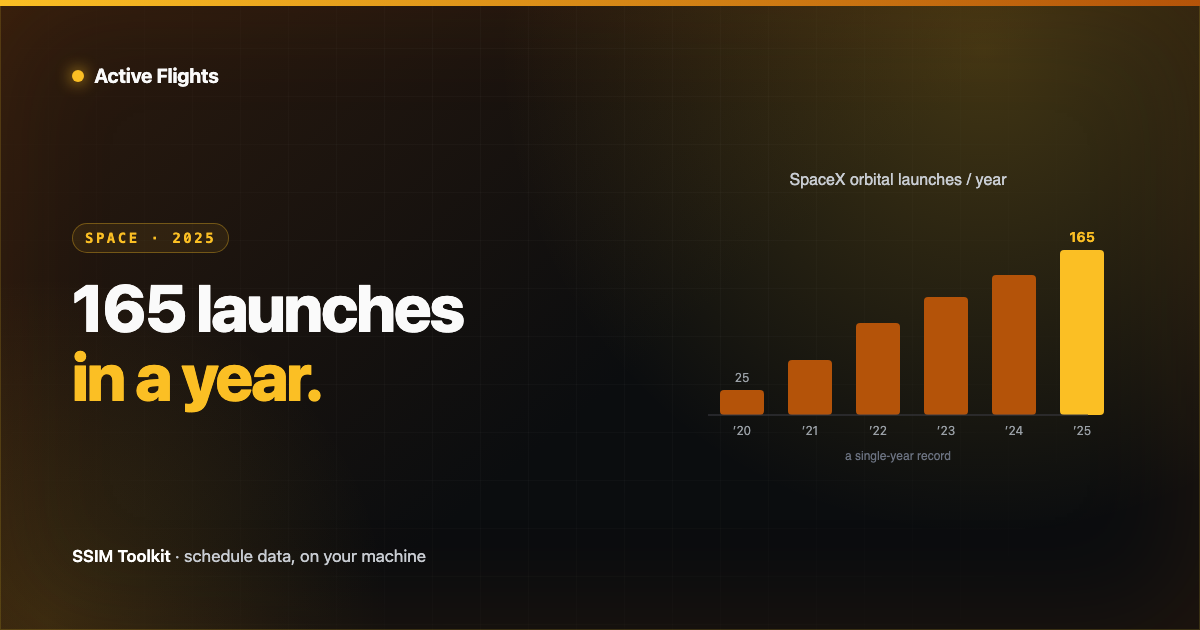
In 2025, a single company launched a rocket to orbit, on average, about once every two days. Not a test campaign, not a stunt — a routine. SpaceX flew 165 orbital Falcon missions in 2025, its highest annual total ever and its sixth consecutive record-breaking year, according to a SpaceNews year-end analysis.
To put that in perspective: worldwide, there were 324 orbital launch attempts in 2025 — meaning SpaceX alone accounted for roughly half of everything humanity sent to orbit. Here’s how one company got there, and the single idea that made it possible.
The numbers behind the record
The headline figures are almost hard to believe when you line them up:
| Metric | 2025 |
|---|---|
| SpaceX orbital launches | 165 |
| Global orbital launch attempts | 324 |
| SpaceX share of global launches | ~51% |
| SpaceX share of US orbital launches | ~85% |
| China’s orbital launches | 92 |
| SpaceX Starlink missions | 123 |
SpaceX flew more orbital missions than the rest of the world combined. It accounted for about 85% of all US launches, and on its own it nearly doubled the entire national output of China, the world’s second-busiest launch nation with 92 flights, per SpaceNews. Globally, launch activity jumped about 25% over 2024’s record of 259 attempts — and a big chunk of that growth was SpaceX.
Most of those flights had a single purpose: building out Starlink, SpaceX’s satellite-internet network. Of the 165 launches, 123 were Starlink missions, lofting more than 3,000 additional spacecraft into a constellation that had grown to more than 9,300 active satellites by the time Space.com tallied the year. Starlink is both the payload and the point: it generates the demand that keeps the rockets flying.
The climb was steep
What makes 2025 remarkable isn’t just the absolute number — it’s the slope. In 2020, SpaceX launched around 26 times. Five years later it did 165. That’s a roughly sixfold increase in half a decade, a growth curve that looks less like an aerospace program and more like a factory ramping production.
The one idea: reuse
You cannot launch every other day if every rocket is thrown away. That’s why the entire record rests on one engineering bet that once seemed absurd: land the rocket and fly it again.
A Falcon 9 has two stages. The big, expensive first stage — the booster, with nine engines and most of the structure — does the hard work of the first couple of minutes, then separates and, instead of crashing into the ocean, relights its engines, steers back through the atmosphere, and sets itself down on a landing pad or an ocean-going drone ship. A few weeks later, refurbished, it flies again.
In 2025 SpaceX passed two milestones that show how routine this has become: its 500th booster landing and its 500th launch of a previously-flown booster, per Space.com. Individual boosters have now flown well over 20 times each. Reuse is what turns a rocket from a one-shot firework into something closer to an airliner — the same hardware, turned around and dispatched again and again.
That is the real reason for the record. Cadence isn’t a marketing target you hit by trying harder; it’s a manufacturing-and-refurbishment problem. Reuse cracked it.
What comes next
SpaceX executives have signalled that 2025–2026 is likely the peak of Falcon 9 activity. The plan from here is to shift the heavy lifting to Starship — the far larger, fully-reusable vehicle that flew a series of suborbital test flights in 2025 — which is meant to launch bigger next-generation Starlink satellites in far larger batches per flight.
If that transition works, the Falcon 9’s astonishing 2025 may not stand as the peak launch rate for long. But it will stand as the year a reusable rocket, flown like a workhorse, quietly took over half the world’s road to orbit.
From the team behind SSIM Toolkit — the local workbench for airline schedule data.
Sources
Want early access?
We're opening SSIM Toolkit to teams in waves through 2026 — free during the preview. Drop your email and we'll reach out when it's your turn.
You're on the list. Check your inbox for a confirmation email to finish signing up.
Something went wrong — please try again, or email hello@activeflights.com.