
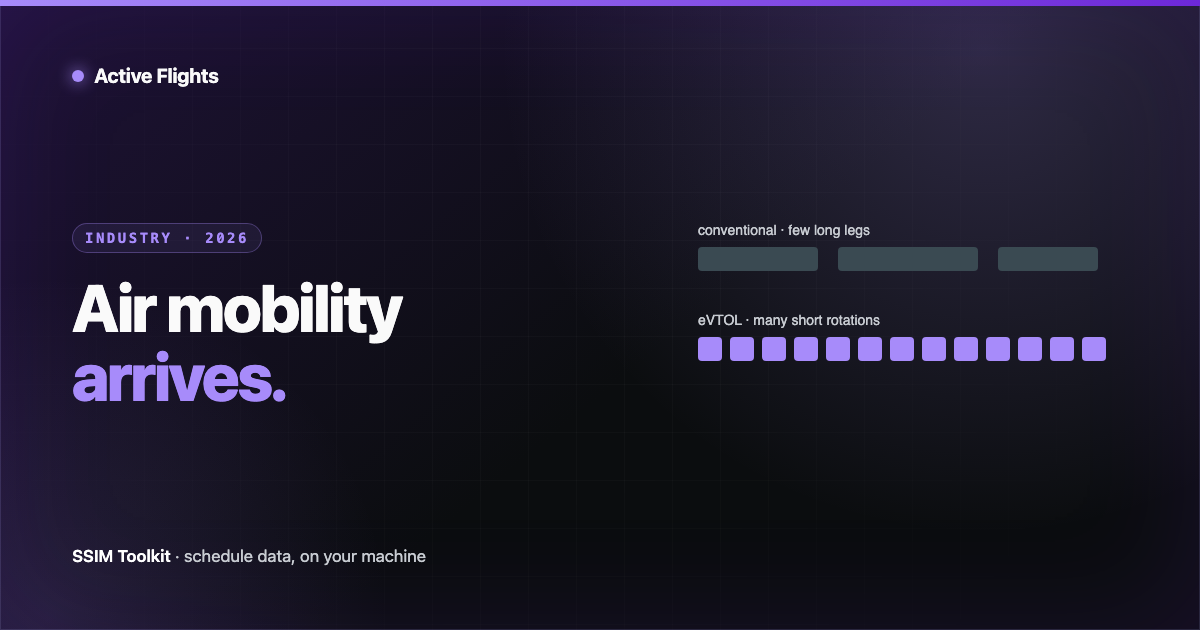
At Farnborough 2026, among the widebodies and the engine makers, a newer category keeps taking up more space: Advanced Air Mobility (AAM) — the electric vertical-takeoff-and-landing (eVTOL) aircraft aiming to run short urban and regional hops. Real airframes are now on the flying and static lines (BETA Technologies’ CX300, Vertical Aerospace’s VA-1X among them). It’s worth thinking early about what happens when these start operating at scale — because they arrive with a scheduling problem.
A familiar problem, at a different tempo
Everything this blog has covered about conventional schedules — reading them, validating them, catching conflicts, respecting slots and connect times — applies to AAM. What changes is the tempo and density:
- Very high frequency. Air-taxi economics assume many short rotations per aircraft per day, not a handful of long ones. That’s far more schedule events per airframe.
- Vertiport capacity. Landing pads and charging stands are scarce, coordinated resources — a slot problem in a new venue, with charging time as an extra constraint on turnarounds.
- Tight turnarounds and charging. “Minimum ground time” gains an energy dimension: an aircraft isn’t ready to fly again until it’s charged, which the schedule has to model.
- Interline to the conventional network. An air taxi feeding an airport is a connection — with its own minimum connect time to the flight it hands off to.
Why the data problem gets harder, not easier
Density is the enemy of sloppy scheduling. Ten times as many rotations per aircraft means ten times as many places for an impossible turnaround or an overlap to hide — and with charging in the mix, a turnaround that looks fine can still be infeasible because the battery isn’t ready. Vertiport slots add another coordinated-resource dataset to reconcile against the plan. The fundamentals are the same; the volume and the tightness are not.
AAM doesn’t invent a new scheduling discipline. It stress-tests the one we already have.
The takeaway
It’s early — most AAM is still pre-scale, and the numbers to size it honestly don’t exist yet, so we won’t pretend they do. But the direction is clear enough to prepare for: a new class of operations that is denser, faster-cycling, and more energy-constrained than anything in today’s schedules. The teams and tools that already treat schedule data as serious infrastructure — read it faithfully, validate it, deconflict it — are the ones that will absorb this new tempo without breaking. It’s the same problem we’ve been writing about all along, arriving in a new aircraft.
Sources
Want early access?
We're opening SSIM Toolkit to teams in waves through 2026 — free during the preview. Drop your email and we'll reach out when it's your turn.
You're on the list. Check your inbox for a confirmation email to finish signing up.
Something went wrong — please try again, or email hello@activeflights.com.