
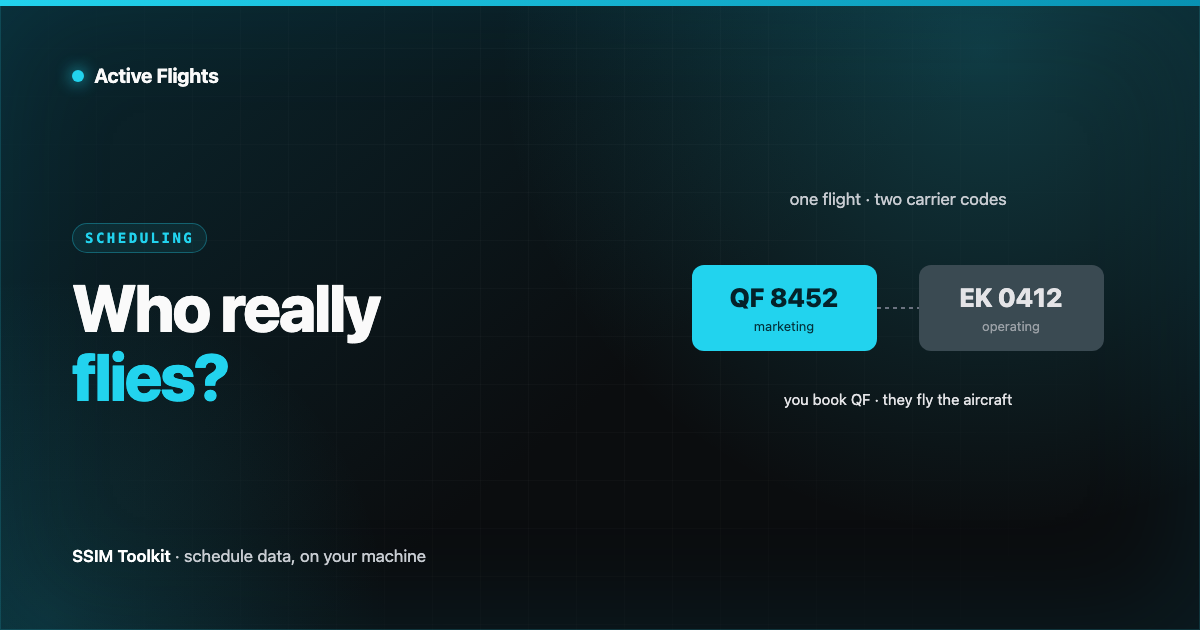
Book a flight marked “QF” and you might board an aircraft painted in another airline’s colours, flown by another airline’s crew. That isn’t a mistake — it’s how the modern network works. Understanding the difference between who sells a flight and who flies it is essential to reading a schedule correctly, because the two aren’t always the same airline.
Marketing vs operating carrier
Two roles hide behind every flight:
- The marketing carrier is the airline whose code and flight number are on your ticket — the airline you booked with.
- The operating carrier is the airline that actually flies the aircraft — its metal, its crew, its operating certificate.
On a plain flight, they’re the same airline. On a codeshare, they differ.
Codeshares
A codeshare is a commercial agreement in which two or more airlines sell the same physical flight under their own flight numbers. It lets a carrier offer a destination it doesn’t fly itself — feeding traffic across a partnership or alliance — without putting an aircraft there. The operating carrier flies once; several marketing carriers may sell it, each under its own code.
In the SSIM schedule, the operating flight is a flight-leg record (type 3); the codeshare marketing designators travel as segment-level data (type 4 DEIs) attached to that leg. Read the leg and you know who flies; read the segment data and you know who else is selling it. Miss the segment data and a schedule looks complete but hides half the commercial picture.
Wet, damp, and dry leases
Leasing is the other reason the airline on the aircraft may not be the one you expect. The distinction is about what comes with the aircraft:
| Lease | What’s included | Crew provided by | Typical term |
|---|---|---|---|
| Wet (ACMI) | Aircraft, Crew, Maintenance, Insurance | Lessor | ~1–24 months |
| Damp | Aircraft + cockpit crew (not cabin) | Mixed | Short-term |
| Dry | Aircraft only | Lessee (on its own AOC) | ~2 years+ |
Under a wet lease (ACMI), one airline supplies a fully crewed, maintained, insured aircraft to another and is paid by the hours operated — common for covering seasonal peaks, delivery gaps, or disruptions. Under a dry lease, only the airframe changes hands; the lessee puts it on its own operating certificate and flies it with its own crew. (A codeshare and a wet lease are not the same thing — one is about selling another airline’s flight; the other is about getting access to more aircraft.)
Why it matters for schedule data
This isn’t trivia. Getting the operating-versus-marketing relationship right drives real outcomes:
- Duty of care and disruption. When a flight is delayed or cancelled, the operating carrier’s operation is affected, but the passenger’s relationship is with the marketing carrier. Systems on both sides need to know which is which.
- Commercial correctness. Selling a codeshare you don’t have, or failing to show one you do, is lost revenue or an unfulfillable booking.
- Analysis and capacity. Count both the marketing and operating numbers as separate flights and you’ll double-count capacity; ignore the codeshares and you’ll under-count the commercial network. You have to know which question you’re asking.
The schedule doesn’t just say when a flight operates. It says who operates it and who’s allowed to sell it — and those are three different facts that have to line up.
Doing it well
Reading a schedule correctly means keeping the operating leg and its codeshare segment data together, distinguishing marketing from operating flights, and not conflating them when you count or compare. That’s exactly the kind of fidelity SSIM Toolkit is built for: parse the record types faithfully, keep the segment data attached to the right leg, and let you see — clearly and locally — who flies and who sells, without a home-grown script guessing at it.
Next: SSM and ASM — how changes to all of this travel between systems.
Sources
Want early access?
We're opening SSIM Toolkit to teams in waves through 2026 — free during the preview. Drop your email and we'll reach out when it's your turn.
You're on the list. Check your inbox for a confirmation email to finish signing up.
Something went wrong — please try again, or email hello@activeflights.com.