
This week the industry’s attention is on Farnborough and the order book — new jets, big numbers, headline deals. But the more consequential number in 2026 isn’t how many aircraft get ordered. It’s how old the ones already flying have become, and what that quietly does to where value accrues.
The fleet got old
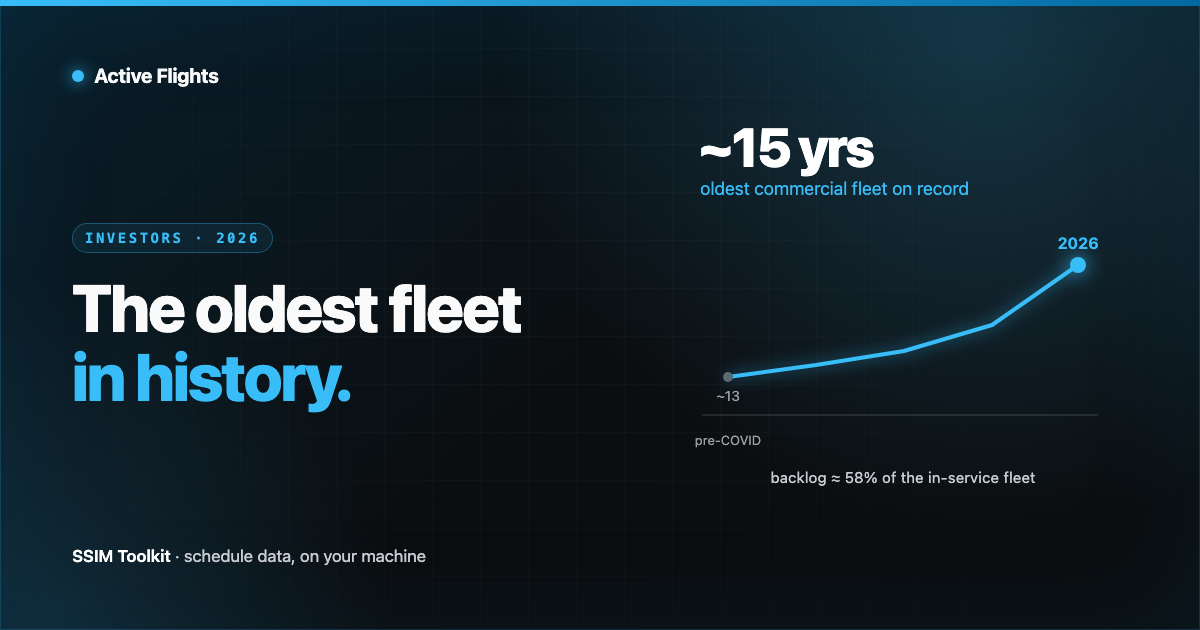
The average age of the global commercial fleet has climbed to about 15 years — the oldest on record, up from roughly 13 before the pandemic, according to industry figures. That isn’t a rounding drift; it’s a structural shift, and the cause is simple arithmetic. The order backlog now exceeds 17,000 aircraft — on the order of 58% of the in-service fleet, against a historical norm nearer 40% — and deliveries keep slipping. Airframes and engines are both scarce. Industry estimates don’t see the shortfall — cumulatively more than 5,000 aircraft — normalising before roughly 2031–2034.
When you can’t take delivery of the new jet, you keep the old one. So retirements that were planned for 2024–2026 have been postponed across the industry, including aircraft well past what used to be their replacement age.
Value moves to the installed base
If you can’t buy your way to growth with new metal, the scarce, valuable asset becomes a flying airplane — and the businesses attached to keeping old ones flying. Two of them are having a conspicuously good 2026.
Maintenance. Carriers are running heavy “C” and “D” checks at record rates — effectively rebuilding airframes for another five-to-seven years of service. Oliver Wyman’s fleet and MRO forecast puts the maintenance market at roughly $104 billion in 2024, about $119 billion in 2025, and on a path toward $156 billion by 2035. Deferred retirement isn’t free; it’s a maintenance bill that someone books as revenue.
Leasing. With airworthy aircraft and engines both short, lease rates and used-aircraft values have firmed up sharply. AerCap, the largest lessor, reported record first-quarter 2026 results, raised full-year adjusted EPS guidance to $14.50, and launched a new $1.0 billion buyback — on $1.5 billion of asset sales in the quarter at a ~24% unlevered gain-on-sale margin (roughly 1.9× book). The used jet you already own is worth more this year than last. That is not what a soft market looks like.
The investor read
The headline order tally at Farnborough measures future capacity that arrives in the 2030s. The money in 2026 is in the present fleet: extending it, maintaining it, leasing it, and — for airlines — squeezing more revenue out of a fixed number of tails. When you can’t add aircraft, ROIC comes from utilisation: flying each airframe more, keeping it available, and turning unavoidable maintenance downtime into the smallest possible disruption to what you sell.
Every one of those levers runs through the schedule. An older fleet flown harder means more maintenance events to route around, more tail swaps, and tighter rotations with less slack to absorb a slip. A single grounded airframe ripples through connections, crew, and downline flights — and the cost of getting that wrong scales with how full and how constrained the network already is. Fleet productivity isn’t decided in the hangar or the boardroom; it’s realised, flight by flight, in the schedule.
That’s the layer we build for. When the asset base is fixed and every tail has to work harder, you want to read, validate, and analyse your schedule from the actual data — locally and deterministically — not guess at it. New aircraft will eventually arrive. The premium on making the ones you have fly efficiently is here now, and it isn’t going away before the decade turns.
Fleet-age, backlog, and shortfall figures are industry estimates and will be revised as deliveries develop. MRO figures are from Oliver Wyman’s published forecast; lessor figures are from AerCap’s reported results.
Sources
- AerCap — Record First-Quarter 2026 Results, Raised Guidance and New $1.0B Buyback
- AerCap — Leased, Purchased and Sold 202 Assets in the Second Quarter 2026
- Oliver Wyman — Global Fleet and MRO Market Forecast 2026–2036
- Aerospace Global News — Airlines fly oldest fleets in history as new aircraft deliveries sag
- eplaneAI — Aircraft Shortage Delays Retirement of Aging Fleets Worldwide
Want early access?
We're opening SSIM Toolkit to teams in waves through 2026 — free during the preview. Drop your email and we'll reach out when it's your turn.
You're on the list. Check your inbox for a confirmation email to finish signing up.
Something went wrong — please try again, or email hello@activeflights.com.