
Most of the attention in an SSIM file goes to the middle — the flight legs, the segment data, the fields you actually query. The last line barely gets read. That’s a mistake. The trailer record is the one line in the file whose entire job is to tell you whether everything above it arrived intact, and skipping it is how a truncated feed becomes a silently wrong schedule.
Where the trailer sits
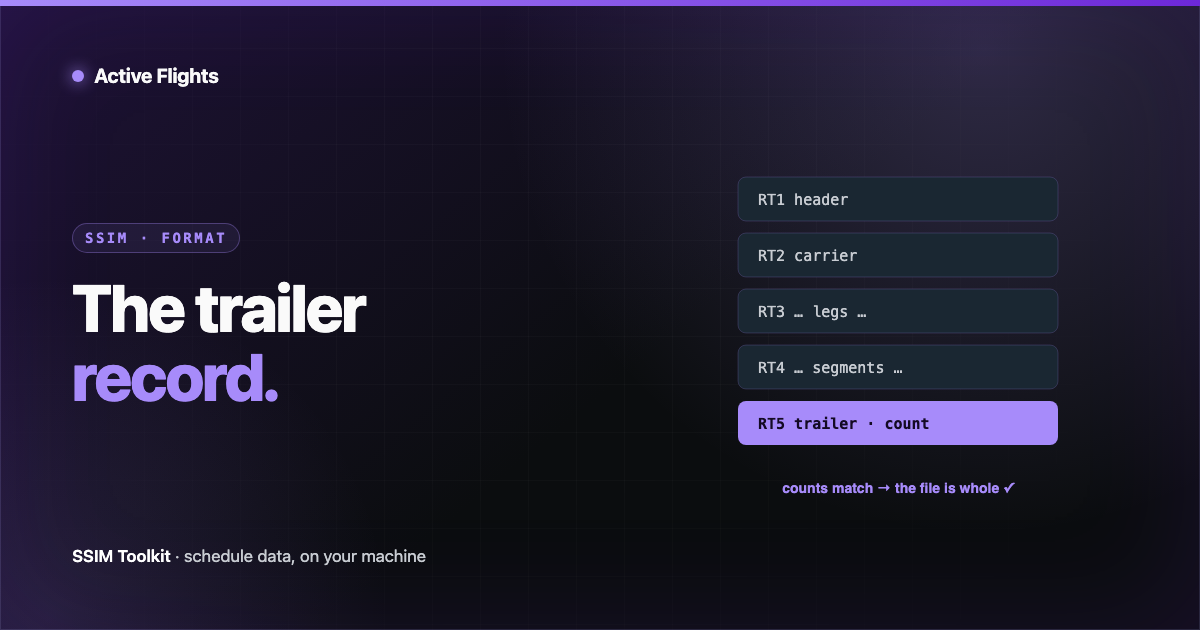
In the SSIM record types there are five, stacked in order: a header, a carrier record, the flight legs, their segment data, and — right at the bottom — the trailer, record type 5. It’s the end marker. When you reach it, the schedule is over; there is nothing meaningful after it.
Read as a story, a small file goes:
1  Header    file title / general header
2  Carrier   QF · northern winter 2026 · time mode = Local
3  Leg       QF0011 · SYD→MEL · daily · 0600/0730 · 738
4  Segment   QF0011 · codeshare · traffic restriction
3  Leg       QF0012 · MEL→SYD · daily · 0815/0945 · 738
5  Trailer   end marker · record counts
The header opens the file and the carrier record names the airline and season. The trailer closes it — and unlike the header, it carries a number you can check your own parse against.
What the trailer actually carries
The trailer is a fixed-width, 200-byte line like every other record in Chapter 7. Two things on it matter for integrity:
- An end-of-file marker. The record-type character and the trailer’s own layout say, unambiguously, this is the last line. If your reader hits end-of-stream without ever seeing a trailer, the file was cut short.
- A record count. The trailer records how many records the file is supposed to contain. That’s the number you compare against what you actually read.
The principle is old and simple: the file states, at the end, how big it should have been, so the receiver can confirm it got all of it. It is a checksum in the plain sense — not a cryptographic hash, but a count that has to reconcile.
The trailer is the file telling you its own length. If your total doesn’t match it, the disagreement is the finding — stop and look.
Why a truncated file is so dangerous
The reason the trailer earns its keep is the nature of the format itself. SSIM has no delimiters and no framing beyond position. A JSON document that gets cut off mid-array fails to parse — the syntax breaks and something complains. A fixed-width flat file that loses its last thousand lines parses perfectly. Every line that did arrive is still a valid 200-byte record. The file just quietly contains less schedule than it should.
That’s the failure mode the trailer catches. A transfer that dropped a chunk, a copy that ran out of disk, a feed that a process wrote only half of — none of them announce themselves. The rows you have look complete and correct. The only signal that something is missing is that the count you tallied doesn’t match the count the trailer declares.
Consider the cost when it slips through. A carrier’s schedule comes up short by a few thousand legs. Every downstream number inherits the gap: capacity looks lighter than it is, a market appears to have lost frequency, a station shows fewer departures than it operates. Nothing errors. The schedule is simply, invisibly, wrong — and you built decisions on it.
Why home-grown parsers skip it
The trailer is the classic thing an in-house SSIM reader leaves for later. It’s easy to see why. The interesting work is the flight legs; the trailer feels like ceremony. A first-pass parser reads records until the input runs out, hands back what it found, and moves on. It works on every file you test it with, because your test files are whole.
The gap only shows up in production, on the one feed that arrived truncated — and by then nobody is looking for it, because the parser never complained. “Read the whole thing and reconcile against the trailer” is cheap to add and expensive to have skipped. It belongs in the same bucket as verifying the time mode before trusting a departure time: unglamorous checks that stand between you and a confidently wrong answer.
Integrity is more than the count
Reconciling against the trailer is the headline check, but it sits inside a broader habit of not trusting a file until it has proved itself:
- The file starts with a header and ends with a trailer. A file missing either is malformed, whatever the middle looks like.
- The record counts reconcile. What you parsed equals what the trailer says you should have.
- The records are all the right width. In a 200-byte format, a line that isn’t 200 bytes is a symptom — a mangled transfer, a stray newline, an encoding slip.
Individually these are small. Together they’re the difference between “I parsed a file” and “I parsed this file, completely, and it’s the one that was sent.”
Where SSIM Toolkit fits
This is exactly the kind of check that’s easy to describe and easy to leave out, so we built it in. SSIM Toolkit reads the whole file and validates against the trailer — confirming the record counts reconcile and the file is structurally whole before it lets you explore, analyse, or export anything. If a feed arrived truncated, you hear about it up front, not three dashboards later. It runs locally, on your machine, on real airline-sized files.
The trailer isn’t ceremony. It’s the file’s own promise about how complete it is — and the one line you shouldn’t skip.
For the wider tour, start with what SSIM is and the record types read end to end; more on the Toolkit at /product/ssim-toolkit.
Want early access?
We're opening SSIM Toolkit to teams in waves through 2026 — free during the preview. Drop your email and we'll reach out when it's your turn.
You're on the list. Check your inbox for a confirmation email to finish signing up.
Something went wrong — please try again, or email hello@activeflights.com.