
You’ve queued at the gate. You shuffle down the jet bridge. Then you stop. And wait. And wait some more, wedged in the aisle behind a stranger heaving a bag into an overhead bin while an entire planeload of people stands frozen behind them.
Boarding is one of the most quietly frustrating parts of flying — and here’s the kicker: the way most airlines do it is close to the slowest possible method. Meanwhile, mathematicians and physicists have known a faster way for years. So what’s going on?
The bottleneck isn’t the door — it’s the aisle
It’s tempting to blame the narrow boarding door, but the real chokepoint is the single-file aisle. Only one person can move down it at a time, and every time someone stops to load a bag or squeeze past a seated neighbour, everyone behind them halts too.
These stalls are called interferences, and there are two main kinds:
- Aisle interference — you’re stuck behind someone stowing luggage.
- Seat interference — you reach your row, but someone in an aisle or middle seat has to get up and step out so you can reach the window.
A good boarding method isn’t about getting people through the door quickly. It’s about spreading people out so they don’t get in each other’s way once they’re inside.
Why “back-to-front” backfires
Loading the plane from the rear rows forward feels obviously efficient. It’s how many airlines board, in groups. But it’s a trap.
When you call the back rows first, you cram everyone assigned to that section into the same short stretch of aisle at the same time. They all try to load bags and shuffle into seats simultaneously — maximum interference, everyone bunched together. Then that whole crowd clears, the next block boards, and it bunches up all over again (Scientific American).
The methods, ranked
A few smarter approaches spread passengers out instead of clumping them:
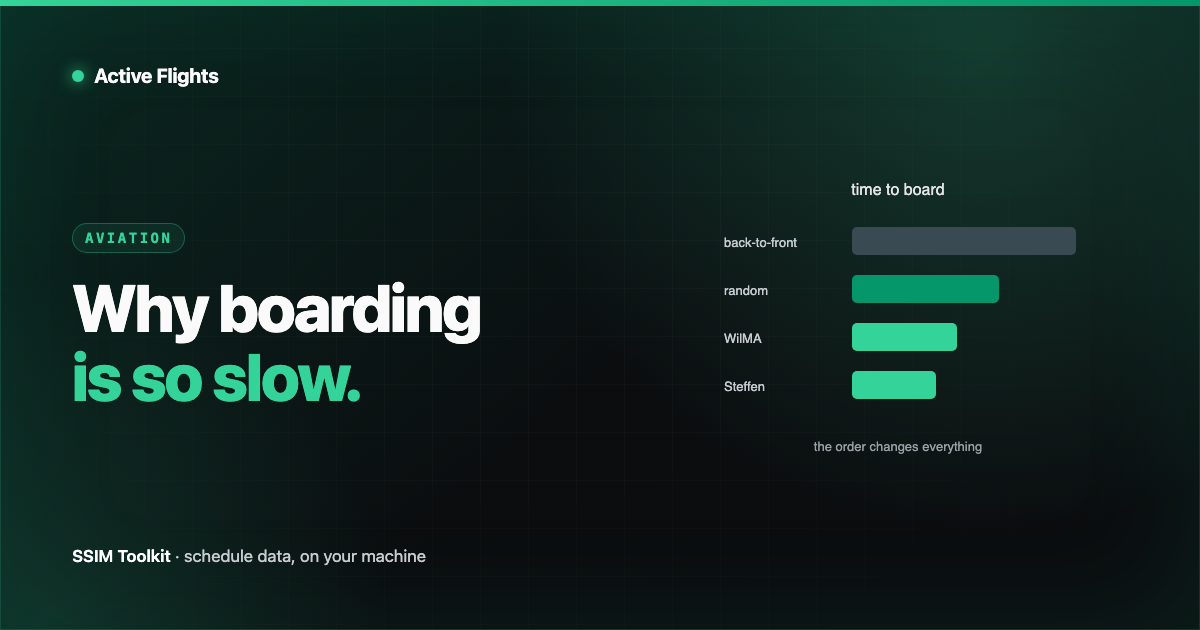
- WilMA (Window–Middle–Aisle) — board all window seats first, then all middles, then all aisles. This kills seat interference: nobody has to stand up to let a window passenger in, because the window seats fill first.
- Random — no assigned order at all; people board whenever. Counterintuitively, this beats back-to-front, because it naturally scatters passengers along the aisle.
- The Steffen Method — the theoretical champion, devised by astrophysicist Jason Steffen in 2008. Passengers board in a precise sequence: window seats in every other row on one side, then the alternating rows, working through middles and aisles the same way. The trick is that adjacent boarders are two rows apart, so several people can load their bags at the same time without blocking each other (Wikipedia: Steffen Boarding Method).
In Steffen’s published research, his optimized method was about twice as fast as back-to-front and roughly 20–30% faster than random boarding (Wikipedia: Steffen Boarding Method).
The TV test that proved it
This isn’t just chalkboard theory. In 2014, the show MythBusters built a realistic 173-seat cabin with working overhead bins and timed real people using different methods. The results lined up with the math (MythBusters Results; Simple Flying):
| Method | Time (approx.) | Passenger happiness |
|---|---|---|
| Back-to-front (blocks) | 24 min 29 s | Moderate |
| WilMA (window–middle–aisle) | 14 min 55 s | Good |
| Random (no assigned seat) | 14 min 07 s | Lowest |
Back-to-front took over ten minutes longer than the alternatives on the same mock aircraft. Random was quickest of the three tested — but testers found the free-for-all the least pleasant experience.
So why don’t airlines just do it?
If the fast methods are known, why is boarding still miserable? Because an airline isn’t optimizing for boarding speed alone — it’s juggling several things at once:
- Money beats minutes for the airline’s revenue. Priority boarding is something airlines sell. First class, frequent flyers and passengers who pay for early boarding get called first — an order that’s about loyalty and revenue, not fluid dynamics.
- Families and groups want to sit together and board together, which breaks any strict seat-by-seat sequence. Steffen himself designed a gentler modified version to keep travel companions closer together — but it gives back much of the speed (Wikipedia: Steffen Boarding Method).
- Carry-on bags are the real villain. More bags in the cabin means more aisle stalls, no matter the method. Bag fees that push travellers to carry on instead of check in can quietly make boarding worse.
Why the airline cares about the clock at all
Here’s the business reason those minutes matter. A parked plane earns nothing — it only makes money in the air. Every minute a jet sits at the gate has a real cost, often estimated at around $100 per minute of delay, and shaving even a few minutes off each turnaround can let an airline squeeze an extra flight out of an aircraft’s day (Simple Flying).
That’s why low-cost carriers obsess over the “turn.” Ryanair, for instance, targets turnarounds of roughly 25 minutes, while many traditional carriers take closer to an hour (Simple Flying). Boarding is a big slice of that clock — which is exactly why a faster method is worth real money.
So the next time you’re frozen in the aisle, take some comfort: the delay isn’t a mystery. It’s a solvable puzzle where the maths, the money and the family behind you don’t quite agree on the answer.
From the team behind SSIM Toolkit — the local workbench for airline schedule data.
Sources
Want early access?
We're opening SSIM Toolkit to teams in waves through 2026 — free during the preview. Drop your email and we'll reach out when it's your turn.
You're on the list. Check your inbox for a confirmation email to finish signing up.
Something went wrong — please try again, or email hello@activeflights.com.