
An SSIM file can be flawless — every one of its 200-byte lines conformant, every record type in order, every leg internally consistent — and the operation it describes can still fall apart on a Friday afternoon in July. The reason is a constraint that appears nowhere in the file: the sky above Europe, and the number of people cleared to manage it.
Europe’s 2026 summer is a clean illustration. The schedule was the easy part. The air traffic control system underneath it is where the plan met reality.
Record traffic, finite airspace
Traffic came back hard. Per EUROCONTROL, Friday traffic peaks are running over 37,500 flights across the network — and were expected to surpass the 2019 network record of 37,228 flights in a day. That’s not recovery to a previous normal; it’s a new ceiling being tested week after week.
The airspace and the workforce managing it did not scale at the same rate. The result is delay — not from bad schedules, but from more demand than the system can smoothly clear.
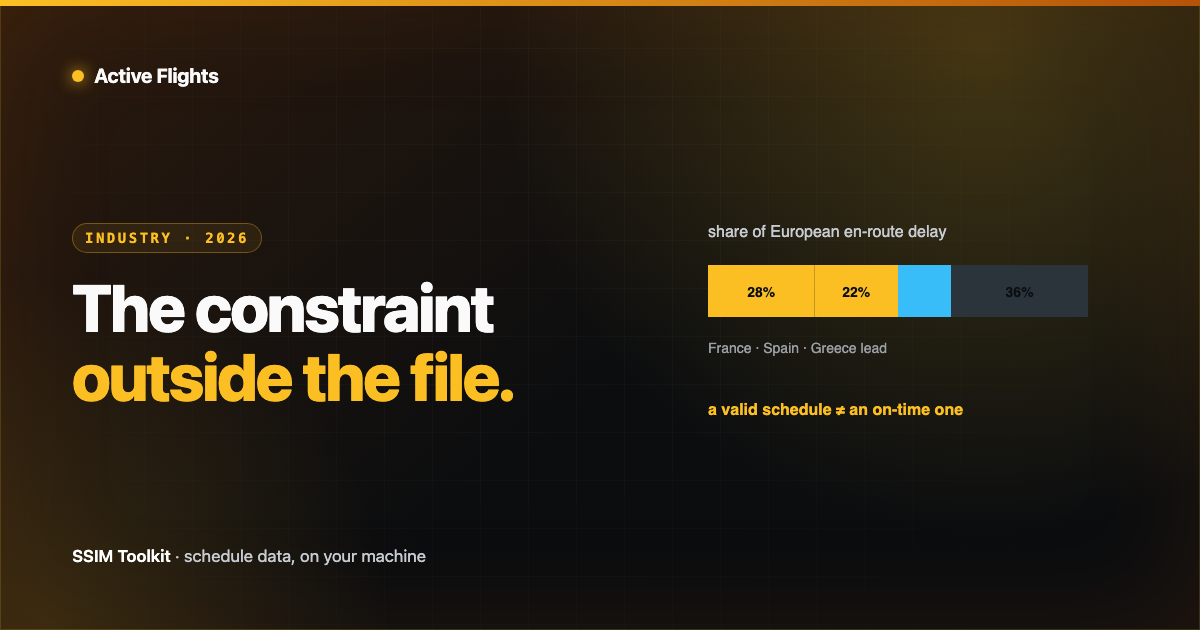
| Europe summer 2026 (en-route delay) | Share |
|---|---|
| France | ~28% |
| Spain | ~22% |
| Greece | ~14% |
Three states account for roughly two-thirds of en-route delay between them. And the leading structural drivers, as EUROCONTROL frames them, are staffing and capacity — not weather, not one-off events. When controller availability and sector capacity are the binding constraint, delay is a property of the system, not of any individual airline’s plan.
A schedule doesn’t fail validation because a sector will be saturated at 1700 on a Friday. Nothing in the file knows that.
Why the file can’t see it
This is the important idea, and it’s worth stating plainly. The SSIM standard describes intent: which flights an airline means to operate, on which days, between which airports, at which local times. It is deliberately silent on whether the airspace those flights pass through will have the capacity to accept them on the day.
SSIM carries no route-of-flight, no sector loading, no controller rosters. It carries no distances at all, and it expresses times as local values with a UTC-variation field. It is a description of a schedule, not a simulation of an operation. So a file can be perfectly valid and still describe a Friday that the network cannot absorb — and the file will tell you nothing, because that constraint lives entirely outside it.
That’s not a flaw in SSIM. It’s the boundary of what a schedule format is for. The trouble starts when teams treat “the file validates” as “the operation is feasible.” Those are different claims, and 2026 keeps proving it.
Half the story, done right
If operational feasibility lives outside the file, what’s the point of getting the file exactly right? Because the file-half is the half you can make clean and certain — and a team that argues from clean schedule data is in a far stronger position when the network constraint bites.
Consider what a controller-staffing delay season actually demands of a schedule team:
- Re-timing to dodge the worst sectors. Shifting departures out of a saturated bank is a schedule change — a new file to validate and re-analyse.
- Protecting rotations. When en-route delay eats into turn times, the rotation that looked fine on paper starts breaking, and connections that were comfortable get tight.
- Defending the plan. When a coordinator, a regulator, or an ops partner asks whether your schedule is the problem, you want to answer from data you trust — not from a spreadsheet nobody’s sure is current.
In each case the file-half being clean, validated, and analysable is what lets you focus your attention on the constraint you can’t control. If you’re still unsure whether the schedule itself is sound, you can’t have a credible conversation about the airspace.
Where SSIM Toolkit fits
SSIM Toolkit doesn’t model airspace or predict ATC delay — no schedule tool honestly can, and we won’t claim otherwise. What it does is make the file-half unimpeachable, locally and deterministically.
Open a European summer schedule and validate it against the SSIM standard so you know the encoding is sound. Analyse it the way the delay season forces you to think: capacity and frequency per market, the departure and arrival banks at each hub, seasonality, and MCT analysis to see which connections have gone tight as turn times erode. Run deconfliction to catch overlapping or impossible flights before they compound a bad day. Inspect a single leg down to the byte when a timing looks wrong, and export any view to CSV, JSON, or Parquet to hand to whoever owns the operational picture downstream.
The engine is deterministic — the same file yields the same answer every time — so a schedule you signed off on Monday means exactly the same thing when the network melts on Friday. And it all runs on your machine: your schedule data never leaves it, with the app touching the network only for things like licensing and updates.
If you want to drive that analysis with your own AI assistant, the Toolkit ships a read-only, on-device MCP server — AI on the outside, determinism on the inside. The assistant can ask questions of the schedule; it never computes the numbers, and the data stays local.
The takeaway
Europe’s 2026 ATC summer is a reminder that a schedule lives in two worlds. One is the file — finite, checkable, and fully within your control. The other is the operation — airspace, staffing, and capacity — which is not. You cannot fix the second from a schedule tool. But you can make the first so clean that when the second goes wrong, you’re arguing from data you trust rather than data you’re guessing at. Owning that file-half, correctly and locally, is what SSIM Toolkit is for.
Traffic and en-route delay figures are drawn from EUROCONTROL’s 2026 network reporting and IATA analysis cited below; weekly network data is revised.
Sources
Want early access?
We're opening SSIM Toolkit to teams in waves through 2026 — free during the preview. Drop your email and we'll reach out when it's your turn.
You're on the list. Check your inbox for a confirmation email to finish signing up.
Something went wrong — please try again, or email hello@activeflights.com.