
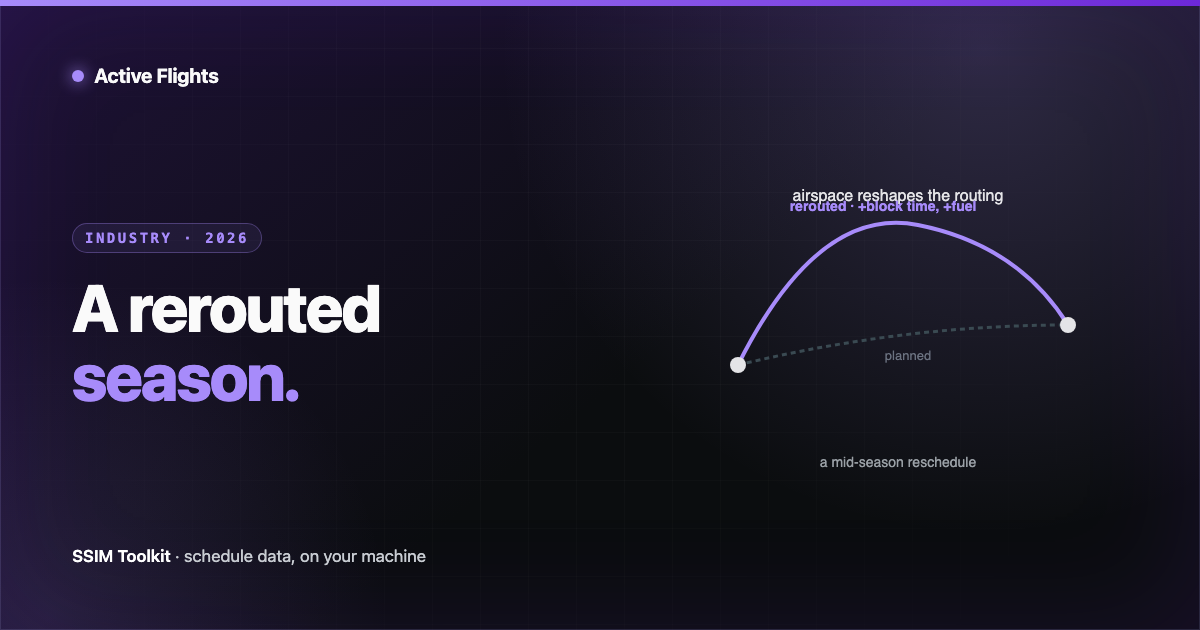
A schedule looks like a fixed thing — a season, published, in the systems. It isn’t. It’s a set of promises about aircraft, times, and city pairs that hold only as long as the world underneath them does. When airspace closes, those promises break in a very specific, very mechanical way, and the schedule has to be rewritten while the season is already flying.
The demand signal, and what it hides
The headline from IATA’s May 2026 figures is a soft one: total air passenger demand fell 2.2% year-on-year. But the more revealing number is what happens when you take one region out. Excluding the Middle East, demand grew 0.7% — and the load factor still set a record for May at 83.5%. IATA attributes the weakness to geopolitical disruption in the Middle East from March onward, which particularly affected international traffic routed through the region.
That gap between “demand fell” and “demand grew almost everywhere else” is the whole story. The problem wasn’t that people stopped wanting to fly. It’s that a chunk of airspace became harder — or impossible — to fly through, and everything that used to cross it had to be re-planned.
A demand statistic is the visible surface. Underneath it is thousands of individual flights that got longer, moved, or disappeared — each of which is a schedule change somebody had to make and somebody downstream had to read.
What a reroute actually does to a flight
When a routing that used to cross a region has to go around it, the change isn’t a line on a map. It propagates through the schedule record by record.
- Block time grows. A longer routing means more minutes in the air. In SSIM the flight-leg record carries a departure and an arrival time — both local, read against the carrier record’s time mode and a per-leg UTC-variation field. Push the arrival later and you may cross a day boundary; get the time-zone and day-change handling wrong and the leg reads as arriving on the wrong date.
- Rotations stop closing. Extra block time eats the turn at the far end. An aircraft that used to make its next leg comfortably no longer does, so the whole rotation has to be re-threaded — sometimes with an extra tail, sometimes by dropping a frequency.
- Payload and range bite. A longer sector can push an aircraft past a comfortable payload-range point, so a route that was a nonstop becomes a one-stop, or moves to a different aircraft type — a new equipment code on the leg, and often new segment-data records behind it.
- City pairs change. Some markets get suspended outright; others get added as aircraft are redeployed to where they can still fly efficiently. The network map for the season is not the one that was published.
None of these happens once. A disrupted region forces a rolling series of schedule revisions as the situation and the overflight permissions shift.
Mid-season change is a messaging problem
An airline doesn’t republish an entire season every time a routing changes. It sends incremental changes — the SSM and ASM messages that adjust, add, or cancel specific flights on top of the schedule already in the systems. During a reroute event those messages come thick and fast, and each one only makes sense against the current state of the schedule.
That’s the operationally awkward part. The reissued schedule isn’t a clean new file you read once — it’s the old file plus a stream of changes, and to understand what actually changed you have to hold the whole picture: which legs got longer, which rotations broke, which markets moved. Read a change against the wrong baseline and the schedule looks consistent while being wrong.
Reading the reissued schedule
When a season gets rerouted, the immediate practical job is unglamorous: take the current schedule feed and understand it correctly, fast, while it’s still moving.
That’s where SSIM Toolkit fits. It opens the real schedule file locally, in seconds, so you can explore the rerouted season — flights, routes, rotations, the calendar — and analyse what the disruption did to it: capacity and frequency per market, the seasonality curve, how the hub and network structure shifted as lift was pulled out of one region and pushed into others. Because SSIM carries no distances, the Toolkit derives block time from the schedule’s own times and UTC variation, so a stretched leg reads honestly rather than as a data error.
Two things matter especially in a reroute:
- Correct time and day handling, so a leg that now arrives after midnight lands on the right date rather than silently shifting the whole downstream chain.
- Deconfliction, so a re-threaded rotation that accidentally double-books an aircraft — easy to introduce when you’re re-planning under time pressure — surfaces before it reaches operations.
And it does all of this on your own machine: your schedule data never leaves it. For a network being reshaped by events outside anyone’s control, that combination — local, fast, faithful to the awkward real-world conventions — is what lets a team keep reading the schedule as quickly as it’s being rewritten.
Geopolitics will keep moving airspace, and airspace will keep moving schedules. The demand numbers are the echo; the reroute is the event. The teams that absorb it best are the ones that can read each reissued schedule and trust what it says.
More on the local, deterministic approach is on the SSIM Toolkit product page.
Source
Want early access?
We're opening SSIM Toolkit to teams in waves through 2026 — free during the preview. Drop your email and we'll reach out when it's your turn.
You're on the list. Check your inbox for a confirmation email to finish signing up.
Something went wrong — please try again, or email hello@activeflights.com.