


How Airlines Decide Which Routes to Fly
How airlines decide which routes to fly: demand, rivals, the right aircraft, airport slots, hub connections, seasons, and whether the route makes money.
The 80/20 slot rule: fly a slot series 80% of the time or lose it. Where it applies, what COVID changed, ghost flights, and where the rule stands now.
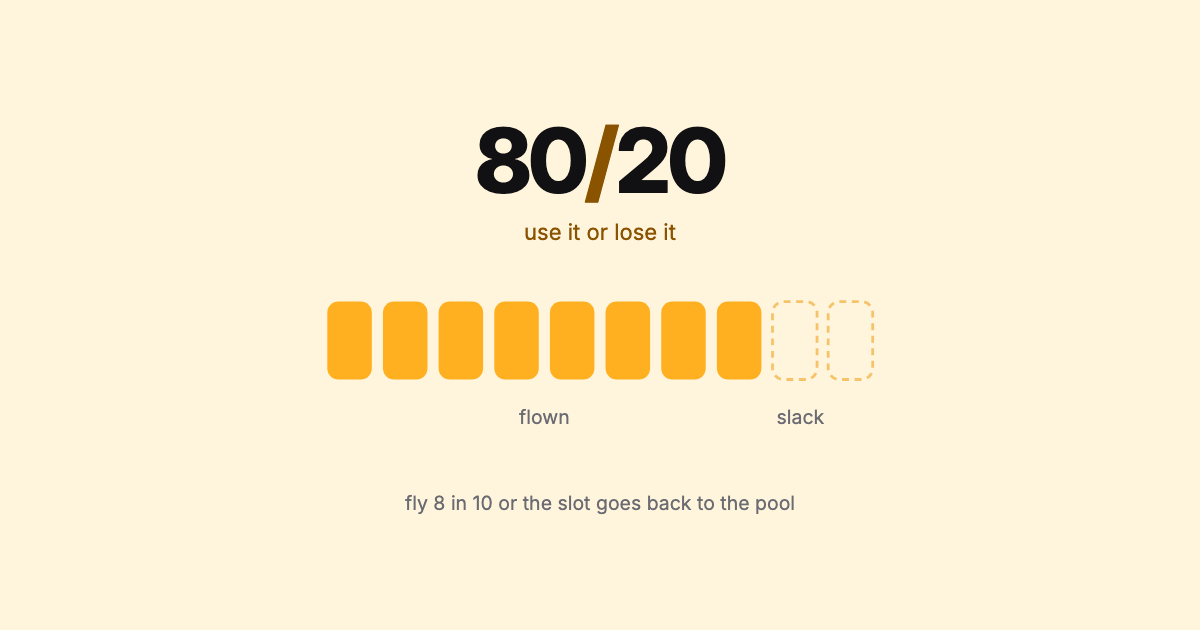
The 80/20 rule, often called “use it or lose it,” says that an airline must operate a series of airport slots at least 80% of the time to keep them for the same season the following year. Fall below that line and the slots can go back into a pool for other airlines. It applies at busy, slot-coordinated airports, where take-off and landing times are rationed.
In the winter of 2021–22, the rule made headlines for an odd reason. Lufthansa said it faced 18,000 extra flights across its Lufthansa and Brussels Airlines brands that winter season, flown only to keep its slot rights. Critics had a name for flights flown to protect slots rather than carry people: ghost flights. (Fortune)
So why would a rule push airlines to fly near-empty planes? And is it still in force? Here’s the short version.
At a slot-coordinated airport, an airline doesn’t own its take-off and landing times. It is allocated them, season by season, as a series: a run of slots at the same time, repeated through the season. (If slots are new to you, start with our plain guide to airport slots and the schedule.)
The reward for using a series is historic precedence, sometimes called “grandfather rights”: a claim to the same series in the next equivalent season, summer to summer or winter to winter. Switzerland’s slot coordinator summarises the condition: “at least 80% of the slots were operated by the airline as cleared by the coordinator.” (Slot Coordination Switzerland)
The “20” is the slack. It’s room for the cancellations any airline has.
A few dates and definitions do most of the work. Under the Worldwide Airport Slot Guidelines (WASG), as summarised by Switzerland’s coordinator:
(Slot Coordination Switzerland)
The incentive is clear: give back what you won’t use early, so someone else can have it, and fly what you keep.
At slot-coordinated (Level 3) airports around the world, following the WASG; we mapped how many there are in the 2026 slot picture. In the European Union, the rule sits in the EU Slot Regulation (Regulation 95/93): in the European Commission’s words, “airlines must use 80% of their allocated slots or risk losing them in the following years.” (European Commission)
The US has its own version: the FAA sets a minimum slot-usage requirement at New York JFK, LaGuardia and Washington Reagan National, and describes “the 20 percent non-utilization allowed under the minimum usage requirement.” (FAA, via Federal Register)
When the pandemic emptied the skies, keeping an 80% rule would have meant flying empty planes on a vast scale. So regulators relaxed it, then brought it back in stages. In the EU:
“Ghost flights” are flights operated mostly or entirely to protect slots, not because passengers need them. The Lufthansa row in early 2022 showed how contested the idea is. The airline blamed the European Commission for the 18,000 flights; Commission officials told Fortune that demand wasn’t the problem and suggested ghost flights were a “scapegoat.” Ryanair’s Michael O’Leary went further: “Lufthansa loves crying crocodile tears about the environment when doing everything possible to protect its slots.” (Fortune)
That argument is the rule’s central tension in miniature. Set the bar too high in a crisis and airlines fly planes nobody needs. Set it too low and scarce slots sit idle while other airlines wait for them.
In the EU, yes. The 2022 legislation set the standard 80% requirement to apply again from the summer 2023 season, and the European Commission describes the 80% rule as the rule today. (Aviation Week, European Commission)
In New York, there’s still relief, for a different reason. The FAA has extended a limited waiver at JFK and LaGuardia (and for Reagan National flights to or from them) through 30 October 2027, because the New York air traffic control facility that handles those airports is short of controllers: 129 certified controllers against a target of 226, or 57% staffed. Carriers can return up to 10% of their slots at JFK and at LaGuardia. The FAA also said it does not anticipate further broad relief beyond summer 2027. (FAA, via Federal Register)
Both sides have a case, and you can hear it in how the industry argued in 2022. As the EU set its winter 2022/23 level, IATA pushed for a lower 70/30 rule, warning that anything higher than 70% could mean operating flights demand may not justify. Airports’ body ACI World wanted the 80/20 rule back in full. (Aviation Week)
The FAA put the defenders’ view in one line: access to New York’s airspace “is a scarce and valuable public asset,” and airlines and airports should be making the most appropriate use of it. (FAA, via Federal Register)
Whether a series clears 80% comes down to plain arithmetic over the schedule: which flights were planned on that slot, which operated, and which were cancelled in time. That’s why the slot book and the schedule have to agree. Holding the schedule side of that picture, flight by flight and season by season, is what SSIM Toolkit does, locally on your machine.
Sources
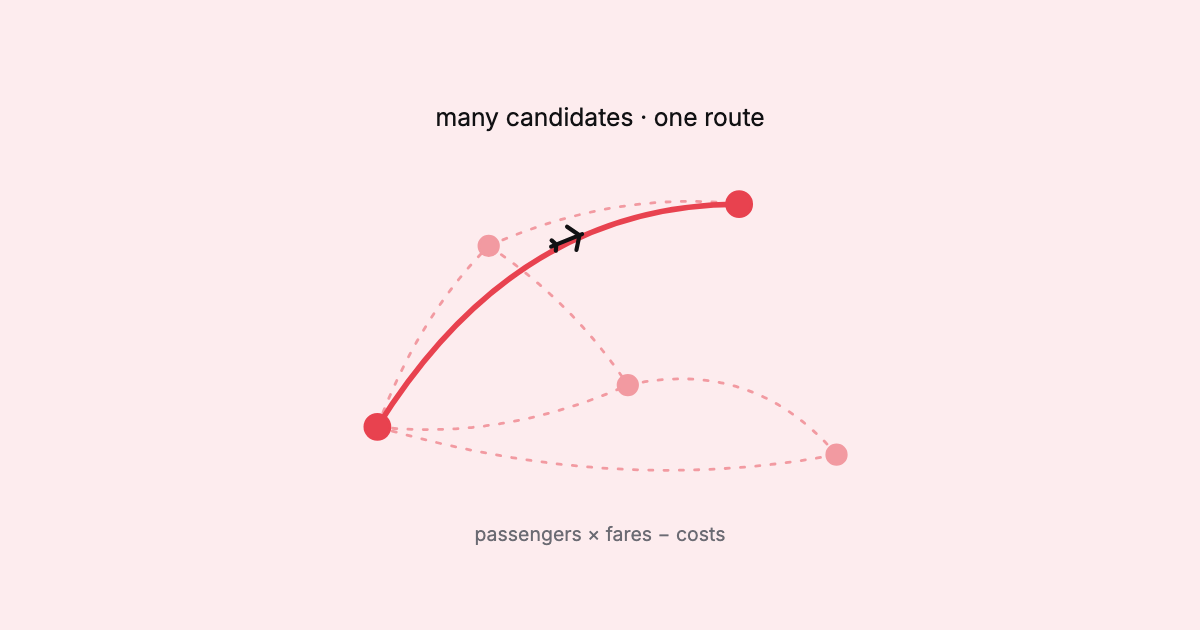
How airlines decide which routes to fly: demand, rivals, the right aircraft, airport slots, hub connections, seasons, and whether the route makes money.
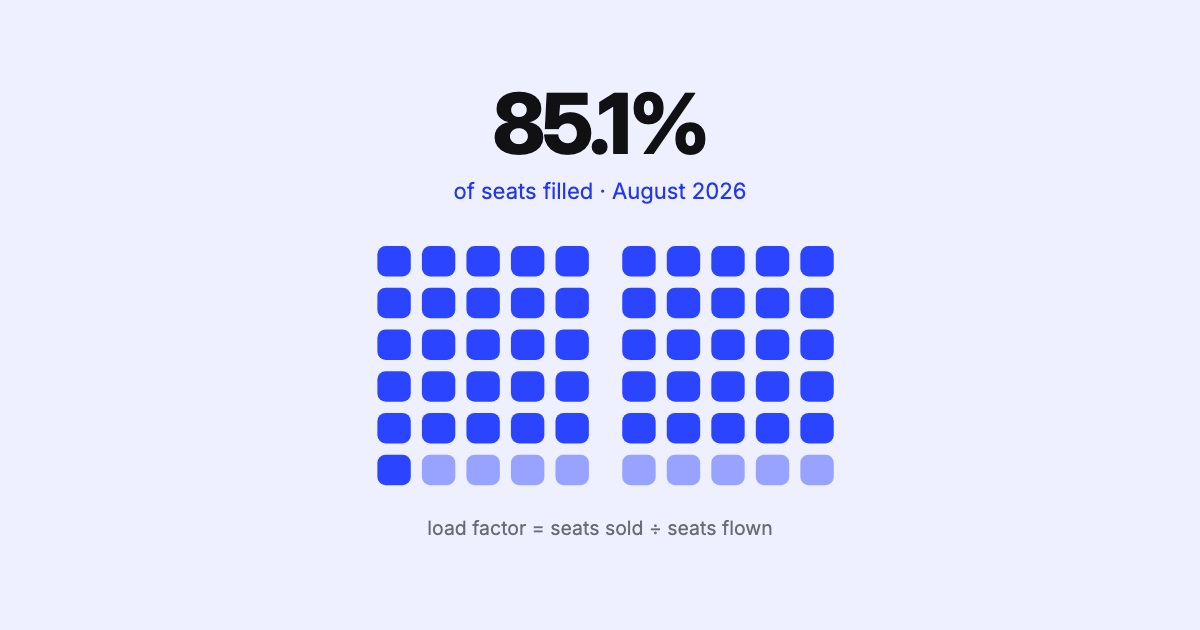
Airline load factor is the share of seats an airline fills. How it's calculated, why it hit a record 83.6% in 2025, and what a full plane doesn't tell you.
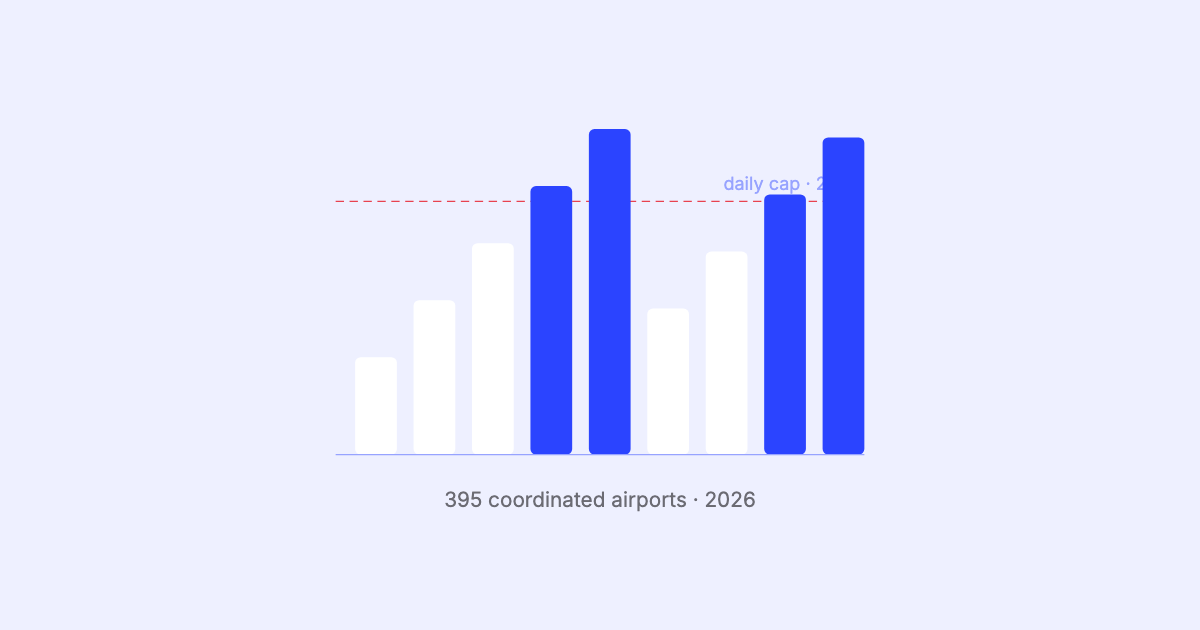
Nearly 400 airports worldwide restrict who can operate and when in 2026, and around 43% of global departures leave a slot-coordinated field. Here's the 2026 landscape — and why a published schedule and its slot holdings have to agree.