
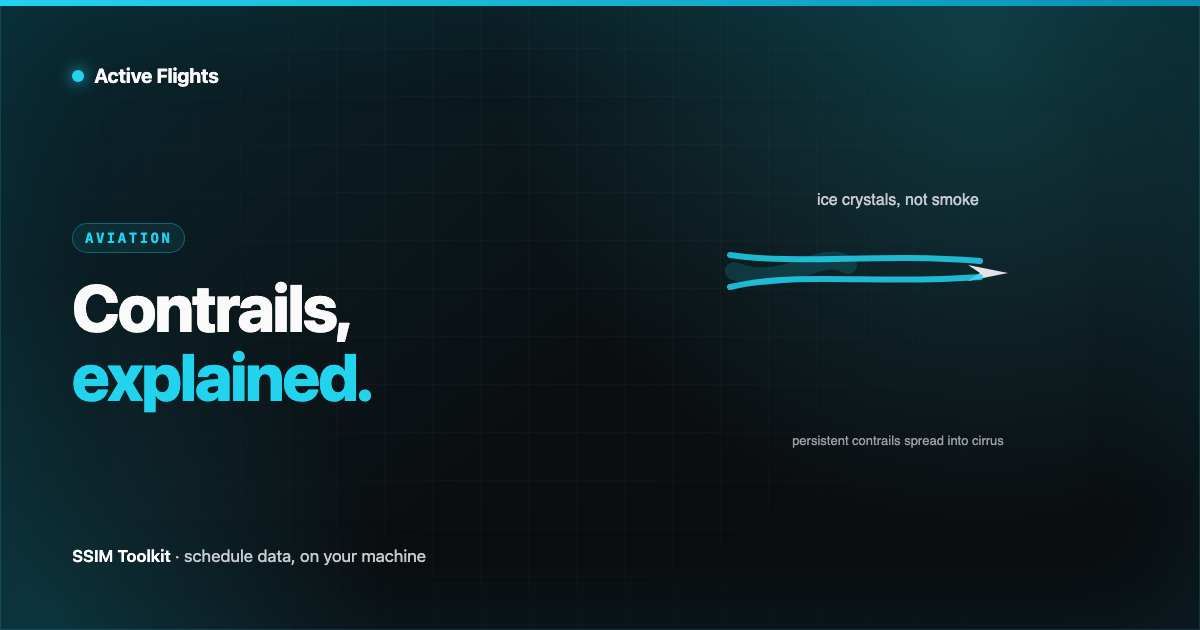
Look up on a clear day near a busy flight corridor and you’ll often see them: long white lines trailing behind high-flying jets. Some vanish in seconds. Others linger, fatten, and smear across the sky into a thin haze. Those lingering ones are quietly one of the more surprising stories in climate science — because line for line, they may warm the planet about as much as all the carbon dioxide aircraft have ever emitted.
Here’s what a contrail actually is, and why atmospheric scientists have spent the last decade taking them seriously.
What a contrail actually is
“Contrail” is short for condensation trail. It has nothing to do with chemicals and everything to do with plumbing physics you already know: warm, wet air meeting cold air.
A jet engine burns kerosene, and one by-product of that combustion is water vapour. When that hot, humid exhaust hits the air at cruising altitude — typically 8 to 12 kilometres up, where temperatures sit around −40°C or colder — the vapour condenses onto tiny soot particles and freezes almost instantly into ice crystals. That ribbon of ice crystals is the contrail. It’s the same reason you can “see your breath” on a freezing morning, just at 900 km/h.
Whether that trail disappears or sticks around depends on how much moisture is already in the surrounding air:
- Dry air: the ice crystals sublimate (turn straight back to vapour) within seconds. Short-lived, harmless, forgotten.
- Ice-supersaturated air: if the surrounding air is already saturated with respect to ice, the crystals don’t evaporate. They persist, drift, and spread — sometimes for hours, sometimes stretching tens of kilometres wide. These are persistent contrails, and over time they blur into what scientists call contrail cirrus — artificial, aviation-made cirrus clouds.
Why a cloud can warm the Earth
Clouds do two competing things to the planet’s energy budget. They reflect incoming sunlight back to space (cooling), and they trap outgoing heat radiating up from the surface (warming). For thin, high, icy contrail cirrus — especially at night, when there’s no sunlight to reflect — the trapping effect wins. The net result is warming.
The key measure scientists use is effective radiative forcing (ERF): essentially, how much a factor pushes Earth’s energy balance toward warming or cooling, measured in watts per square metre. The larger and more positive the number, the more warming.
In the most-cited assessment of aviation’s total climate impact, Lee et al. (2021) estimated that contrail cirrus is the single largest non-CO2 contributor to aviation warming — with a best-estimate ERF around 57 mW/m², compared with roughly 34 mW/m² from aviation’s accumulated CO2. In other words, the white lines may edge out the carbon.
Add up everything, and aviation accounts for an estimated 3.5% of all human-caused effective radiative forcing, with roughly two-thirds of that coming from non-CO2 effects — contrails chief among them, alongside nitrogen-oxide chemistry. The IPCC’s Sixth Assessment Report likewise lists contrail cirrus as a distinct, warming aviation forcer.
Two honest caveats keep this in perspective. First, contrail warming is short-lived — the clouds dissipate in hours, whereas a molecule of CO2 keeps warming for centuries, so the two aren’t perfectly interchangeable. Second, the uncertainty band on contrails is wide; the science is genuinely still tightening. But the direction is not in doubt: persistent contrails warm, and there are a lot of flights.
The twist: it’s a small share of flights
Here’s the detail that makes contrails such an appealing problem to solve. Persistent, warming contrails don’t form on most flights — they only form where a plane happens to fly through a patch of cold, ice-supersaturated air. Studies suggest a minority of flights create the large majority of contrail warming. Nudge just those flights up or down a few thousand feet to skirt the humid layer, and you erase the contrail without erasing the flight.
That’s exactly what a 2023 trial by Google Research, Breakthrough Energy and American Airlines set out to test. Pilots flew 70 flights using AI-generated forecast maps of where contrail-forming air lay ahead, tweaking altitudes to avoid it. The result: a 54% reduction in the contrails those flights created, at a total fuel penalty of about 0.3% — a rounding error on a fuel bill.
That trade-off is the whole reason contrail avoidance is one of the most-discussed near-term climate levers in aviation: it’s cheap, it’s software-driven, and it doesn’t require a single new aircraft. The forecasting still has to get more accurate before airlines reroute at scale — a wrong prediction burns extra fuel for nothing — but the proof of concept is on the table.
Why it matters
Contrail radiative forcing could triple by 2050 on current air-traffic trends, according to modelling published in Nature Communications. That makes the white lines one of the few climate impacts that is both large and, in principle, fixable this decade — no new fuel, no new fleet, just smarter flight planning.
So the next time you see a jet stitching a slow white seam across the sky, you’re not looking at pollution in the usual sense. You’re looking at ice — and at one of the more solvable problems in the business of flying.
From the team behind SSIM Toolkit — the local workbench for airline schedule data.
Sources
- Lee et al., The contribution of global aviation to anthropogenic climate forcing for 2000 to 2018, Atmospheric Environment (2021)
- Bock & Burkhardt, Contrail cirrus radiative forcing for future air traffic, Nature Communications / Atmospheric Chemistry and Physics (2019)
- Understanding the role of contrails and contrail cirrus in climate change, Atmospheric Chemistry and Physics (2024)
- IPCC Sixth Assessment Report, Working Group I (2021)
- Google Research: AI is helping airlines mitigate the climate impact of contrails (2023)
- American Airlines: first-of-its-kind research on contrail avoidance (2023)
Want early access?
We're opening SSIM Toolkit to teams in waves through 2026 — free during the preview. Drop your email and we'll reach out when it's your turn.
You're on the list. Check your inbox for a confirmation email to finish signing up.
Something went wrong — please try again, or email hello@activeflights.com.