
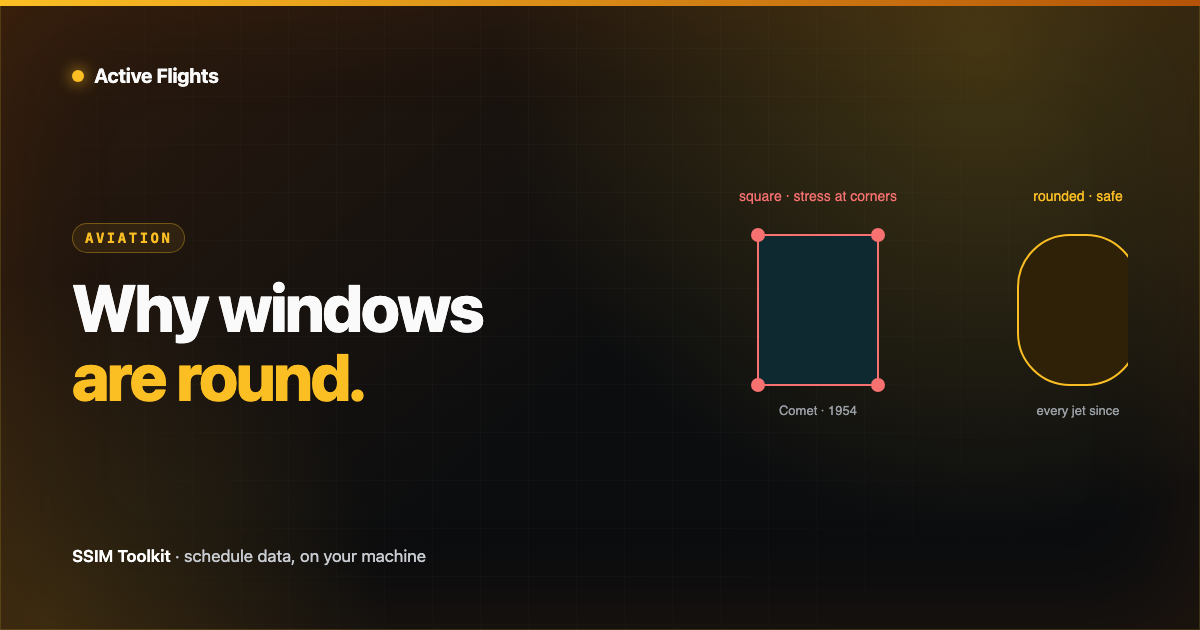
Look out the next time you fly and you’ll notice something you’ve probably never questioned: the window is a rounded rectangle. Never a square. Never a sharp corner anywhere in the cabin.
That shape isn’t a styling choice. It’s the direct result of one of aviation’s most important — and most costly — engineering lessons, learned when the world’s first jet airliner started falling out of the sky.
Britain’s beautiful, doomed pioneer
In 1952, Britain leapt ahead of the entire world. The de Havilland Comet entered service with BOAC as the first commercial jet airliner, and it was a marvel: it flew roughly twice as high and twice as fast as the propeller planes of the day, in a cabin so smooth and quiet it felt like the future had arrived early (Wikipedia: de Havilland Comet).
Passengers loved it. For a brief moment, Britain owned the jet age.
Then, in the first months of 1954, two Comets tore themselves apart in mid-air.
- 10 January 1954 — BOAC Flight 781 broke up while climbing near the Italian island of Elba. All 35 on board died.
- 8 April 1954 — South African Airways Flight 201 broke apart in similar circumstances. All 21 on board died (This Day in Aviation).
Two near-identical, catastrophic failures in three months. The Comet fleet was grounded, and Britain launched one of the most thorough accident investigations ever attempted.
The “water torture” test
Investigators suspected the fuselage itself was failing, but they needed proof. So they did something clever. They took a complete Comet airframe, sealed it inside a giant water tank, and used water pressure to simulate the stress of pressurising and depressurising the cabin — over and over, cycle after cycle, as if the plane were flying flight after flight (FAA Lessons Learned).
Water was used instead of air for a grim, practical reason: if the fuselage burst under air pressure it would explode violently, but water — being nearly incompressible — would simply let go without destroying the evidence.
Eventually, the fuselage split open in the tank. The equivalent of roughly 3,000 pressurisation cycles had cracked it apart (Wikipedia: de Havilland Comet). The investigators had found their killer, and it hid in plain sight.
The tyranny of the sharp corner
Every time a jet climbs, the cabin is pressurised so passengers can breathe; every time it descends, that pressure is released. The metal skin swells slightly and relaxes with each flight — thousands of tiny stretches over an aircraft’s life. This slow, repeated flexing is called metal fatigue, and it can crack metal that would never fail under a single load.
The trouble is where it cracks. When stress flows through a panel and hits a sharp corner — like the corner of a squared-off window or cutout — it doesn’t spread out evenly. It bunches up, concentrating at that point far more intensely than the designers expected. Engineers call this a stress concentration, and a sharp corner is the worst possible place for one (Admiral Cloudberg).
On the Comet, fatigue cracks began at the corner of a cutout in the fuselage skin and grew, flight by flight, until the pressurised cabin ripped open in the air.
The fix that’s still flying today
The solution was almost embarrassingly simple: round the corners. A curved corner gives the stress a smooth path to flow around, spreading the load instead of piling it up in one spot. The peak stress drops dramatically, and fatigue cracks have nowhere to take hold.
Every pressurised airliner built since has used rounded windows and rounded cutouts as a direct consequence of the Comet (MiGFlug). The disaster also transformed the science of fatigue testing — the “water torture” method became standard practice, and structural design rules were rewritten so that no future aircraft would repeat the mistake.
Britain’s lead in jet aviation never fully recovered; by the time an improved Comet returned, Boeing and Douglas had taken the market. But the price paid bought something that protects everyone who flies today.
So the humble oval window beside your seat is a small monument. Its gentle curves are the reason the cabin around you stays in one piece — a lesson written into the shape of every airliner, learned the hard way, more than seventy years ago.
From the team behind SSIM Toolkit — the local workbench for airline schedule data.
Sources
Want early access?
We're opening SSIM Toolkit to teams in waves through 2026 — free during the preview. Drop your email and we'll reach out when it's your turn.
You're on the list. Check your inbox for a confirmation email to finish signing up.
Something went wrong — please try again, or email hello@activeflights.com.