
Imagine a long-haul jet that lifts off from London bound for Los Angeles, tanks brimming with the fuel it needs for an 11-hour crossing. Ten minutes into the climb, a warning light forces the crew to turn back. There’s a problem: the plane is now far too heavy to land safely. So the crew does something that sounds alarming but is entirely deliberate — they dump thousands of gallons of fuel into the sky.
It looks dramatic. It’s actually one of aviation’s quieter safety tools. Here’s what’s really going on.
The weight problem nobody tells you about
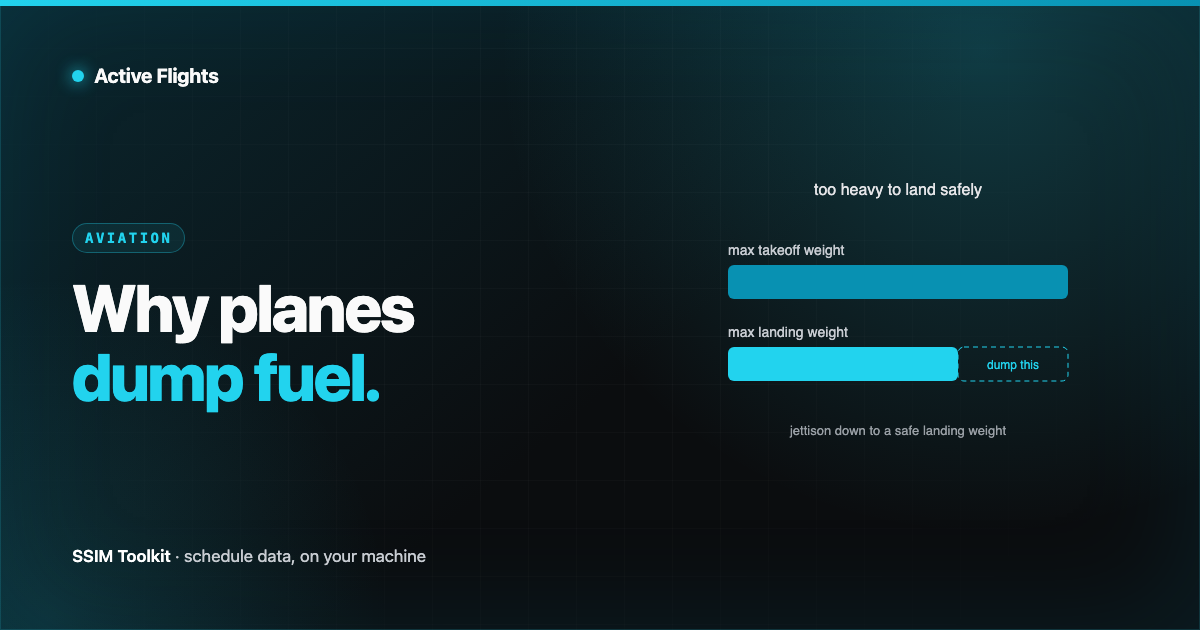
Every airliner has two important weight limits, and they are not the same number.
- Maximum takeoff weight (MTOW) — the heaviest the aircraft is allowed to be when it starts its takeoff roll.
- Maximum landing weight (MLW) — the heaviest it’s allowed to be when the wheels touch down.
The takeoff limit is almost always higher than the landing limit. That’s by design: a plane is meant to burn off a big chunk of its fuel in flight, so it naturally slims down before arrival. The landing gear and structure are stressed far more by a hard arrival than a smooth departure, so the certified landing weight is deliberately lower (Wikipedia: Maximum landing weight).
The gap can be enormous. A fully loaded long-haul jet can weigh dozens of tonnes more at takeoff than it’s cleared to weigh on landing. Normally that’s fine — you burn the difference away over the ocean. But if you have to turn back right after departure, all that fuel is still on board.
Three ways out of an overweight landing
A crew facing an early return has options, and dumping fuel is often the last one they reach for.
- Burn it off. If there’s no rush, the crew can circle, fly at a lower altitude or higher speed, or hold — all of which burn fuel faster — until the weight drops below the landing limit (Boldmethod).
- Land overweight anyway. In a genuine emergency, a crew can simply land above the maximum landing weight. It’s permitted, but it triggers a mandatory engineering inspection of the aircraft afterward.
- Jettison fuel. If the aircraft is equipped to do so, nozzles in the wings spray fuel out into the airflow, shedding weight quickly.
Not every plane can do it
Here’s the surprise: many aircraft have no fuel-dumping system at all.
Regulators don’t require one on every aircraft. Under the US airworthiness rules (FAR 25.1001), a jettison system isn’t needed if the aircraft can still meet its climb-performance requirements on one engine at maximum takeoff weight, assuming a short flight (SKYbrary). In practice, that splits the fleet roughly in two:
- Big widebodies (the long-haul, twin-aisle jets) usually can dump fuel, because the difference between their takeoff and landing weights is huge.
- Most single-aisle narrowbodies (the workhorses of short-haul flying) generally cannot. Their takeoff and landing weights are closer together, so they’re built to burn off the excess or land overweight instead.
So the next time you’re on a short domestic hop, your aircraft probably can’t dump a drop — and doesn’t need to.
Where does all that fuel go?
This is the part that worries people, understandably. The short answer: done by the book, most of it never reaches the ground as liquid.
Fuel is jettisoned at altitude, in a thin spray, so it atomises and evaporates in the air. Boeing has stated that dumping above about 4,000 feet above the ground allows for complete evaporation, and controllers typically want it done at or above 5,000 to 6,000 feet to make sure the fuel dissipates before reaching the surface (SKYbrary; Wikipedia: Fuel dumping). Air traffic control also keeps other aircraft clear and steers the dumping jet toward open water or unpopulated areas where possible.
That coordination matters — and when it breaks down, it makes headlines. In January 2020, a Boeing 777 operating Delta Flight 89 turned back to Los Angeles with an engine problem and released fuel at only around 2,000 feet over a populated area, dousing several elementary schools and causing minor skin and lung irritation to dozens of people on the ground. Safety experts questioned why fuel was dumped so low and without alerting controllers, and the airline later agreed to a large legal settlement (CBS News; Wikipedia: Delta Air Lines Flight 89).
A rare event, on purpose
Even on aircraft that can jettison, it’s uncommon. It costs the airline a tank of expensive fuel, it’s environmentally unwelcome, and crews prefer to burn off weight when time allows. Fuel dumping is what you do when the clock is against you and you need to get heavy metal back on the ground safely, now — a deliberate trade of fuel for a lower landing weight.
It looks like a stunt. It’s really just physics and a checklist.
From the team behind SSIM Toolkit — the local workbench for airline schedule data.
Sources
Want early access?
We're opening SSIM Toolkit to teams in waves through 2026 — free during the preview. Drop your email and we'll reach out when it's your turn.
You're on the list. Check your inbox for a confirmation email to finish signing up.
Something went wrong — please try again, or email hello@activeflights.com.