
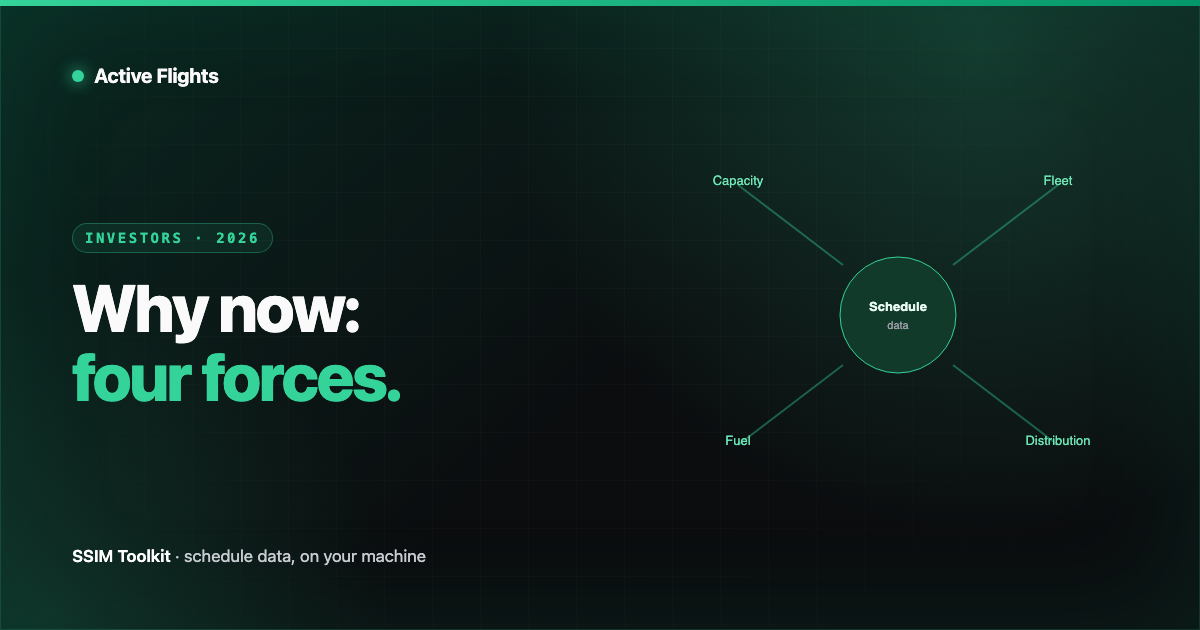
Any investment thesis has to answer “why now.” For schedule-data infrastructure, the answer in 2026 is that four separate industry forces — none of which we invented, each well-documented this year — happen to be pushing in the same direction at the same time. Individually they’re just news. Together they raise the value of the foundational data layer everything runs on.
Four forces, one direction
1. Capacity discipline. Mid-2026 demand actually softened, yet load factors hit records because airlines pulled capacity in step. Full planes on tight capacity mean no slack — every schedule error costs, and every regional shift means redeployment rather than growth.
2. A decade-long fleet backlog. The Airbus/Boeing order book runs about twelve years, and Farnborough 2026 will only lengthen it. Deliveries slip, fleet plans can’t be trusted, and schedules get rebuilt continuously to match the aircraft that actually arrive.
3. A permanent fuel premium. ReFuelEU and the SAF cost gap make operating economics depend on which airports a rotation touches — another airport-keyed dataset the schedule has to reason against.
4. A distribution overhaul. NDC and Offers-and-Orders put more automated retailing logic on top of the schedule over the rest of the decade — so a wrong schedule corrupts a smarter, more expensive sales layer.
Why convergence matters
Any one of these would make schedule accuracy a bit more valuable. What makes 2026 interesting is that they compound. Tighter capacity + less reliable fleets means more schedule versions. More versions + more external datasets (fuel, slots, MCT) means more reconciliation. More automation on top means each error propagates further. The demand on the schedule-data layer is rising on several axes at once, and the tools most teams use for it — in-house parsers and spreadsheets — were sized for a calmer decade.
None of these forces is about schedule software. All of them raise the cost of getting schedule data wrong.
The takeaway
“Why now” isn’t a single catalyst; it’s a convergence. The macro picture — disciplined capacity, constrained fleets, structural fuel costs, modernizing distribution — is making the foundational data layer under all of it more load-bearing precisely as the incumbent tooling for that layer looks most inadequate. That gap, widening in real time, is the timing case. It’s the environment we built SSIM Toolkit for.
Sources
Want early access?
We're opening SSIM Toolkit to teams in waves through 2026 — free during the preview. Drop your email and we'll reach out when it's your turn.
You're on the list. Check your inbox for a confirmation email to finish signing up.
Something went wrong — please try again, or email hello@activeflights.com.