
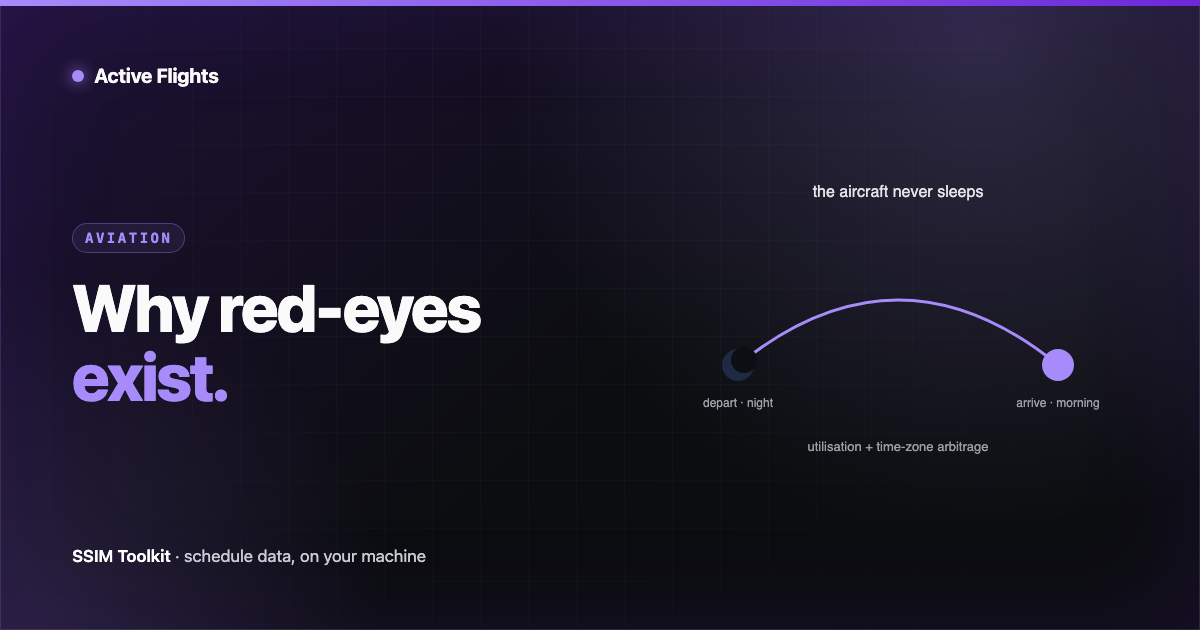
You board at 11pm, wedge a neck pillow into an impossible position, and doze fitfully across time zones until the cabin lights snap on for a 6am landing. The “red-eye” — named for the tired, bloodshot look of overnight travellers — feels like something airlines do to you. It isn’t. It’s one of the most deliberate, profitable decisions in a schedule planner’s toolkit.
Here’s why these flights exist, and why they aren’t going anywhere.
A parked plane is a bleeding asset
Start with the single most important fact in airline economics: an aircraft only earns money while it’s flying.
A modern jet is a nine-figure asset. Every hour it sits at a gate — clean, fuelled, and empty — it earns nothing while still racking up ownership costs, financing, and crew on payroll. Airlines therefore obsess over aircraft utilisation: the number of hours a plane is actually in revenue service each day.
That pressure has only intensified. With aircraft manufacturers running years behind on deliveries, carriers have squeezed record hours out of the fleet they already have. In 2024, average daily aircraft utilisation across the global fleet surpassed 8.5 hours for the first time ever — a record. (Aerodata, IATA)
An overnight flight is how airlines claw back the “dead” hours between the last evening arrival and the first morning departure. Instead of leaving a jet idle from midnight to dawn, they send it on a productive trip — and it’s ready to start a fresh day of flying at its destination.
Time zones do the heavy lifting
The other reason red-eyes work is a quirk of the clock. On long east-bound routes, an overnight departure lands at a genuinely useful hour.
Fly from the US West Coast to the East Coast, or from North America to Europe, and you’re travelling against the clock — losing hours as you go east. A flight leaving Los Angeles late at night arrives in New York in time for a morning meeting. A jet leaving the US East Coast in the evening touches down in London mid-morning. The overnight timing isn’t a bug; it’s what makes the trip convenient, letting travellers skip a hotel night and arrive ready for the day.
This is why so many transcontinental and transatlantic flights are scheduled overnight — the geography of time zones practically designs the timetable for you.
Who actually wants a red-eye
Airlines don’t fill these planes by accident. Overnight flights serve real demand:
- Business travellers who want to maximise a working day at both ends and not “waste” daytime hours in the air.
- Price-sensitive flyers. Off-peak demand is softer, so overnight fares tend to run cheaper than prime daytime departures — a trade of comfort for cash.
- Connection builders. A red-eye arrival feeds a bank of early-morning onward flights at a hub.
Curfews push flying into the night — and the reverse
There’s a scheduling squeeze at both ends of the day. Many big airports enforce night-time noise curfews, restricting departures and arrivals during sleeping hours — London Heathrow, Frankfurt, Sydney and others all limit overnight movements. That caps how many red-eyes can operate.
But at slot-constrained airports, daytime capacity can be fully booked. Shifting some flights to the shoulders of the night eases daytime congestion and can even mean quieter skies and smoother routings. The schedule that lands on your booking screen is the resolved answer to all of these forces at once.
How this shows up in an airline’s schedule
Everything above is encoded, quietly, in the published timetable. Each flight in an airline’s schedule carries a departure time, an arrival time, and — crucially — the time-zone information and day-of-operation for every leg. Chain those legs together and you can see a single aircraft’s day take shape: an evening arrival, an overnight red-eye, a morning turnaround, then a full day of short hops. Read across a whole fleet, and the utilisation story — how many hours each jet flies, how time zones bend the timetable, where the idle gaps fall — is right there in the data.
From the team behind SSIM Toolkit — the local workbench for airline schedule data.
Sources
Want early access?
We're opening SSIM Toolkit to teams in waves through 2026 — free during the preview. Drop your email and we'll reach out when it's your turn.
You're on the list. Check your inbox for a confirmation email to finish signing up.
Something went wrong — please try again, or email hello@activeflights.com.