
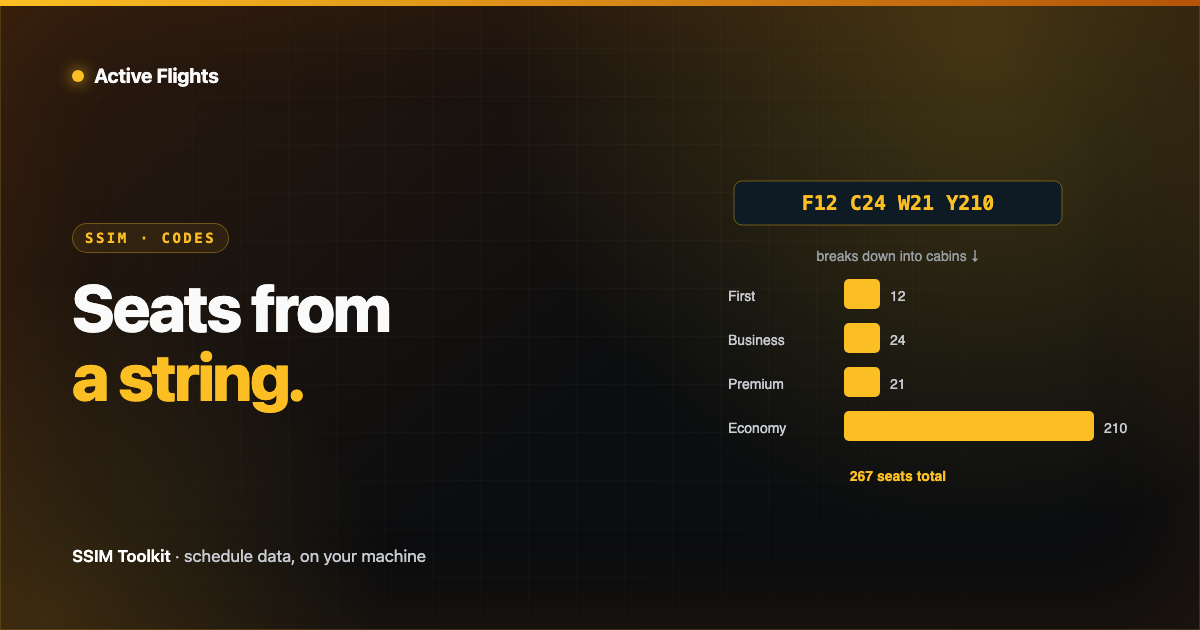
“How many seats is this flight?” sounds like a lookup. It isn’t. Ask SSIM and you don’t get a number back — you get a short coded string describing the cabin layout, from which you derive the seat count yourself. Read the string wrong, or confuse it with the aircraft type code sitting a few fields away, and every capacity number downstream inherits the mistake.
Two different fields that both sound like “the aircraft”
A flight-leg record carries two things that people routinely conflate:
- The equipment (aircraft type) code —
738,320,77W, and so on. This tells you what kind of aircraft operates the leg. It’s an IATA three-character code, and we cover it in detail in equipment codes. What it does not tell you is how many seats are on board. - The aircraft configuration / version — a separate string describing the cabin layout: which compartments exist and how many seats each holds.
The distinction matters because the same aircraft type flies with wildly different
seat counts. A 787 in a three-class long-haul layout and a 787 packed for high-density
leisure are both 789; only the configuration string separates them. Read only the type
code and you’ve answered “what plane,” not “how many seats.”
The equipment code is the airframe. The configuration is the cabin. Capacity lives in the second one.
Reading the configuration string
The configuration string is a compact list of compartments. Each entry pairs a class-of-service letter with the number of seats in that compartment. Concatenate the compartments and you get the whole cabin.
F12C24W30Y200
│  │   │   └──── Economy:   200
│  │   └──────── Premium:    30
│  └──────────── Business:   24
└─────────────── First:      12
                              ───
                Total seats:  266
The letters are the familiar cabin classes — broadly First, Business, Premium economy, Economy — and the digits after each are that compartment’s seat count. Sum the seat counts and you have the total seating capacity of the leg: here, 266.
That derived total is the number most analysis actually wants. Capacity per market, seat-departures, load-oriented rollups — they all start from summing the compartments in this string, not from a lookup on the equipment code.
The parts that trip people up
A few realities keep this from being a clean regex exercise:
- The letters aren’t only cabins. A configuration string can carry codes that aren’t passenger seats at all — version markers and non-seat compartments among them. Sum everything as seats and you’ll over- or mis-count. The reliable reading takes the seat-bearing cabin compartments and treats the rest for what it is.
- Layouts vary by carrier and season. The same type, same route, can re-configure between seasons. Configuration is a property of the leg, not a fixed attribute of the aircraft type — which is exactly why SSIM puts it on the leg.
- Some legs carry no usable configuration at all. When the string is missing or unrecognisable, the honest answer is “seat count unknown for this leg” — not zero, and not a guess. Treating an absent configuration as zero seats silently deflates every capacity figure it rolls into.
There’s a finer layer underneath
The configuration string gives you cabin capacity — how many seats in First, Business, and so on. Sitting beneath that is a finer booking-class layout: the ordered list of booking (reservation) designators the flight sells, which is a different and more granular slicing of the cabin than the compartment totals.
For most capacity work — “how many seats does this market get a week” — the cabin compartments from the configuration are what you need. The booking-class layer matters when you get into per-class service and inventory detail. The two are related but not the same, and it’s worth keeping them straight: capacity comes from the configuration’s compartments; the booking classes are a separate, finer dimension.
Why getting this right matters
Every capacity and frequency number leans on this one derivation. If the seat count is wrong — because the type code got used as a proxy, or non-seat codes got summed, or a missing configuration was read as zero — then market capacity, seat-departures, and any per-route seat totals are all wrong by the same amount, invisibly. It’s the classic data-quality failure: nothing errors, the numbers just quietly don’t match reality.
The rule of thumb is simple. Don’t ask the equipment code how many seats there are. Ask the configuration, sum the seat-bearing compartments, and keep “unknown” as a first-class answer when the string won’t support one.
This is exactly what SSIM Toolkit does: it reads the aircraft configuration on each leg, sums the cabin compartments into a total seating capacity, keeps the equipment type code as the distinct thing it is, and leaves capacity honestly blank where a leg carries no usable configuration — so the capacity and frequency views are built on real seat counts, not on a stand-in. More on SSIM Toolkit.
Related reading: equipment codes for the type side of the picture, and record types for where both fields live in the file.
Want early access?
We're opening SSIM Toolkit to teams in waves through 2026 — free during the preview. Drop your email and we'll reach out when it's your turn.
You're on the list. Check your inbox for a confirmation email to finish signing up.
Something went wrong — please try again, or email hello@activeflights.com.