Airline earnings Q3 2026: record revenue, fuel takes the profit
Airline earnings for Q3 2026: Delta, United and Southwest stayed profitable, American and Alaska lost money. Record revenue at four of them — and fuel up over 60%.
US airlines just booked record summer revenue — and two of the biggest still lost
money. That is the strange headline from the third-quarter 2026 earnings season, the
results covering July to September. Revenue hit records almost everywhere. Then the fuel
bill arrived. Here is a plain-language roundup of who made a profit, who didn’t, and why.
The quarter in one sentence
People kept flying and paying more, but jet fuel cost around 60% more than a year earlier,
and that ate most of the gain.
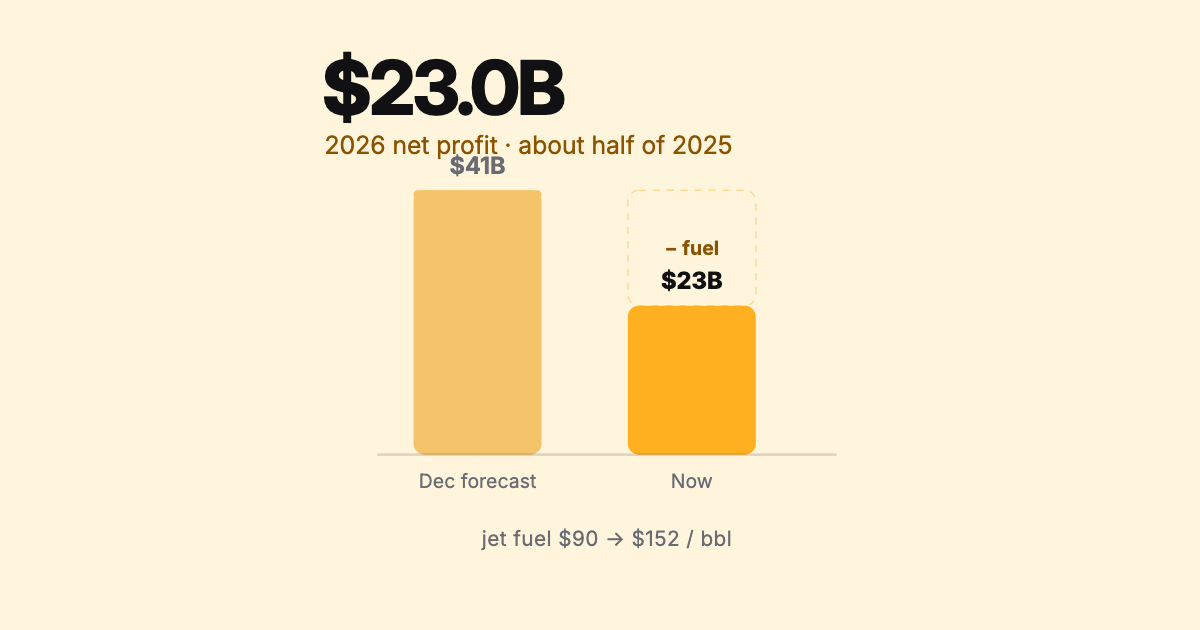
The cause is the oil shock that followed the conflict in the Middle East this year, which
we covered when IATA halved its 2026 profit forecast.
Q3 is the peak summer quarter. The five big US
airlines below paid between $3.80 and $3.94 a gallon for fuel in the quarter; a year
ago, United and Southwest were paying about $2.40.
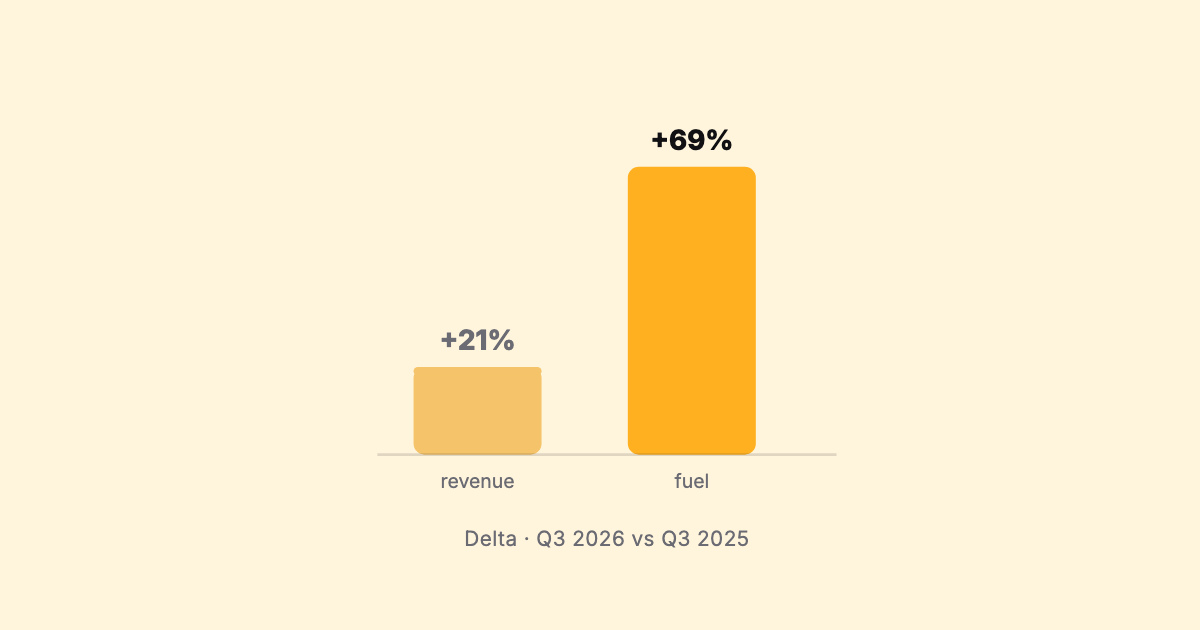
Revenue up about a fifth, fuel up by two-thirds
Record revenue, but the fuel bill grew more than three times as fast. Source: Delta, United and American Q3 2026 earnings releases.
When a cost that is roughly a quarter of your spending (23% of Delta’s operating expense this
quarter) jumps by two-thirds, a 20% rise in revenue isn’t enough. That is the whole quarter in one chart.
Who made money in Q3 2026
Delta stayed solidly profitable. Revenue rose 21% to $20.2 billion, a record for the
September quarter, and it earned $756 million — but that’s down from $1.4 billion last year, and its fuel bill was up
69% to $4.35 billion. Delta cut its full-year profit forecast to $5.10–$5.60 per share,
from $6.50–$7.50 in July, saying it will absorb a $6 billion rise in fuel costs this
year. Chief executive Ed Bastian’s explanation of why revenue held up: “Demand remains strong, supported by
consumers’ growing preference for experiences and travel.”
United earned $1.0 billion on record revenue of $17.9 billion (up 17.4%), with
premium revenue up 17%. Fuel cost $4.8 billion, up 61.6%. United expects another
revenue record in the fourth quarter.
Southwest had the most interesting quarter. It made $270 million, up from $54 million
a year ago, on record revenue of $8.4 billion (up 21.2%) — while flying slightly less
(capacity down 0.4%). Its revenue per seat-mile, the airline industry’s standard measure of
how much it earns from each seat it flies one mile, rose a record 21.6%. Chief executive Bob Jordan
said demand stayed strong even as Southwest lapped last year’s bag fee and other commercial
changes. It has trimmed its full-year capacity growth to about 1.2%, from about 1.5%.
Who lost money
American reported a record $16.3 billion in revenue, up 19.3% — and a $269 million
net loss. Its fuel bill rose 67.5% to $4.6 billion. Chief executive Robert Isom called it
“the strongest year-over-year revenue growth in my career,” but American now expects a loss
for the full year. Unlike Delta and Southwest this quarter, it kept growing capacity — up 4.2% in Q3,
with 5.5–6.5% planned for Q4.
Alaska Air Group lost $147 million, against a profit a year earlier, even as revenue
rose 14% to $4.3 billion. Fuel came in at $3.94 a gallon, above the $3.75 it had expected,
and the airline puts this year’s fuel headwind at $1.8 billion.
Three in profit, two in the red — in a quarter when revenue grew at all five. Source: company Q3 2026 earnings releases.
Why some airlines did better than others
Three things separate the winners from the strugglers this quarter:
Premium and loyalty revenue. Delta’s premium revenue rose 18% and United’s
premium revenue 17%. Business travellers and front-cabin seats pay more and are less
sensitive to price rises, so they help absorb a fuel shock.
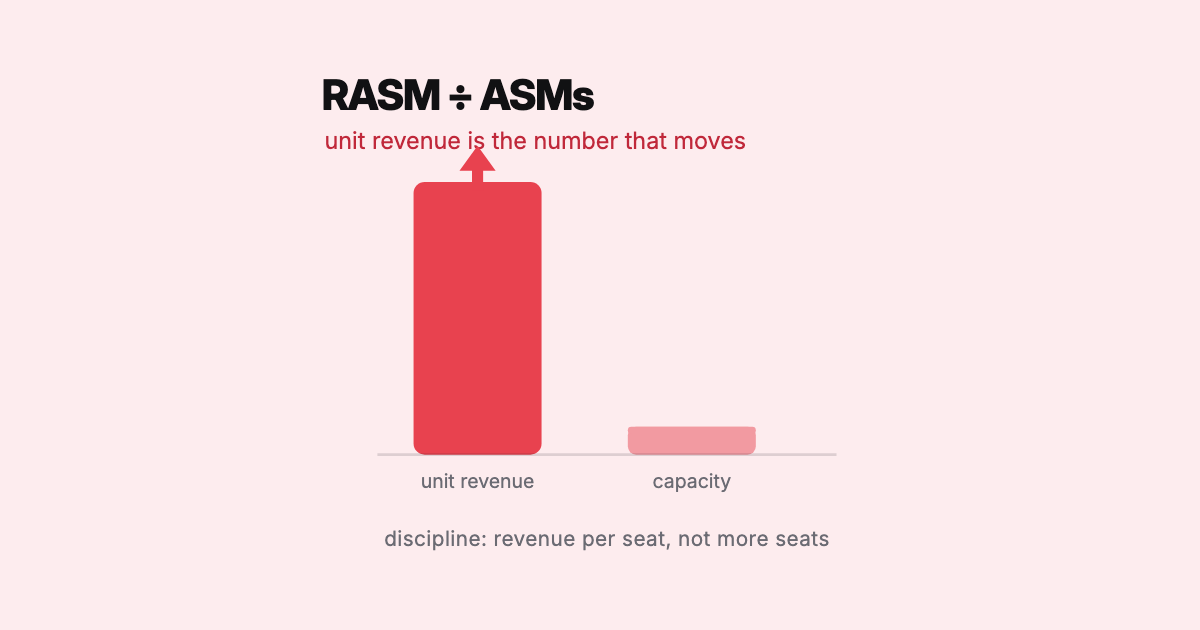
Capacity discipline. Delta flew about the same amount as a year ago and Southwest
slightly less. Flying less when fuel is expensive keeps planes full and fares firm. (We
explain why unit revenue is the number that moves.)
Timing of the fuel price. Every carrier is exposed. The difference is how much of the
increase it can pass on in fares quickly enough.
What to watch next
Fuel isn’t easing yet. Airlines are guiding fourth-quarter fuel prices higher still — for
example about $4.70 a gallon at American, $4.55 at Southwest and $4.65–$4.85 at Alaska.
Demand, though, still looks strong: Delta expects Q4 revenue up about 20%, and United
expects growth above 20%.
Outside the US, Europe’s big airline groups — IAG, Lufthansa Group and Air France-KLM — report
on their own calendars. Their summer results will show how much fuel hedging (buying fuel in
advance at fixed prices) has protected them.
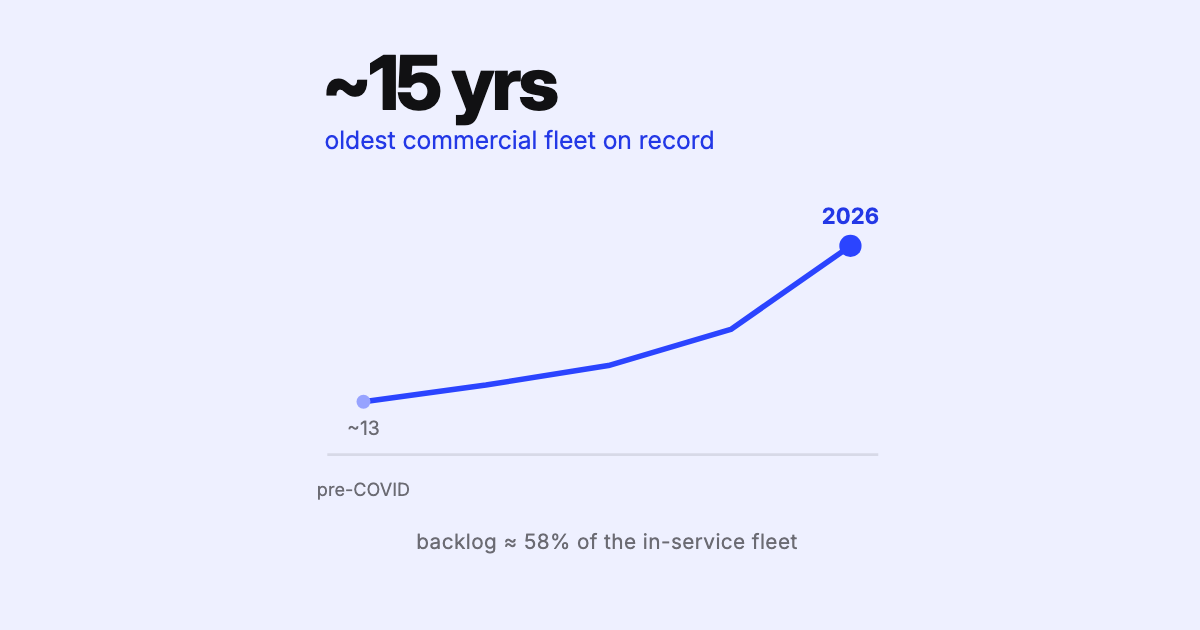
The lesson of Q3 is the one from our look at 2026’s capacity squeeze:
when costs are out of your hands, the airline that decides where and how much to fly most
carefully keeps more of its money. Those decisions live in the schedule — the thing
SSIM Toolkit helps teams read, compare and check.
Figures are from each airline’s Q3 2026 earnings release (Alaska’s as reported by the
Anchorage Daily News); “net income” is GAAP. Fuel
prices are the airlines’ reported average cost per gallon, and fourth-quarter numbers are
company guidance, not results.