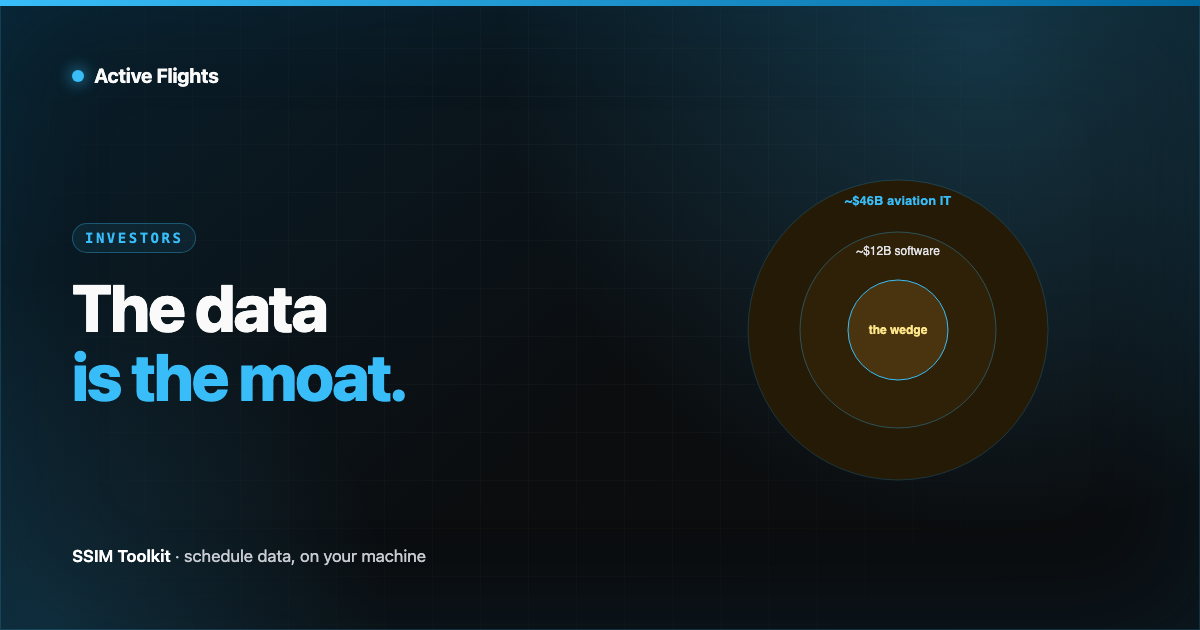
“What’s the moat?” is the right question to ask of any software business, and it’s especially sharp for infrastructure, where the UI is thin and the value is underneath. For a foundational schedule-data tool, the honest answer isn’t “the features.” It’s four things that are much harder to copy.
Four sources of defensibility
1. Domain depth. The hardest thing to replicate is the encoded knowledge of the industry’s real-world conventions — the carrier quirks, the date/DST edge cases, the MCT and slot logic. A newcomer can write a parser in a week and spend years discovering what it gets wrong. That gap is the moat.
2. Determinism and trust. Infrastructure is only valuable if people build on it, and they only build on what they trust. A deterministic, reproducible engine — same file, same answer, auditable — earns the kind of trust that makes it the default. Trust compounds; it’s slow to build and slow to lose.
3. Foundation position. Being the layer the rest of the stack sits on is structurally strong. The schedule feeds analytics, retailing, ops — so the tool that owns the schedule layer is upstream of everything, and displacing it means disturbing everything above.
4. Data gravity and switching cost. Once a team’s workflows, exports, and integrations run through a tool, it accretes gravity: pipelines depend on its output shape, people learn its surfaces, it’s wired into how the business runs. Replacing it is a project — the same stickiness that makes vertical SaaS defensible.
What is not the moat
Worth stating plainly: the moat is not the UI, and it’s not a proprietary dataset you hoard. Schedule data belongs to the customer; the value is in reading their data correctly, on their machine, better than they could themselves. A tool that tried to lock in customers by holding their data hostage would be trading a real moat (competence and trust) for a brittle one (lock-in) — and in a domain this security-conscious, that’s a losing trade.
The durable moat in infrastructure is being correct and trusted at something genuinely hard — not being sticky through lock-in.
The takeaway
For a foundational schedule-data business, defensibility comes from domain depth, determinism, foundation position, and honest data gravity — none of which a competitor can screenshot and clone. That’s the moat worth building, and it’s the one we’re building toward: get the hard thing right, earn the trust, and become the layer the rest of the stack quietly depends on.
Sources
Want early access?
We're opening SSIM Toolkit to teams in waves through 2026 — free during the preview. Drop your email and we'll reach out when it's your turn.
You're on the list. Check your inbox for a confirmation email to finish signing up.
Something went wrong — please try again, or email hello@activeflights.com.