
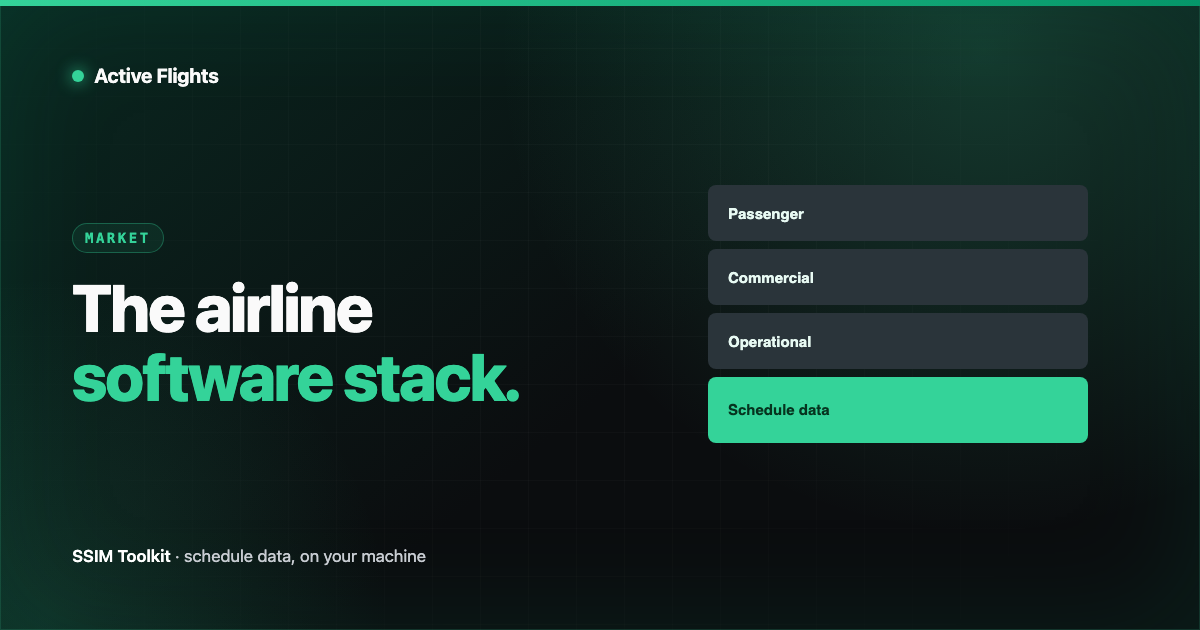
It helps to picture airline technology as a stack. Passenger-facing apps sit at the top, where most people (and most budgets) look. Underneath run the commercial and operational systems. And at the very bottom sits the data everything else depends on — including the schedule. Where that foundation gets attention, the whole stack is healthier. Where it doesn’t, every layer above inherits the weakness.
The layers
Top to bottom:
- Passenger layer. Booking and e-commerce, mobile apps, check-in, and the biometric, touchless journey that gets most of the headlines — and, per SITA, most of the investment.
- Commercial layer. Revenue management, pricing, loyalty, and distribution through GDSs and NDC. This is where the schedule becomes something to sell.
- Operational layer. Operations control, crew management, maintenance (MRO), and ground handling — running the schedule on the day.
- The data foundation. Reference and schedule data: the SSIM feed, MCT tables, slots. Every layer above reads from here.
Everything depends on the schedule
Follow any thread up the stack and it runs back down to the schedule. The app shows a flight because the schedule says it operates. Revenue management prices a seat on a flight the schedule defines. Ops control flies the plan the schedule laid out. The biometric gate, the loyalty accrual, the crew pairing — all of it reasons about the same underlying set of flights.
Which means a single truth: if the schedule is wrong, everything above it is wrong too — confidently, and invisibly, until someone notices. A mis-parsed overnight, a missed codeshare, an unreconciled change at the foundation propagates silently through every layer that trusts it.
The investment mismatch
Here’s the tension worth naming. The money in aviation IT — on the order of $46 billion across airlines and airports, per SITA — flows overwhelmingly to the top of the stack: the passenger experience, AI, biometrics, security. The foundation? Still, across much of the industry, handled by in-house parsers and spreadsheets. The layer everything depends on is the layer least likely to have been bought as a proper tool.
The most-funded layer is the one the passenger sees. The least-funded is the one the whole stack stands on.
Doing it well
We build for the base of the stack, deliberately. Get schedule data right — read it faithfully, validate it, keep it local and deterministic — and every layer above stands on something solid. SSIM Toolkit is that foundation layer, done as a first-class product rather than a side-project parser.
Next, the same picture from an investor’s chair: a map of aviation schedule tooling.
Sources
Want early access?
We're opening SSIM Toolkit to teams in waves through 2026 — free during the preview. Drop your email and we'll reach out when it's your turn.
You're on the list. Check your inbox for a confirmation email to finish signing up.
Something went wrong — please try again, or email hello@activeflights.com.