
We’ve spent this series looking at schedule data from the inside — the format, the workflows, the architecture. This final post steps back and looks at it the way an investor would: as a market. It’s a smaller market than the headline aviation-IT number, but it has an unusually attractive shape.
The size and the shape
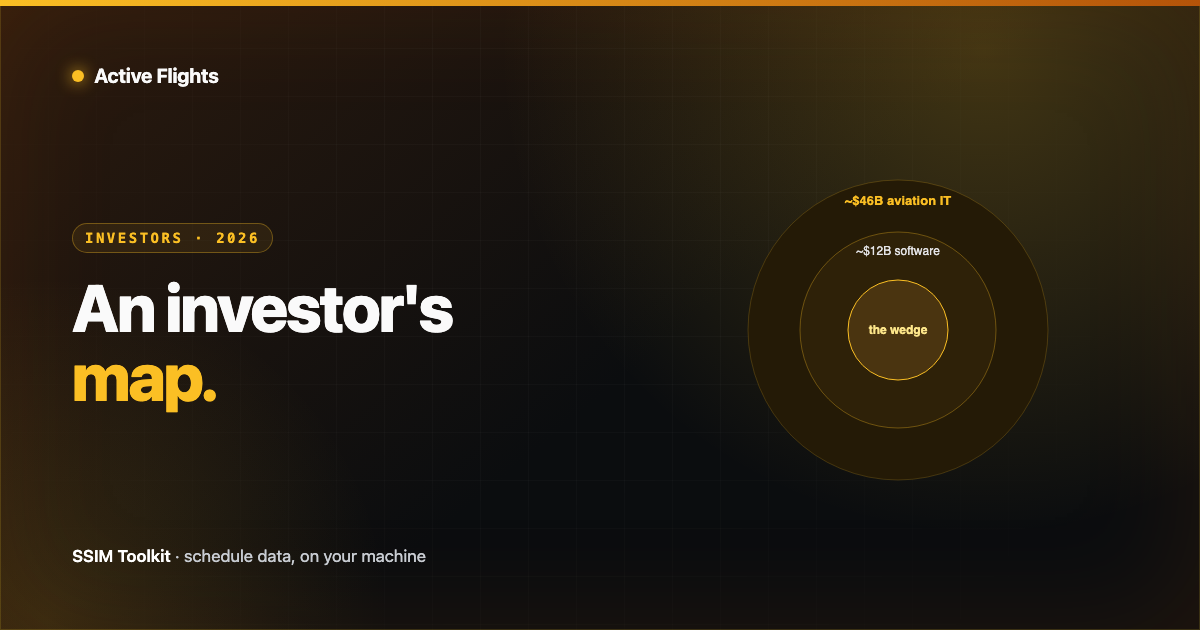
The macro backdrop is large: airlines and airports are set to spend on the order of $46 billion on IT (per SITA), and the narrower aviation software market is estimated around $12 billion. Schedule-data tooling is a slice of that software layer — not the whole thing. But it’s a slice with three properties investors tend to like: it’s foundational, it’s built on a durable standard, and the need is recurring, not one-off.
The buyers
The addressable set is wider than “airlines,” because the SSIM schedule is exchanged across the whole ecosystem:
| Buyer | Why they touch schedule data |
|---|---|
| Airlines | Build, validate, publish, and maintain their own schedules |
| Airports & ground handlers | Plan resources against the arriving/departing schedule |
| GDSs & distributors | Ingest and redistribute schedules at scale |
| OTAs & aggregators | Parse feeds to power search and booking |
| Slot coordinators | Reconcile schedules against allocations |
Anyone who consumes or produces a schedule is a candidate — and almost all of them are doing the parsing themselves today.
Why the wedge is attractive
- Durable standard. SSIM isn’t a trend; it’s how the industry has exchanged schedules for decades and will for decades more. Tooling on a stable standard doesn’t churn with fashion.
- Recurring, not one-off. As record load factors and the aircraft backlog have shown, schedules are rebuilt continuously. The need to read, validate, compare, and deconflict is permanent.
- Build-vs-buy tilting. Every team maintaining an in-house parser is paying an invisible tax. When a dependable tool exists, “why are we still maintaining this?” becomes an easy question.
- AI raises the stakes on data quality. The more decisions get automated on top of the schedule, the more it matters that the schedule underneath is correct and reproducible.
Where the moats are
For a product in this wedge, defensibility comes from a few places: domain depth (the real-world conventions a naïve parser gets wrong), determinism and trust (a foundation others can build on), local-first handling of commercially sensitive data, and the foundation position itself — being the layer the rest of the stack stands on is a durable place to be.
The honest risks
No map is complete without the hazards. The schedule-tooling wedge is narrower than horizontal SaaS; the incumbent competitor is often “we already built one,” which is free-until-it-isn’t; airline sales cycles are long; and the buyer base, while wide, is concentrated at the top. A serious view of the opportunity has to price these in, not wish them away.
The thesis in a line: an under-tooled foundational layer, on a durable standard, with permanent demand and a tilting build-vs-buy calculus — a small market with an unusually good shape.
Where we sit
This is the market we’ve chosen to build into, foundation-first and deliberately narrow: SSIM Toolkit as the dependable, local, deterministic layer for schedule data, sold to the people who currently maintain a parser they’d rather not. The bet is simple — get the foundation right, and both the operators and the stack above them are better for it.
That closes the series. Thanks for reading — if any of it resonates and you’d like to see what we’re building, the product tour is the place to start.
Sources
Want early access?
We're opening SSIM Toolkit to teams in waves through 2026 — free during the preview. Drop your email and we'll reach out when it's your turn.
You're on the list. Check your inbox for a confirmation email to finish signing up.
Something went wrong — please try again, or email hello@activeflights.com.