
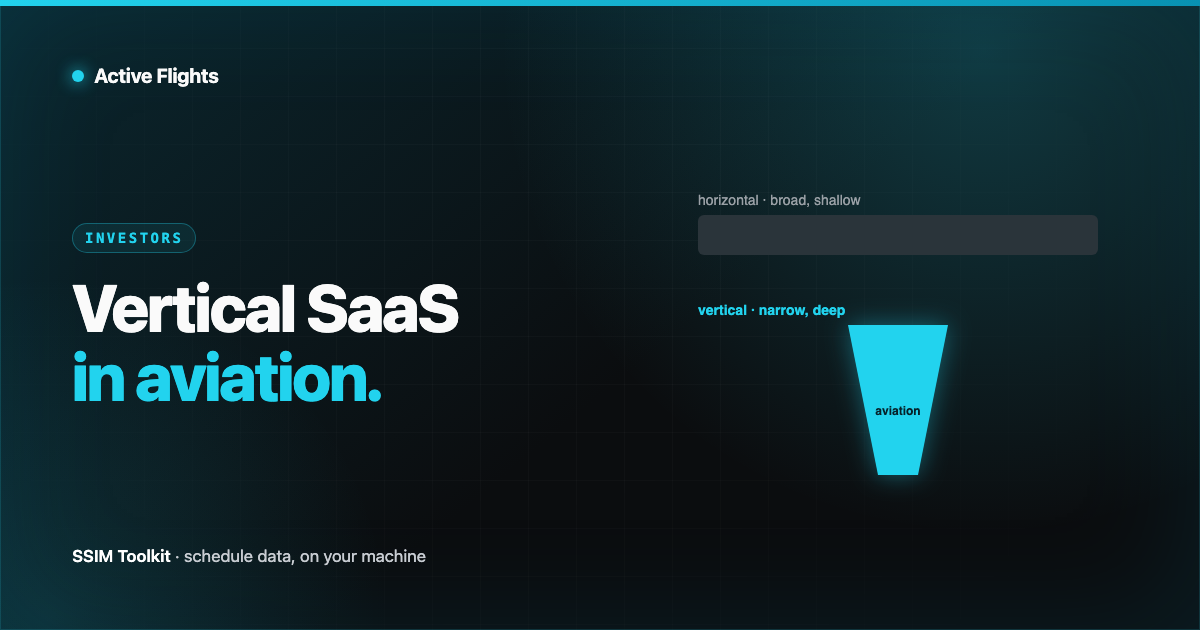
If you’ve watched software investing over the last decade, you’ve seen the thesis migrate. The generic, horizontal tools — another CRM, another dashboard — became a knife fight of undifferentiated competitors. The durable returns increasingly came from vertical SaaS: software built deep into the workflow of one industry with real, specialized complexity. Aviation is one of those industries, and the schedule-data layer is a clean example of why the vertical thesis holds.
Horizontal vs vertical
| Horizontal SaaS | Vertical SaaS | |
|---|---|---|
| Buyer | Anyone | One industry |
| Moat | Features, brand | Domain depth, workflow fit, data |
| Competition | Crowded, generic | Few who truly understand the domain |
| Switching cost | Often low | High — it’s wired into how the business runs |
The vertical advantage isn’t that the market is bigger — it’s usually smaller. It’s that the moat is deeper. A tool that encodes an industry’s hard-won conventions is defensible in a way a general-purpose tool can’t be, because the barrier to entry is understanding the domain, not writing the code.
Why aviation schedule data fits the mould
Everything that makes vertical SaaS attractive is present in schedule data:
- Genuine, specialized complexity. SSIM, MCT tables, slot regimes, SSM/ASM messaging, the real-world conventions that only a domain insider knows. You can’t fake this from the outside.
- A durable standard. SSIM has been the industry’s schedule format for decades and will be for decades more. Tooling on a stable standard doesn’t churn with fashion.
- A permanent, recurring workflow. As 2026 has shown — full planes on soft demand, a decade-long fleet backlog — schedules are rebuilt continuously. The need doesn’t go away.
- High switching cost by nature. Once a tool is wired into how a team reads, validates, and compares schedules, replacing it is a project — the good kind of stickiness.
- A tilting build-vs-buy calculus. Most teams still run an in-house parser — an incumbent that’s free until it isn’t, and increasingly a cost people want to shed.
The trade-off, honestly
Vertical isn’t a free lunch. The addressable market is narrower than a horizontal tool’s; the buyer base is concentrated; sales cycles in aviation are long. The vertical bet is explicitly depth over breadth — you win a smaller market more completely and defend it longer. For the right team in the right niche, that’s a feature, not a bug.
Horizontal software competes on features and loses on price. Vertical software competes on understanding the domain — and that’s much harder to copy.
The takeaway
The vertical-SaaS thesis rewards durable standards, specialized complexity, recurring workflows, and real switching costs. Aviation schedule data has all four. It’s a smaller market than the aviation-IT headline, but it’s exactly the kind of deep, defensible layer the vertical playbook was written for.
That’s the category we’ve deliberately chosen to build in: not a horizontal tool that does a little of everything, but a foundation-deep one that does schedule data properly. The next post looks harder at where the moat actually comes from.
Sources
Want early access?
We're opening SSIM Toolkit to teams in waves through 2026 — free during the preview. Drop your email and we'll reach out when it's your turn.
You're on the list. Check your inbox for a confirmation email to finish signing up.
Something went wrong — please try again, or email hello@activeflights.com.