Q3 2026 aircraft deliveries: Airbus and Boeing vs their targets
Q3 2026 aircraft deliveries: Airbus has 547 jets out the door and needs about 108 a month to hit 870; Boeing delivered 161. What it means for next summer.
Every airline schedule for next summer rests on a simple question: will the new planes
actually show up? The third-quarter delivery numbers from Airbus and Boeing are in, and
they give a fairly clear answer — more jets than last year, but nowhere near enough to
loosen the squeeze. Here is where Q3 2026 aircraft deliveries stand against each
manufacturer’s target, and what that means for capacity in summer 2027.
Airbus: 547 delivered, a big Q4 still to come
Airbus handed over 72 aircraft in September, bringing its total for the first nine
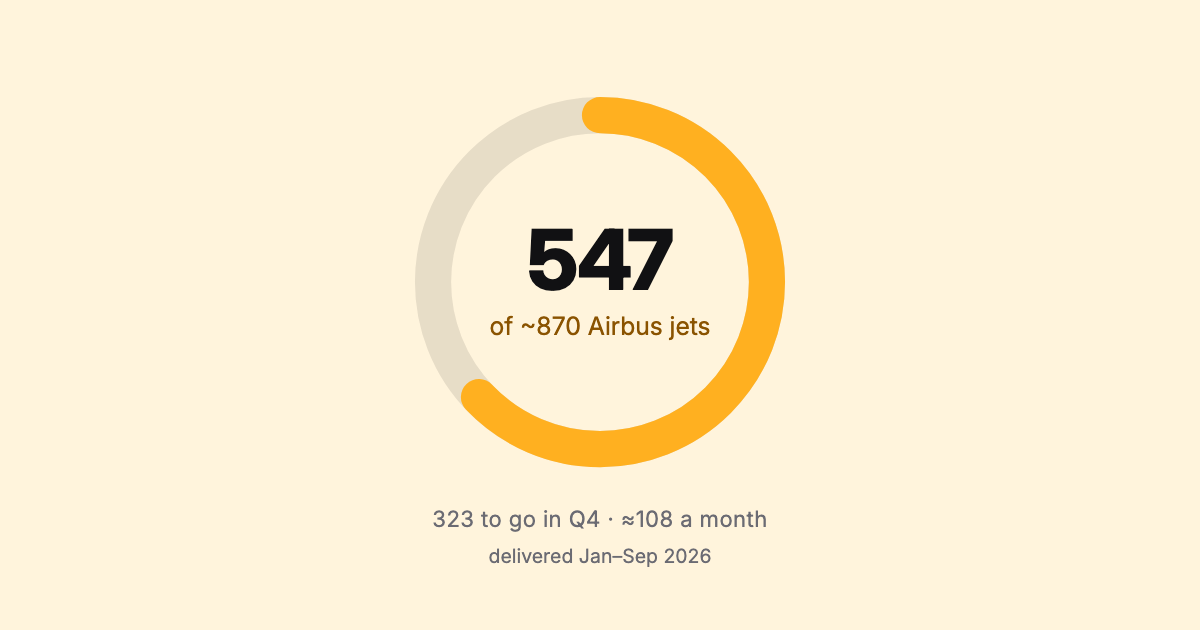
months of 2026 to 547 — up 8% on the 507 it had delivered by the same point in 2025.
The quarter itself was softer. Airbus reported 351 deliveries for the first half, so the
third quarter accounts for 196 — slightly below the 201 of Q3 2025 (507 by September
2025, less 306 in the first half). August was a quiet month at 57.
The problem is the target. Airbus is aiming for about 870 deliveries this year, roughly
10% more than the 793 it managed in 2025. With 547 done, that leaves 323 for October to
December — about 108 a month, against an average of roughly 61 a month so far.
To reach about 870, Airbus must deliver roughly 108 jets a month in Q4 — about 1.8 times its pace so far this year. Source: Airbus H1 2026 results; September figures via AirData News and Aviation News, October 2026. Monthly rates are our arithmetic.
That is a steep climb in a single quarter, and the question is whether the supply chain
can support it. Reports cite
continuing supply-chain trouble, including engine availability and manufacturing
quality issues affecting the A321neo. (Engines have been the bottleneck for a while — see why the
engine shortage reaches the schedule.) Airbus
publishes its nine-month results at the end of October, so we will know shortly whether the
870 target holds.
What is on order is not the issue. Airbus’s backlog stood at 9,310 aircraft at the end of
September. The A320 family made up 59 of September’s 72 deliveries, led by the larger
A321neo with 37.
Boeing: 161 jets in Q3, a steadier climb
Boeing delivered 161 commercial aircraft in the third quarter — almost exactly the 160 of
Q3 2025 — and 475 in the first nine months, up from 440 a year earlier.
The 737 does nearly all the work; 787 and 777 deliveries are down on a year ago. Source: Boeing third-quarter delivery releases, October 2026 and October 2025.
The 737 is the engine of the recovery: 124 in the quarter and 367 so far this year,
against 330 at the same point in 2025. In May, after consulting the US regulator, the FAA, Boeing said it
was increasing 737 production, aiming for 47 a month in 2026. The smallest and largest versions, the
737-7 and 737-10, are still waiting for certification; Boeing now expects to start
delivering them in 2027.
The 787 Dreamliner is the weak spot. Boeing delivered 22 in Q3 and 62 this year, while
chief executive Kelly Ortberg reaffirmed in June a target of 90 to 100 for 2026 — which
means 28 to 38 more in the last three months. He also said Boeing had “fallen behind in
delivery on engines” earlier in the year. The new 777-9 is still in certification, with
first delivery planned for 2027.
Boeing notes that its delivery figures are not final until it reports quarterly results.
What it means for next summer’s capacity
Put the two together and the picture is “more, but still not enough.”
Narrowbodies are arriving faster. Both A320neo-family and 737 deliveries are up on
2025 so far, and those are the jets that fill short- and medium-haul schedules.
Widebodies are the constraint. Boeing’s 787 deliveries are flat on the year (62
against 61), its 777s are down (20 against 29), and Airbus delivered fewer A330s in the
first half (10 against 12) — which limits how fast long-haul networks can grow.
Airlines are planning cautiously. Ryanair, for example, expects to grow capacity only
2–3% in summer 2027, while trimming this winter because of fuel costs.
For schedule planners, a late delivery is not an abstract number: it is a flight in next
summer’s timetable that needs a different aircraft, a lower frequency, or no aircraft at all.
Seeing those changes clearly from one schedule version to the next is the kind of work
SSIM Toolkit is designed for.
Delivery figures are company-reported; Boeing’s are preliminary until it reports quarterly
results. Airbus’s Q3 total and monthly averages are our arithmetic from its published
half-year and nine-month totals.