
There is a class of scheduling problem that never appears in the schedule file. The Pratt & Whitney geared turbofan (GTF) durability issue is the clearest current example. A defect in the powder metal used for certain engine discs has forced accelerated inspections across the A320neo family — and inspections mean removals, and removals mean aircraft on the ground. The fleet plan says one thing; the ramp says another. The gap between them lands on the schedule.
What actually happened
The GTF, which powers a large share of the A320neo family alongside CFM’s LEAP, was found to have a contamination issue in the powder metal used to manufacture high-pressure discs. The risk is that affected parts crack earlier than designed, so the fix is not optional tuning — it is pulling engines and inspecting them.
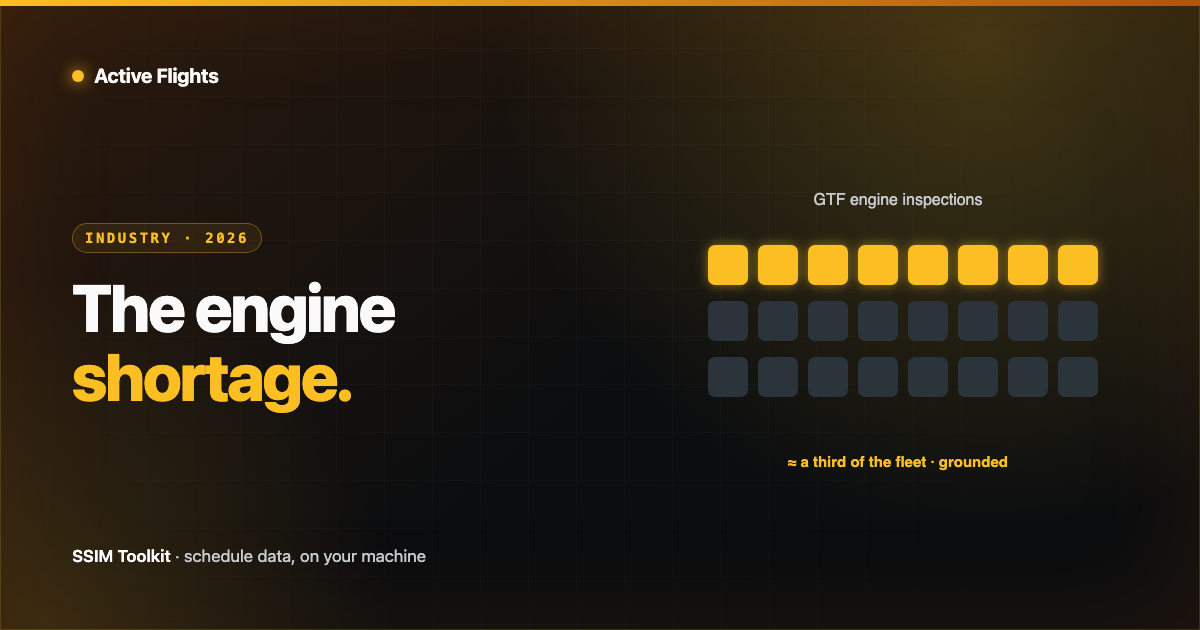
The scale is significant. Industry reporting put roughly 720 A320neo-family jets grounded globally for GTF inspections, with about a third of the GTF-powered Airbus fleet — on the order of 636 aircraft — grounded or in storage at the peak of the programme. Shop visits are long: an inspection-and-repair cycle runs an estimated 250 to 300 days per engine, so an aircraft doesn’t come back next week — it comes back next season.
An engine in the shop for the better part of a year is, for scheduling purposes, an aircraft that no longer exists.
There is a path out. The upgraded GTF Advantage reached EASA certification in April 2026, and Pratt has prioritised getting the grounded fleet back in the air. But the industry expectation is that the fleet doesn’t fully recover until late 2027 into early 2028. That’s not a disruption you wait out. It’s a condition you schedule around.
Why groundings force schedule changes
An airline’s published schedule is, at bottom, a promise about which aircraft will be where and when. Remove a meaningful slice of the narrowbody fleet and that promise can no longer be kept as written. Planners have three broad levers, and they tend to pull all three at once:
- Cut frequencies. The simplest response — fly a market five times a day instead of seven — but every cut ripples into connections, crew pairings, and downstream slot use.
- Down-gauge. Swap a grounded neo for an older, often smaller frame kept in service past its planned retirement, which changes seat counts, ranges, and turn times market by market.
- Rebuild rotations. The hardest one. When the specific tails available change, the chains that link legs into an aircraft’s day have to be re-solved so no frame is asked to be in two places at once.
Each lever produces a new schedule. Not a tweak to the old one — a re-timed, re-fleeted, re-sequenced plan that has to be published, distributed, and ingested downstream. In a groundings environment, that happens far more often than once a season.
The knock-on to rotations and connections
The GTF story is a useful reminder that fleet problems are rarely local. Pull one aircraft out and the effects propagate along the rotation — the sequence of legs a single frame flies through the day. A missing tail doesn’t just cancel one flight; it orphans the leg that was supposed to follow it, and the leg after that, until a planner rebuilds the chain around the metal that actually showed up.
Minimum connection times feel the same pressure. When frequencies thin out and aircraft get swapped for different types, the banks at a hub shift, and connections that were comfortable become tight — or stop existing. A schedule that was internally consistent last month may quietly violate its own MCT rules after a down-gauge, and nobody notices until a passenger misses a bag.
This is exactly the kind of second-order effect that doesn’t show up in a headline about engines. It shows up in the schedule, in how many times a plan gets rebuilt between publication and the day of operation.
A live example of the pressure
The stress isn’t abstract. Spirit Airlines ceased operations on 2 May 2026 — an outcome shaped by many factors, but one operating in an environment where an ultra-low-cost carrier’s economics depend on keeping every narrowbody flying, and the GTF issue put a share of exactly those aircraft on the ground. When the fleet you planned around is smaller than the fleet you have, the schedule is where the arithmetic either works or doesn’t.
We’re careful not to over-read a single carrier’s failure. But the direction is clear: groundings compress the margin for error in the schedule at the same moment they force more frequent rebuilds of it.
Every rebuild is a file someone has to trust
Here’s the part that connects the engine bay to the data desk. Each of those rebuilt schedules arrives as an SSIM file — the fixed-width, 200-byte-per-line format the industry uses to exchange schedules, with its five record types stacked in order. A file can span millions of legs. And the rebuild that came out of a fleet reshuffle is precisely the file most likely to carry a subtle error: a rotation that no longer closes, an overlapping frequency left behind by a partial cut, a connection that got too tight after a down-gauge.
Someone has to read that file, confirm it conforms to the standard, and check that the network it describes is actually flyable — often on a tight turn, and often repeatedly through a disrupted season. SSIM carries no distances and expresses times as local values with a UTC-variation field, so even “how long is this flight, really” is a computation, not a lookup. Doing that work by hand, against a home-grown parser and a folder of spreadsheets, is exactly what caps how fast a team can respond when the fleet moves again.
Where SSIM Toolkit fits
This is the gap SSIM Toolkit is built for. It opens a rebuilt schedule locally and fast, faithful to the real-world conventions in the feed; validates it against the SSIM standard so encoding errors surface before they reach operations; and lets you analyse the network the rebuild actually produced — capacity and frequency per market, hub structure, rotations, and overlapping or impossible flights — plus MCT analysis to catch connections that a down-gauge quietly broke. The engine underneath is deterministic: the same file always yields the same answer, so a scenario you checked last week means the same thing this week.
And it runs on your own machine. Your schedule data never leaves it — the app does all its data work locally, reaching the network only for things like licensing and updates. When you’re modelling a sensitive fleet reshuffle in the middle of a groundings crisis, that matters.
The engine shortage is a manufacturing and maintenance story. Its second-order effect is a scheduling story — more rebuilds, tighter margins, less room to be wrong. Getting the file-half of that right, quickly and locally, is what SSIM Toolkit is for.
Groundings, shop-visit, and recovery figures are drawn from 2026 industry reporting cited below; fleet counts move as the inspection programme progresses.
Sources
Want early access?
We're opening SSIM Toolkit to teams in waves through 2026 — free during the preview. Drop your email and we'll reach out when it's your turn.
You're on the list. Check your inbox for a confirmation email to finish signing up.
Something went wrong — please try again, or email hello@activeflights.com.