
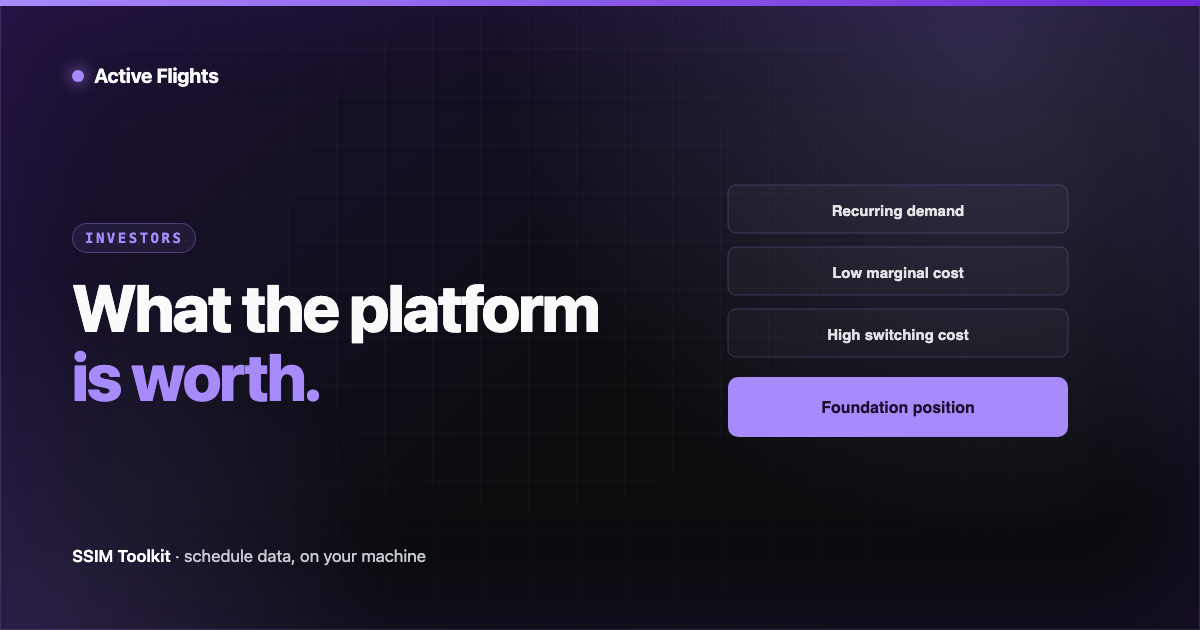
We’ve made the market case, the vertical-SaaS case, the moat case, and the cost-of-error case. This post puts the economics together: what actually makes a foundational schedule-data tool a good business, in the plain language of unit economics.
The value drivers
| Driver | Why it’s favourable |
|---|---|
| Recurring demand | Schedules are rebuilt continuously — the need is permanent, not one-off |
| Low marginal cost | A local, deterministic engine runs on the customer’s machine, so there’s no per-parse infrastructure bill that scales with data volume |
| High switching cost | Once wired into workflows and exports, replacement is a project |
| Foundation position | It sits under the whole stack — upstream of analytics, retailing, ops |
| Durable standard | Built on SSIM, which doesn’t churn with fashion |
The unit economics, in shape (not invented numbers)
We won’t put fake figures on this — but the shape is what matters:
- Revenue: recurring, seat-based. A per-seat licence against a permanent workflow is durable, expandable (more seats, more workspaces), and predictable.
- Cost to serve: unusually low. Because the engine runs on the customer’s machine, there’s no per-usage compute cost scaling with data volume — a multi-gigabyte feed costs the same to “serve” as a small one. The heavy lifting is the domain engineering done once, not infrastructure paid per parse.
- Retention: driven by embeddedness. Value compounds as the tool becomes how a team works; the moat is also the retention mechanism.
- Expansion: natural. The same foundation supports more surfaces (explore → validate → deconflict → export → analyse), so the account grows without re-acquiring the customer.
The counter-weights (kept honest)
The narrower market and long aviation sales cycles are real, and the incumbent — “we already built a parser” — is free until its maintenance cost becomes obvious. A serious model prices these in. The bet is that a permanent, foundational need with low marginal cost and high switching cost, sold into a market with converging tailwinds, outweighs a smaller TAM and a slower cycle.
Recurring demand, near-zero marginal cost, and stickiness by nature is a good trio to own — even in a deliberately narrow market.
The takeaway
The economics of a foundational schedule-data platform are the quiet, durable kind: recurring revenue against a permanent need, an unusually low cost to serve because the work runs locally, and retention that comes from being embedded rather than from lock-in. It’s not a hypergrowth land-grab; it’s a defensible layer with attractive margins and a rising tide. That’s the business we’ve chosen to build — and the whole series has been, in one way or another, about why that foundation is worth getting right.
Thanks for reading. If it resonates, the product tour is where to see what we’re building.
Want early access?
We're opening SSIM Toolkit to teams in waves through 2026 — free during the preview. Drop your email and we'll reach out when it's your turn.
You're on the list. Check your inbox for a confirmation email to finish signing up.
Something went wrong — please try again, or email hello@activeflights.com.